
It is a Thursday, the shop is loud, and one of your booth renters asks you to hold her 3pm because she is running late. You say sure, and move her next client to another chair. Small thing. Except you just did three things a landlord never does for a tenant: you managed her schedule, moved her client, and made an operating decision about her business. Do that enough times, in front of the wrong auditor, and the state stops seeing a booth renter. It sees an employee you forgot to pay payroll tax on.
Here is the short answer. A chair worker is one of three things: a booth renter (an independent contractor who rents space and runs their own business), a commission employee (a W-2 worker paid a percentage), or an hourly or salaried W-2 employee. Which one they are is not decided by the label on the agreement, but by how much control you have over their work. The IRS, your state, and the Department of Labor all look at control first. Call someone a renter while treating them like staff, and you own their unpaid taxes plus penalties.
Key takeaways (the TL;DR)
- Control decides classification, not the label. You can write “independent contractor” on the page and still have an employee in the eyes of the IRS if you control how, when, and where the work gets done.
- The IRS uses three categories: behavioral control, financial control, and the type of relationship. A true booth renter sets their own prices, keeps their own book, buys their own products, and takes their own clients.
- Misclassification is expensive. Under IRC section 3509, an owner who wrongly called an employee a contractor owes back withholding and the worker’s Social Security and Medicare share, and the amount doubles if you never filed the required 1099s.
- The 1099 rules changed: the nonemployee-compensation reporting threshold was $600 through 2025 and rises to $2,000 for payments made in 2026 and later. In California, licensed barbers, cosmetologists, and estheticians are judged under the older Borello test, not AB5’s strict ABC test.
- This is not legal or tax advice. Confirm your situation with a CPA or employment attorney before changing how you pay anyone.
Table of contents
- What getting this wrong actually costs
- The three models, side by side
- The real test: three kinds of control
- How each model breaks
- Three real shops, three right answers
- California, AB5, and the federal picture
- Steal this: the self-audit and the agreement
- Objections
- FAQ
What getting this wrong actually costs
Classification looks like a filing question, a box you tick once. It is really a liability question, and the bill lands on you, not the worker. When you misclassify an employee as a contractor, you did not withhold income tax, pay the employer half of Social Security and Medicare, or pay unemployment tax. The government still wants that money and collects it from the business, and the US Department of Labor treats misclassification as a wage-and-hour matter on top, which can add unpaid overtime and minimum-wage claims.
One piece of the tax code, IRC section 3509, softens the blow when the mistake was honest. An owner who did not willfully misclassify owes income-tax withholding at 1.5 percent of wages and 20 percent of the employee’s Social Security and Medicare share. The catch: those figures double, to 3 percent and 40 percent, if you failed to file the 1099s you were supposed to file. The paperwork you skipped to keep things simple is the thing that doubles the penalty.
Employer liability for the worker’s unpaid Social Security and Medicare share under IRC section 3509, as a percent of what should have been withheld, for a non-willful misclassification. It doubles when the required 1099s were never filed. Source: IRS; see DOL on misclassification.
The three models, side by side
Most shops run a mix. That is fine, as long as each person is genuinely in the box you put them in.
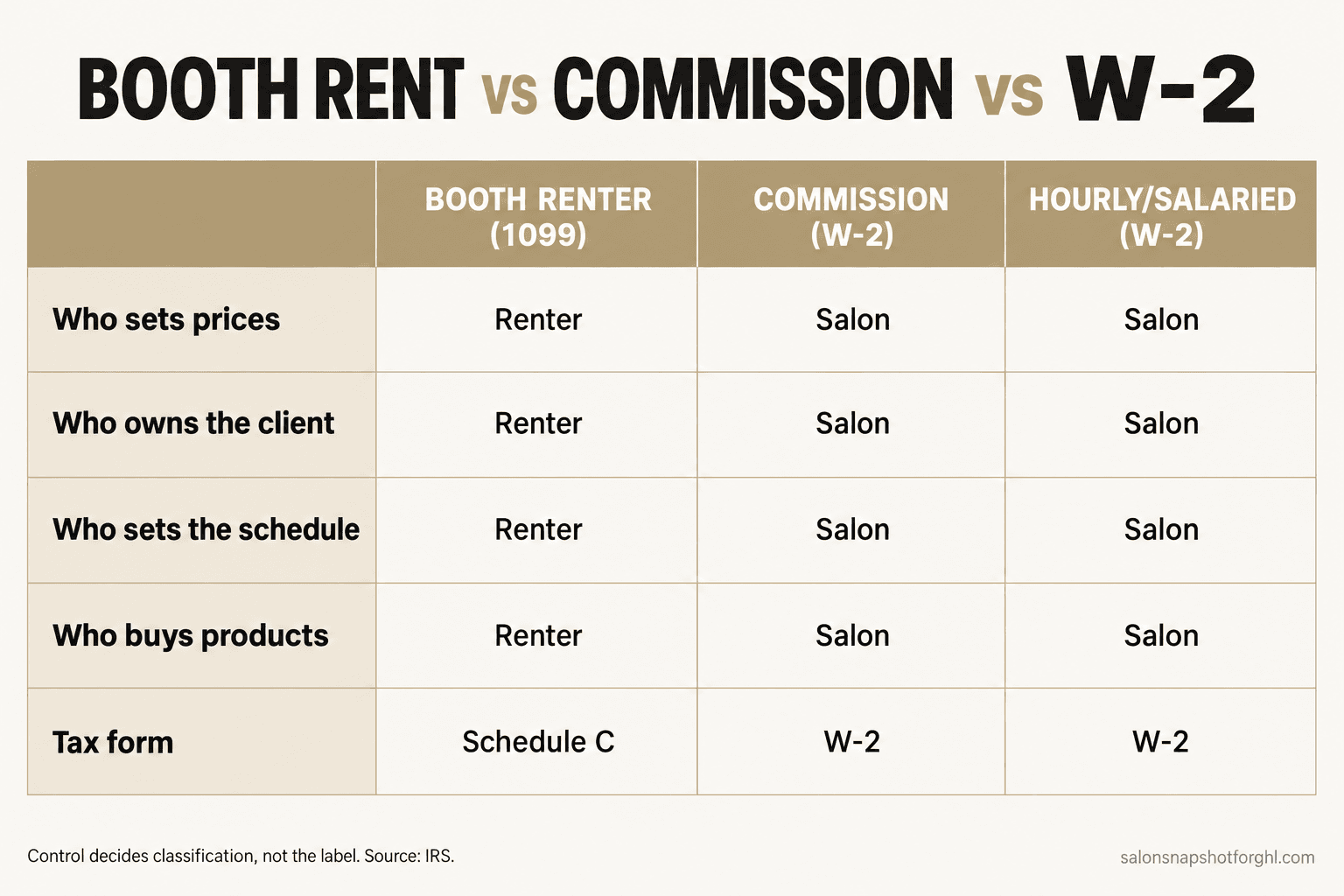
| Booth renter (1099) | Commission employee (W-2) | Hourly or salaried (W-2) | |
|---|---|---|---|
| What they are | Independent business renting space | Your employee, paid a percentage | Your employee, paid for time |
| Who sets prices | The renter | The salon | The salon |
| Who owns the client | The renter | The salon | The salon |
| Who sets the schedule | The renter | The salon | The salon |
| Who buys products & tools | The renter | The salon | The salon |
| Tax form | They file Schedule C | W-2 | W-2 |
| You withhold payroll tax | No | Yes | Yes |
| You can require hours, training, dress code | No | Yes | Yes |
Booth rent makes you a landlord: you collect fixed rent, and what happens in the chair is the renter’s business. The IRS spells this out in Publication 4902: a booth renter is self-employed, files a Schedule C, and pays self-employment tax on their own income and tips. You withhold nothing and you do not run their day. Suite rent is the cleanest version of this, since the whole point is independence.
Commission and hourly are both W-2 employment. Paying a share of the take instead of an hourly rate does not make someone a contractor: if you set prices, own the client, and require a schedule, they are staff, and you withhold and pay payroll tax. Treating a commission stylist as a contractor is the most common and most expensive mix-up in salons.
The real test: three kinds of control
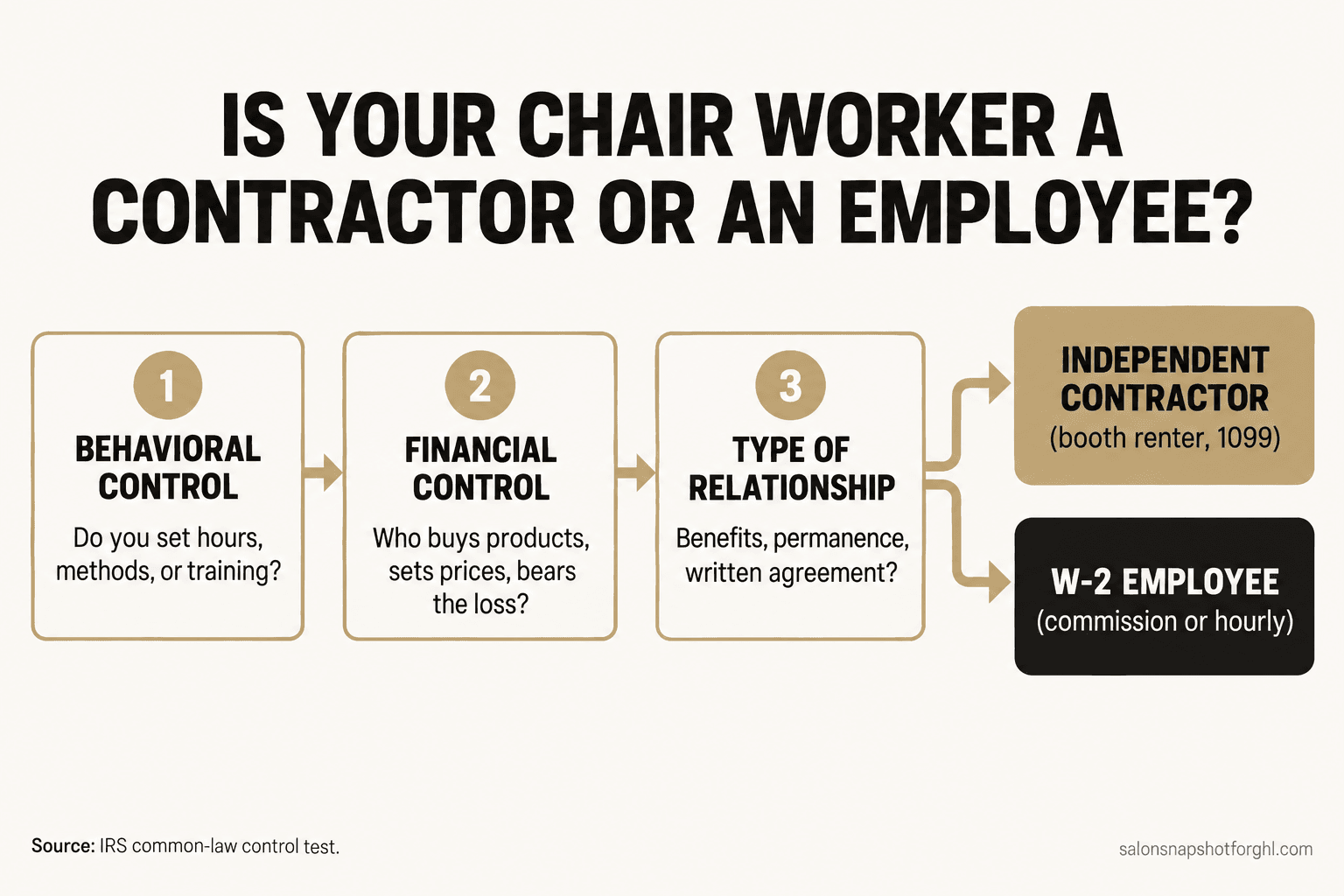
The IRS decides worker status with common-law rules grouped into three categories. No single fact wins. Read each as a question about your own shop.
Behavioral control: do you direct how the work is done? Do you set the hours the chair must be staffed, require meetings, dictate products, or train people on how you want services performed? Every “yes” pulls toward employee. A true renter decides their own hours and methods. You can care that the bathroom is clean. You cannot tell a renter how to do a balayage.
Financial control: who runs the money side? Does the worker invest in their own tools and products, keep their own clients, and stay free to work other shops? A renter buys their own color, sets their own prices, keeps their own tips, and eats the cost of a slow week. An employee is insulated from that risk because it is your risk.
Type of relationship: what does it look like over time? Is there a written agreement, and does it match reality? Do you provide employee-style benefits? A renter looks like a separate business operating under your roof, not an open-ended fixture of yours.
Stuck after weighing all three? You can file IRS Form SS-8 and ask the IRS to formally determine a worker’s status. A faster gut check: if this person walked out today, would you lose a tenant or a stylist? If it feels like losing staff, you have been running them like staff.
How each model breaks (the failure modes)
Misclassification happens by drift, one helpful decision at a time.
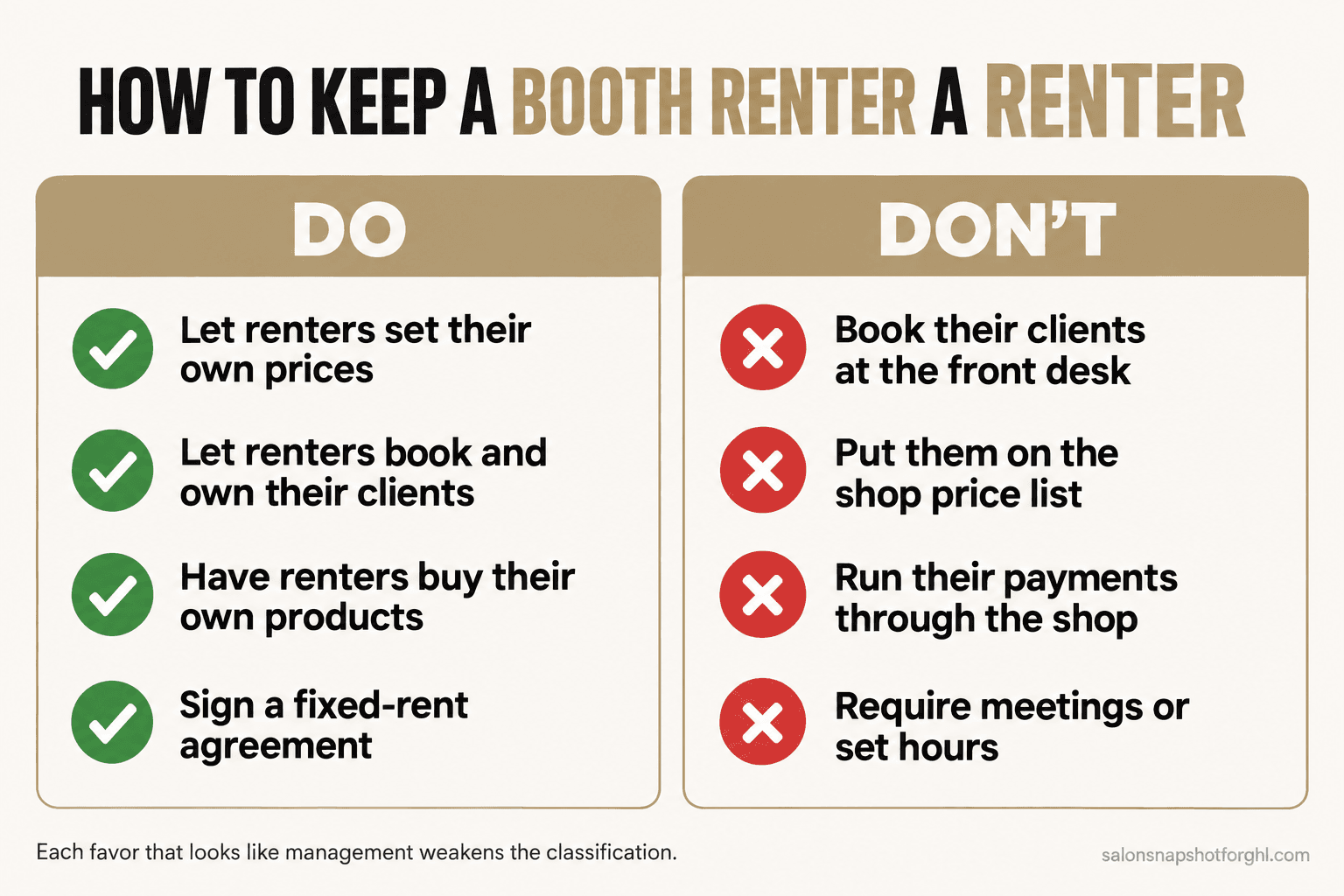
How booth rent breaks. You start as a clean landlord, then convenience erodes it. The front desk books the renter’s clients “to be nice,” so now you control their schedule. You put them on the shop price list and take payment through the shop system, so now you set prices and own the transaction. You ask them to cover the phones on Saturdays, so now you direct their time. Each favor is small. Together they rebuild an employment relationship on top of the rental agreement, and the agreement will not save you. The fix: renters book themselves, set and collect their own prices, and are never scheduled or assigned duties. If you would not do it for an office tenant, stop.
How commission employees break. The opposite mistake. Owners hear “commission” and think “contractor,” hand the stylist a 1099, and skip payroll. Now you have an employee you control completely, prices, schedule, clients, dress code, with no withholding and no 1099 either. That is the doubled-penalty scenario from earlier, sitting in your shop right now. The fix: if you control the work, they are W-2 no matter how you calculate the pay. Run commission through payroll, and remember a commission employee is still owed minimum wage for all hours worked.
Three real shops, three right answers
The right structure depends on your size. Run your own numbers with a CPA.
The solo operator or single booth renter. One chair, your own clients, no staff. You are self-employed, you file a Schedule C, and any chair you rent out is a straight landlord arrangement with a written agreement and fixed rent. Your risk is low as long as you do not start managing the person in the second chair. This is the most common salon business in the country, since close to half of hairdressers, hairstylists, and cosmetologists are self-employed per the BLS: one person running one book.
The five-chair commission-and-rent shop. This is where owners get burned. Say you have three commission stylists you actively manage and two renters who run themselves. Draw a hard line: commission stylists are W-2, on payroll, on your schedule and price list; renters set their own prices, book their own clients, and pay rent. The danger is convenience creep, putting a renter on the shop calendar because it is easier. Write down which chairs are which and audit it every quarter.
The twelve-chair or suite-style operation. At this size you are either a real employer with a front desk and mostly W-2 staff, or a landlord running a rental building of independent operators. Pick a lane. The messy middle, a big shop full of “renters” you schedule and price and manage, is the profile that draws attention, because the numbers are big enough to be worth an auditor’s time.
In a hybrid shop, classify chair by chair and keep renters and staff visibly different.
California, AB5, and the federal picture
If you operate in California, the rules are stricter. Everywhere else the federal test above is your anchor, but check your own state, since several changed classification rules recently.
AB5 and the Borello exemption. California’s AB5, at Labor Code section 2775 and following, makes the strict “ABC test” the default, which is very hard to pass. But it carves out specific licensed occupations. Licensed barbers, cosmetologists, estheticians, and electrologists are judged under the older, more flexible Borello test instead, as long as the arrangement reflects real independence: own rates, paid directly by clients, own schedule, own book. Licensed manicurists had their exemption lapse at the start of 2025, then AB 1514, signed in October 2025, restored it through January 1, 2029.
What Borello weighs. The California Division of Labor Standards Enforcement puts the hiring party’s right to control the work first, then secondary factors: whether the worker runs a distinct business, who provides tools and workspace, how long the relationship lasts, and the chance of profit or loss. That is the federal control test in different words, asking the same question: whose business is this?
The federal FLSA rule is in flux. Separately from the IRS, the US Department of Labor uses an “economic reality” test under the Fair Labor Standards Act. A 2024 rule tightened it, but the DOL is now rescinding and replacing that version. Build your shop around control, which every test shares, and you stay safe as the rules move.
Steal this: the self-audit and the agreement
Two things protect you: auditing your own shop honestly, and a written agreement that matches how you operate.
The ten-question booth-rent self-audit. Score each chair you call a rental. Every “no” is a crack in the classification.
- Does the renter set their own service prices?
- Does the renter collect payment directly, in their own account?
- Does the renter set their own hours and days?
- Does the renter book and own their own clients?
- Does the renter buy their own products, tools, and back-bar?
- Is the renter free to work at other locations or take mobile clients?
- Does the renter carry their own liability insurance and license?
- Is there a written agreement with a fixed rent, not a percentage of sales?
- Do you avoid requiring meetings, training, dress code, or shared duties?
- Would an outsider watching for a day say “landlord and tenant,” not “boss and worker”?
Straight yes and your rental looks like a rental. Any no is a place you are behaving like an employer, and either the behavior changes or the classification does.
The booth rental agreement, essential clauses. A real rental agreement should state, in writing:
- Fixed rent amount and schedule (weekly or monthly), not a share of sales.
- That the renter is an independent business, sets their own prices, keeps their own clients, and is responsible for their own taxes, including self-employment tax.
- That the renter provides their own products, tools, and liability insurance, and holds a current license.
- That the renter controls their own schedule and is not required to work set hours, cover duties, or attend meetings.
- Use of the space, access, and how either party ends the arrangement.
On the 1099s. Rent you collect is rental income to you, and you generally do not issue a renter a 1099 for their own service income. But payments your business makes for services can trigger a 1099-NEC, and the threshold rose from $600 to $2,000 for payments made in 2026 and later, per the IRS. A missing 1099 is what doubled the penalty earlier, so ask your CPA which of your payments need one and do not skip them.
Objections
“My agreement says independent contractor, so I am covered.” No. Every test above ignores the label and looks at what you actually do. A contract that calls someone a renter while you schedule them, price their services, and own their clients is evidence against you. The paper has to match the practice.
“Switching a renter to W-2 will cost me a fortune.” It costs the employer share of payroll tax, yes. But compare that to the back-tax exposure of getting caught, which can reach several years plus penalties. If a chair only pencils out as a rental because you control the work like an employer, the model is not saving money. It is deferring a bill.
“Do I have to be a tax expert to run a salon?” No, but you have to keep asking the one question that matters, whose business is this chair, and keep your practice matching your paperwork. A CPA who knows the beauty industry is the cheapest insurance you will buy. And if you want the booking, reminders, and review side handled without a stack of tools, our done-for-you GoHighLevel setup runs those for the shop. (That link is our GoHighLevel partner link, and we may earn a commission if you sign up.)
FAQ
Is a booth renter an employee or an independent contractor?
A true booth renter is an independent contractor: a separate business that rents your space, sets their own prices, keeps their own clients, and controls their own schedule. If you control how, when, or where the work is done, they are likely an employee regardless of the agreement. The IRS decides on control, not the label.
Does paying a stylist by commission make them a contractor?
No. Commission is just a way to calculate pay. A commission stylist whose prices, schedule, and clients you control is a W-2 employee, and their pay must run through payroll. Handing out a 1099 instead is one of the most common and most expensive salon misclassifications.
What happens if I misclassify an employee as a booth renter?
You become liable for the payroll taxes you did not withhold or pay. Under IRC section 3509, an honest mistake means reduced amounts (1.5 percent of wages, 20 percent of the employee's Social Security and Medicare share), but those double if you failed to file the required 1099s. Wage claims and interest can stack on top. Consult a CPA.
Do booth renters get a 1099 from the salon?
Generally no, not for their own service income, which they report on a Schedule C. The rent you collect is rental income to you. Payments your business makes for services can require a 1099-NEC, and that threshold rose from $600 to $2,000 for payments made in 2026 and later.
Are salon workers in California treated differently under AB5?
Yes. AB5 defaults to the strict ABC test, but licensed barbers, cosmetologists, estheticians, and electrologists are judged under the more flexible Borello test if the arrangement reflects real independence. The manicurist exemption lapsed in early 2025 and was restored by AB 1514 through January 1, 2029.
Back to that Thursday
Return to the 3pm you moved without thinking. One favor will not sink you. The point is that classification is not a form you file once, it is a hundred small decisions about who controls the chair, and they add up in a direction. The shops that stay clean are the ones where the owner knows exactly which chairs are tenants and which are staff, and behaves accordingly.
Run the ten questions this week. Fix the cracks, or change the label to match reality, then get a CPA who knows salons to check your work. If filling those chairs is next on your list, our guides on stopping no-shows and the six-week rebooking rhythm cover the booking side, and you can book a walkthrough of the system that runs it.
Sources
- IRS: Independent contractor (self-employed) or employee?
- IRS: About Form SS-8, Determination of Worker Status
- IRS: About Form 1099-NEC
- IRS: Publication 4902, Tax Tips for the Cosmetology and Barbering Industry
- US Department of Labor: Misclassification of employees as independent contractors
- US Department of Labor: FLSA independent contractor rulemaking
- California Labor Code section 2783
- California AB 1514 (2025-2026)
- California DIR: Independent contractor FAQ
- BLS Occupational Outlook Handbook: Barbers, Hairstylists, and Cosmetologists
- FCC: Stop unwanted robocalls and texts
- FTC: CAN-SPAM Act compliance guide