
It is a normal Tuesday until the board inspector walks in and asks to see the license posted at each station. Four are current. One, your best color tech, expired eleven weeks ago, because her renewal notice went to an old apartment and nobody was watching the date. Now you are explaining why a service was performed in your building by someone without an active license, and whose problem that becomes depends on your state, your paperwork, and your luck.
Here is the short answer. In almost every state a license is good for two years (a few run longer), it does not renew itself, and the renewal notice goes to whatever address the board has on file, which is usually wrong. Most states require zero continuing education to renew a cosmetology license, but a handful require a fixed number of hours on specific topics, and missing them blocks the renewal. The license belongs to the stylist, but an expired one worked in your shop is a risk you carry too. The fix is boring: one register of every license in the building, a reminder that fires months before each date, and a hard rule that nobody touches a client on an expired license.
Key takeaways (the TL;DR)
- A license does not renew itself, and the reminder goes to the wrong address. Boards mail the notice to the address on file, and people move. The date is yours to track, not theirs.
- Most states require no continuing education for cosmetology renewal. A minority require set hours on fixed topics, so you have to know which camp each worker is in, state by state.
- An expired license worked in your shop is your exposure too. Even with booth renters, “it is their license” is not the whole story. You verify at onboarding and keep verifying.
- One register beats five sticky notes. Track name, license type, number, expiration, and CE status for everyone in the building, renters included, and set reminders at 90, 60, and 30 days out.
- This is general information, not legal advice. Your state board sets the real rules, and they change. Confirm every date and requirement on your own board’s site.
Table of contents
- What a lapsed license actually costs you
- Why renewal is messier than it looks
- The six-part license-tracking system
- Three shops, three right setups
- Who is actually liable, and the deregulation wave
- Steal this: the register, the texts, the onboarding check
- Objections
- FAQ
What a lapsed license actually costs you
A lapsed license looks like a small admin slip until it is not. The direct cost is the late renewal fee, usually modest. The bigger costs are the ones nobody budgets for.
First, the chair goes cold. A stylist whose license lapses cannot legally take clients until it is reinstated, which can take days or weeks. For a trade where, per the Bureau of Labor Statistics, 48% of hairdressers and cosmetologists and 80% of barbers are self-employed, an idled chair is somebody’s whole income, not a line on your schedule.
Second, there is the enforcement risk. Practicing on an expired license is a violation in every state, and boards can fine the individual, the salon, or both, and in repeat cases suspend. Georgia makes the split concrete: its board fining schedule sets a $150 fine for practicing on an expired license and a $500 fine against an owner who lets an unlicensed person work. Numbers differ by state, but no state treats it as nothing, and the owner is often named alongside the worker.
Third, there is liability. If something goes wrong during a service and the worker’s license was not active, your coverage and your defense get more complicated. The empty chair you can refill; the claim with an unlicensed-service fact baked into it is harder to make go away.
Why renewal is messier than it looks
Two things make this harder than “write the date on a calendar.”
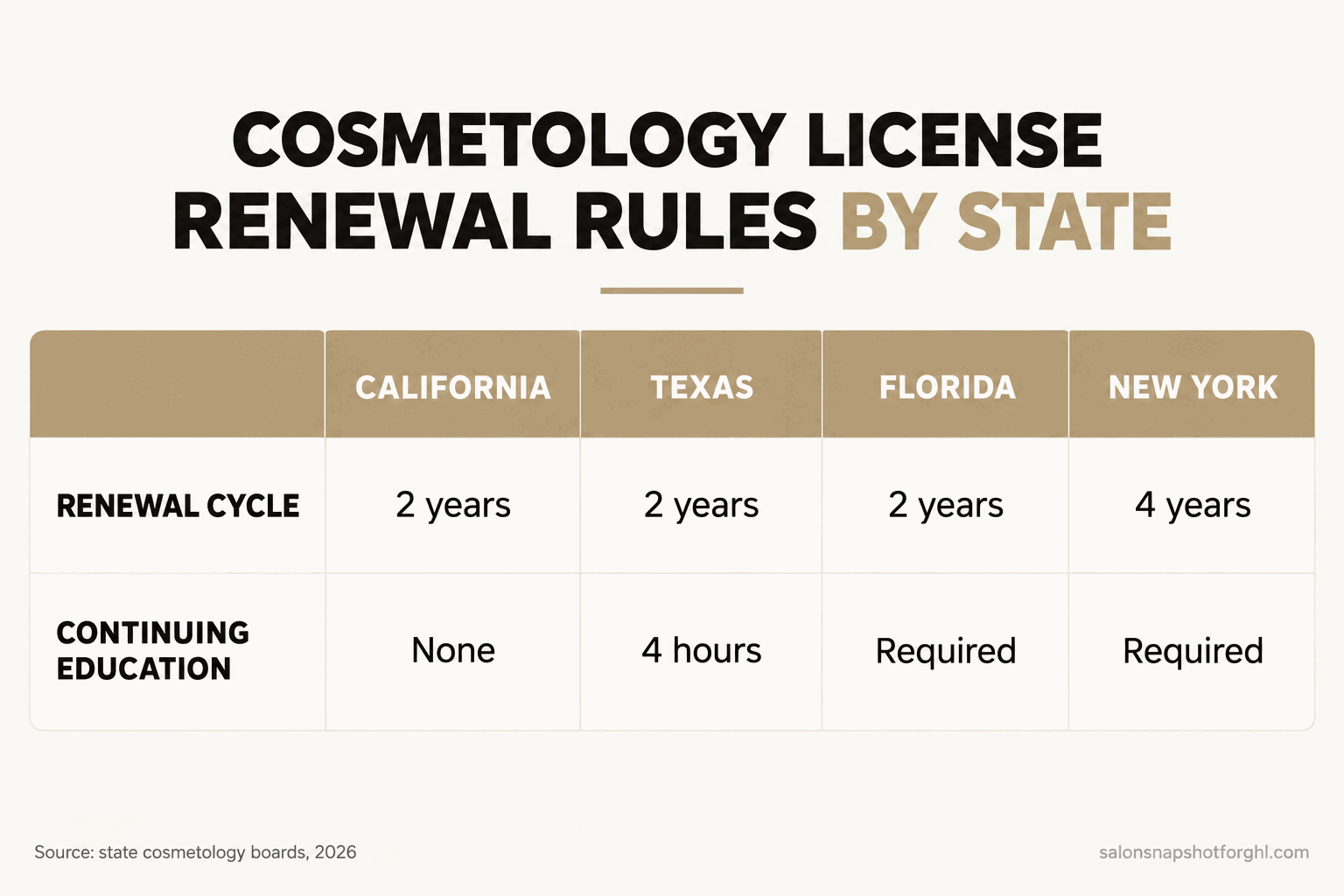
Renewal cycles are not the same everywhere. The common pattern is a two-year (biennial) license, which is what California uses, but the cycle and due date differ by state and license type. New York runs a four-year term. Some states tie expiration to your birthday or issue date; others set a fixed date for everyone. If you hire across state lines, or your renters came from another state, you cannot assume one rule covers the room.
Continuing education is all over the map. Owners get this wrong most. In many states there is no CE requirement at all, you pay the fee and you are done. But a handful require a set number of hours on specific topics, and a renewal submitted without them gets rejected. Florida requires CE and names the subjects it must cover, including HIV/AIDS, OSHA regulations, workers’ compensation, environmental issues, and the laws that apply to salons and booth renters. Texas requires four hours of department-approved CE every two years. California, by contrast, imposes no CE requirement to renew. Same trade, opposite rules, a state line apart. And the board’s renewal notice goes to the address on file, which where people move and switch shops often is stale more than not, so a missed renewal is rarely a decision, it is a notice nobody saw.
The six-part license-tracking system
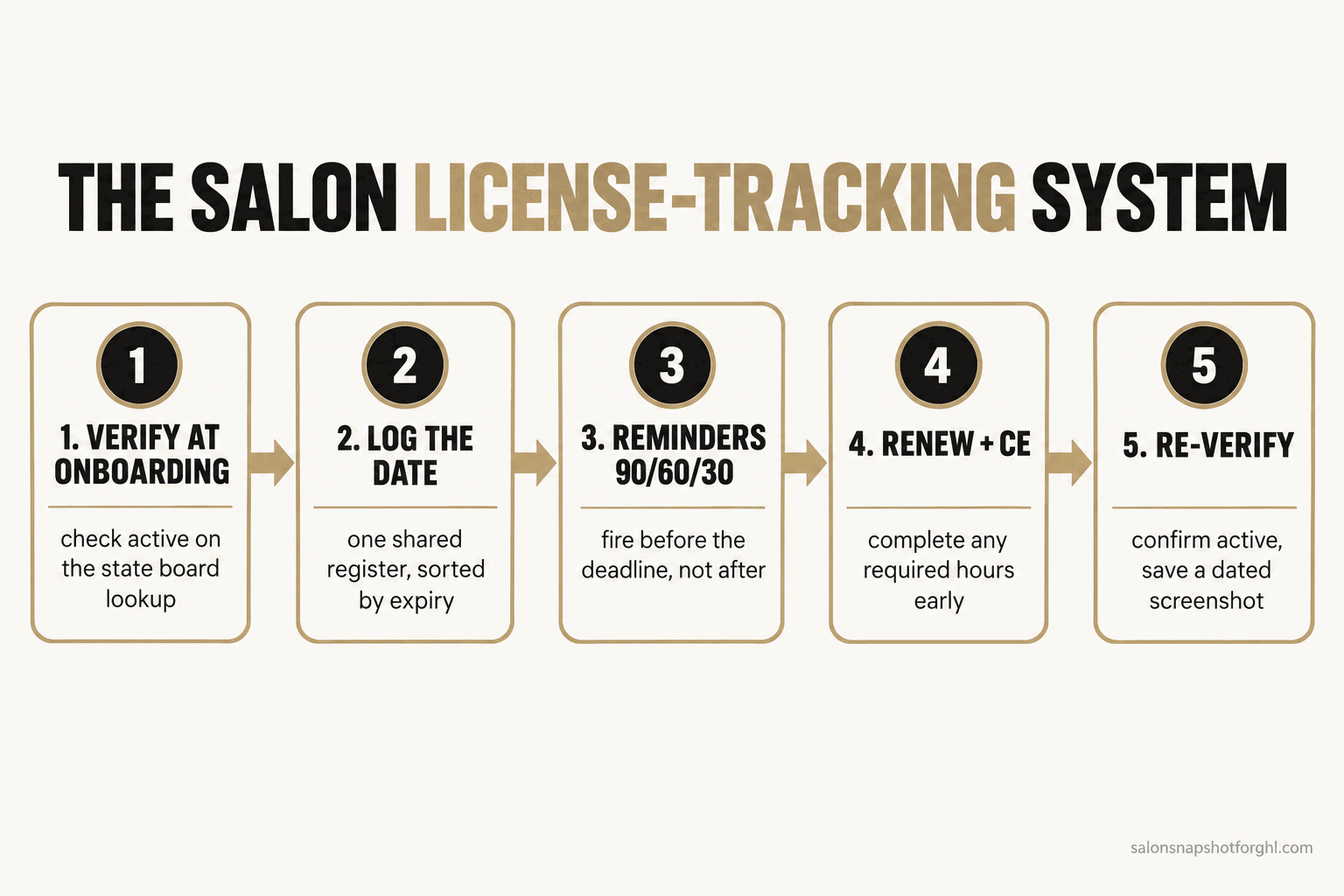
You do not need special software, just one list, a few reminders, and a rule everyone knows. Here is the whole system, and how each part breaks if you get lazy.
1. Build one register for the whole building
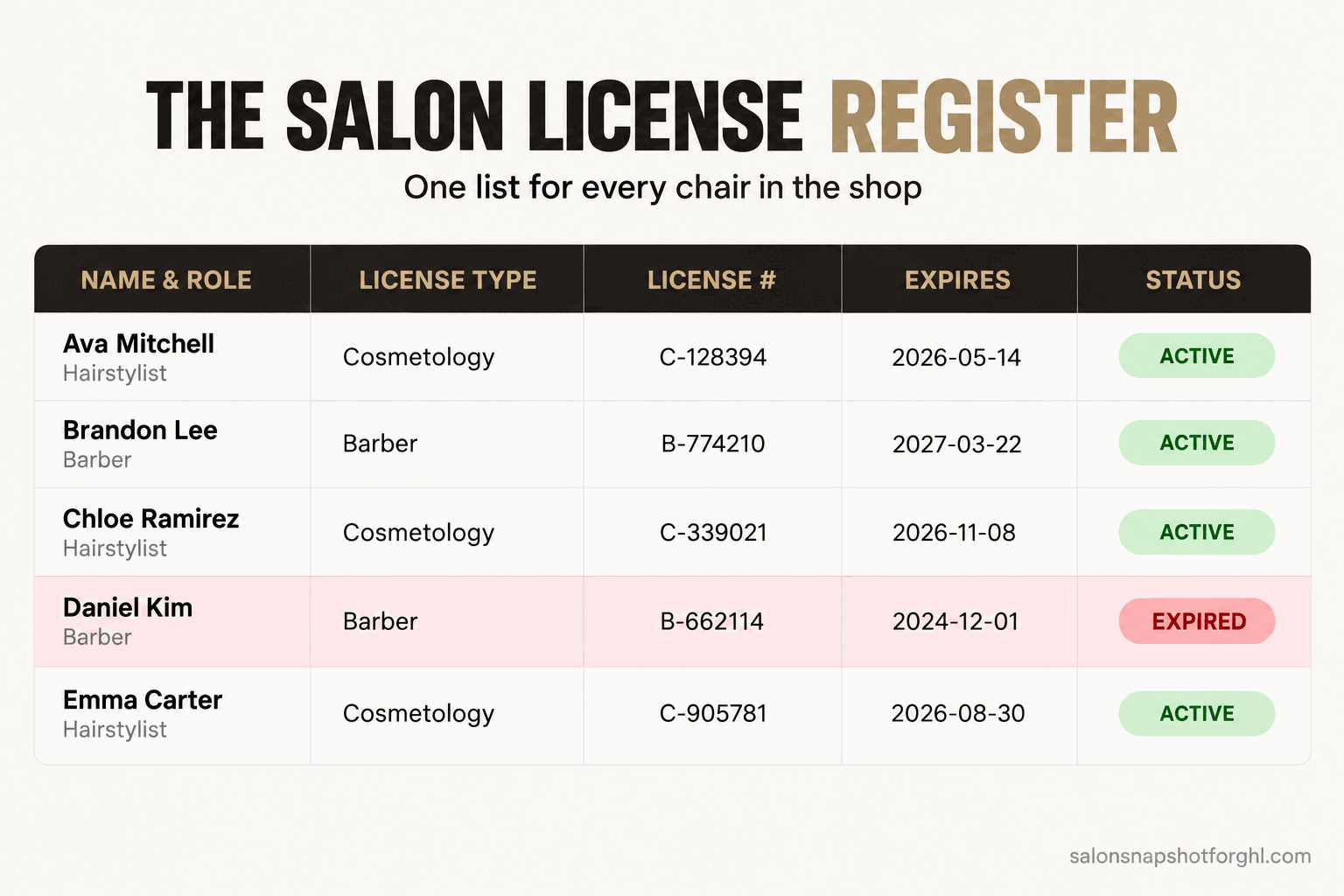
Make a single list of every licensed person under your roof: employees, commission staff, booth renters, suite tenants, and you. For each, record name and role, license type (cosmetologist, barber, esthetician, nail tech, plus the shop license if your state issues one), license number, issuing state, expiration date, and CE status. One source of truth.
How it breaks: the list lives in one person’s head or on a business card, and when they leave or the front desk turns over, the dates stop getting watched.
2. Verify at onboarding, and verify renters too
Before anyone takes a client in your building, confirm their license is active on your state board’s online lookup, and save a dated screenshot. Do this for booth renters exactly as you do for staff; not controlling their work does not mean you want an unlicensed person operating in your space.
How it breaks: you take their word, or glance at a laminated card from years ago. A card is not proof of an active license; the board’s live lookup is.
3. Know each person’s cycle and CE rule
For each person, write down their renewal cycle (usually two years, but confirm) and whether their state requires CE, and if so how many hours. One state for the whole shop means one rule; multi-state renters mean it is per person.
How it breaks: you assume the room is uniform, miss one renter licensed in a CE state, and a gap opens you did not see coming.
4. Set the reminder ladder
Do not rely on the board’s notice. For every expiration date, set your own reminders at 90, 60, and 30 days out, and on the renewal day. Ninety days is enough runway to complete CE hours if their state requires them; thirty days is the “do it now” nudge. This is the part that does the most work, because it moves the deadline off the board’s stale mailing list and onto a schedule you actually see.
How it breaks: you set one reminder, a week before, and it fires while the person is on vacation or mid-CE-course with no time left. One reminder is a coin flip; the ladder is what makes it reliable.
5. Handle the CE states properly
If anyone renews in a CE state, treat the hours as a deadline, not a last-minute scramble. Confirm which providers your board approves, book the hours early, and file the certificates with the register, so they are done before the renewal opens.
How it breaks: the hours get left to the last fortnight, the only approved course is full, and the date arrives unmet. CE is not hard; it is just unforgiving about timing.
6. Catch the move, reciprocity, and name-change traps
Three edge cases sink renewals. A worker moves and never updates their address, so the notice vanishes. A stylist relocates and assumes their old license transfers, when reciprocity rules differ and some states make you reapply. Or a legal name change leaves the board record not matching their ID. Build an address, name, and status check into the routine.
How it breaks: you learn about the reciprocity gap the day a new hire tries their first client and the lookup comes back empty.
Three shops, three right setups
The system is the same; how much you need scales with your shop.
The solo operator. Just your license, so it collapses to one thing: put your expiration date on a reminder ladder, and if your state requires CE, book it early. The solo failure mode is complacency: you renew fine for years, stop watching, and the year your address changed is the year it lapses.
The five-chair commission-and-rent shop. Now you are tracking a mix. Commission and W-2 staff are plainly yours. Booth renters are independent, but you still verify them at onboarding, because an unlicensed renter is your inspection problem even if the income is theirs. One register for the whole room, marked by who is staff and who rents. For why that line matters for taxes and control, see our guide on classifying every chair as booth rent, commission, or W-2.
The multi-location or suite operation. At this size you cannot hold it in your head, and you likely have workers licensed in more than one state. The register has to be shared across sites, with a named person keeping it current and a monthly check of what expires in the next 90 days. The risk is scale: a dozen half-remembered dates are a dozen ways to get caught.
Who is actually liable, and the deregulation wave
You are not a bystander. Because most states regulate the salon as well as the stylist, an expired license at a station can be cited against the worker, the shop, or both. Not a reason to panic, a reason to verify, track, and enforce the no-expired-license rule.
Booth renters do not get you off the hook. A renter being an independent contractor does not make an unlicensed person legal to operate in your space. The classification matters for taxes and control, but you still verify renters at onboarding and keep them on the register. (If a renter situation has gone sideways another way, our piece on what to do when a booth renter walks out with your clients covers that.)
The rules are moving, mostly looser. There has been a steady push to cut training hours and ease licensing, so what was true two cycles ago may not be true now. California is the cleanest example: under SB 803, effective January 1, 2022, the state cut required cosmetology training from 1,600 hours to 1,000 and barbering from 1,500 to 1,000, and dropped the practical exam. Other states have trimmed hours or expanded reciprocity so a worker moving in from out of state can start faster. None of this changes the duty to hold an active license; it changes the numbers around it, so confirm the current rule, not the one you learned when you got your own license.
Required pre-license training hours in California before and after SB 803, effective January 1, 2022. Source: California Board of Barbering and Cosmetology, SB 803 Q&A. This is initial training, separate from renewal, but it shows how fast a state’s licensing numbers can change.
Every state board posts its current renewal cycle, fee, CE rule, and a license lookup online. That page, not a blog, is your source of truth, and the rules change often enough to check yours once a cycle.
Steal this: the register, the texts, the onboarding check
Three things to put in place this week.
The license register, as columns. Build this as a shared spreadsheet or in whatever holds your staff records, sorted by expiration date so the next renewal due is always at the top:
- Name & role (staff / commission / booth renter / suite)
- License type (cosmetologist, barber, esthetician, nail tech, shop)
- License number and issuing state
- Expiration date
- CE required? Hours done / needed
- Last verified on board lookup (date)
The reminder texts to send staff and renters. Short, friendly, and early beats formal and late.
90 days out: “Hey [name], heads up, your [cosmetology/barber] license renews on [date]. If your state needs CE hours, now is the easy time to knock them out. Want the board link?”
30 days out: “[Name], your license renews in about a month ([date]). A lapse means you cannot take clients until it is reinstated. Want me to resend the renewal link?”
Renewal week, if not confirmed: “[Name], I do not see your renewal confirmed yet and the date is [date]. Can you renew today and send me a screenshot of the active status? I have to keep the register current.”
If you send these by text at any scale, do it with consent and carrier registration in place, exactly as you would for appointment reminders. Our guide on sending salon texts legally under TCPA and 10DLC covers the rules.
The onboarding license check. Before a new stylist or renter takes a single client:
- Ask for license type, number, and issuing state.
- Look it up on the state board’s online verification; confirm it is active and matches their name.
- Save a dated screenshot in the register.
- Record the expiration date and set the 90/60/30-day reminders.
- Note whether their state requires CE.
Five minutes here saves the cold-chair scramble later.
Objections
“The license is the stylist’s responsibility, not mine.” Maintaining it is theirs, yes. But the inspection is in your building, the lapsed chair costs your schedule, and most states inspect the salon itself. Tracking it is not taking over their job; it is protecting the business on top of it, the way you check a contractor’s insurance certificate.
“I just rent booths. I am a landlord.” You should not manage a renter’s schedule or clients, that is the line that keeps them a contractor. But verifying a license at move-in is not controlling their work; it is confirming the person in your space is allowed to be. A commercial landlord checks a tenant is a real business. Same thing.
“My state does not require CE, so there is nothing to track.” The renewal date still has to be met, CE or not. Plenty of lapses happen in no-CE states because people hear “no CE” as “nothing to do.” It is a few minutes per person a year, and it goes wrong exactly when you are not watching. Track the date.
FAQ
How often do you have to renew a cosmetology license?
In most states a cosmetology or barber license is valid for two years and must be actively renewed before it expires; a few run longer, such as New York's four-year term. The exact period and due date, often tied to your birthday or issue date, are set by your state board. The license does not renew itself.
Do you need continuing education to renew a cosmetology license?
It depends on the state. Many require no continuing education, you simply pay the fee and submit. A minority do: Florida names required subjects in state law, and Texas requires four hours of approved CE every two years. Check your own state board for the current rule.
What happens if a stylist works on an expired license?
Practicing on an expired or lapsed license is a violation in every state. The worker cannot legally take clients until it is reinstated, and boards can fine the individual, the salon, or both, with repeat cases risking suspension. The exact penalty is set by your state board.
Is the salon owner responsible for a booth renter's license?
The license is the renter's own responsibility, and tracking it does not make them an employee. But an unlicensed person operating in your establishment is still your inspection and liability problem, and many states license the salon itself. Verify a renter's active license at move-in and keep it on your register.
How can a salon owner keep track of everyone's renewal dates?
Keep one shared register listing every licensed person with their license type, number, issuing state, expiration date, and CE status, and set reminders at 90, 60, and 30 days before each date instead of relying on the board's notice. Verify each license on the board's lookup at onboarding and once per cycle, and confirm reciprocity before a relocating worker takes a client.
Back to that Tuesday
Go back to the inspector at the station with the eleven-weeks-expired license. What made it a crisis was not the lapse itself; it was that nobody in the building knew the date. The notice went to an old address, and no second system was watching.
That is the whole problem, and the whole fix. Build the register, run the reminder ladder, verify at onboarding, and keep one rule non-negotiable: no client on an expired license. It is an hour to set up and a few minutes a year to keep. If you would rather the dates live in the same place that already runs your booking and reminders, book a walkthrough and we will show you how the salon system handles it.
Sources
- BLS Occupational Outlook Handbook: Barbers, Hairstylists, and Cosmetologists
- Florida Statutes section 477.019 (cosmetology renewal and continuing education)
- Texas TDLR: Barbering and Cosmetology continuing education
- California Board of Barbering and Cosmetology: license renewals
- California Board of Barbering and Cosmetology: SB 803 Q&A
- New York Department of State: Cosmetology
- Georgia Board rule 130-7-.04: schedule of fines (expired and unlicensed practice)