
It is a normal Wednesday when your best booth renter catches you by the back sink and says she is moving to a suite across town in three weeks. She is lovely about it. And while she talks, you are doing the math on the eleven regulars who only come in to see her, and the rent check that just walked out the door.
Here is the answer first. You almost certainly cannot stop a booth renter from taking the clients who came to see them. A booth renter is a tenant, not an employee, and the law treats them like a separate business that rents your chair. What you can do is protect the shop’s own book, so the next exit costs you a slow week instead of a quarter. That work happens before anyone gives notice, and this guide walks it, with the clauses and texts to steal.
Key takeaways (the TL;DR)
- A booth renter is an independent contractor, which means they own their clients. You rent them space, not their book.
- Trying to lock them down backfires twice. A non-compete against a true contractor is hard to enforce anywhere, and in California it is void. Worse, the more you control how a renter works, the more you look like an employer, which can undo their contractor status and hand you back taxes.
- The fix is owning the front door. When clients book, pay, and get reminded through the shop instead of one stylist’s cell, the relationship is partly the shop’s, and that is the difference between losing a renter and losing their whole column.
Table of contents
- What losing a booth renter actually costs you
- The hard truth: a tenant, not an employee
- Why locking them down backfires
- The system: six things you can control
- Part 1: Put the real levers in the agreement
- Part 2: Own the front door, not just the chair
- Part 3: Keep a clean shop booking record
- Part 4: Retention that is not chair-dependent
- Part 5: Warning signs, and the 72-hour response
- Steal this: clauses and texts
- Three shops, three versions
- The legal fine print
- Objections
- FAQ
What losing a booth renter actually costs you
There are two bills when a renter leaves, and most owners only brace for the small one.
The small bill is the rent: a $250-a-week chair sitting empty for six weeks is $1,500 you did not get. The big bill is the book. When a renter takes their clients, you also lose the walk-by traffic they brought, the retail they bought, and the referrals they would have sent for years. For a shop built on self-employed talent, that lands on the whole business. The Bureau of Labor Statistics reports about 76% of barbers and 48% of hairdressers, hairstylists, and cosmetologists are self-employed, out of roughly 651,200 jobs in 2024. This is not an edge case. It is a Tuesday.
Share of workers who are self-employed, by occupation. Source: BLS Occupational Outlook Handbook, 2024 data.
You cannot stop a renter from leaving. You can make sure that when they do, a chunk of their clients still think of your shop as where they go, not just who they saw. That is a systems problem, and systems you can build.
The hard truth: a tenant, not an employee
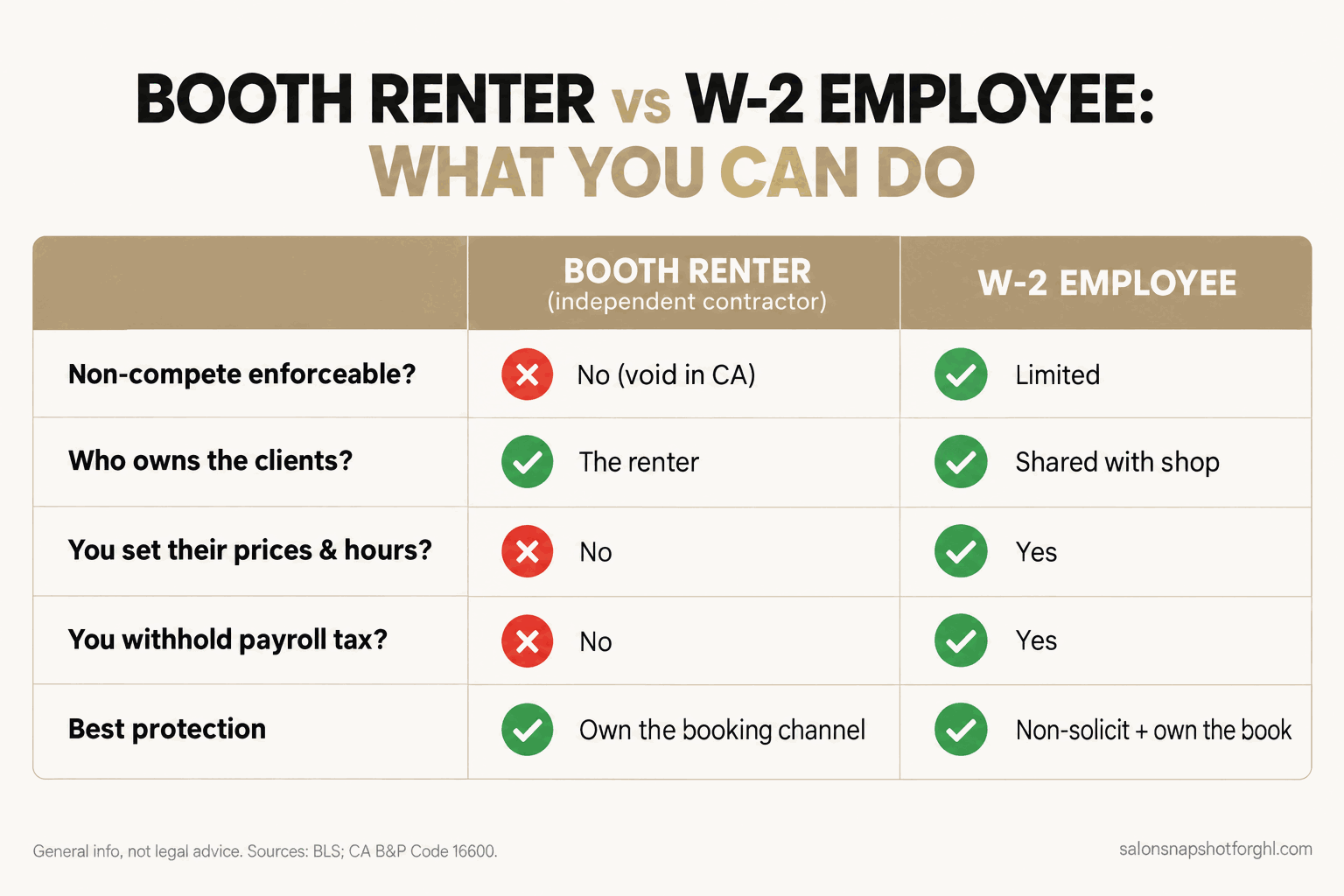
A booth renter runs their own business inside your four walls. They set their own prices, choose their own hours and clients, take payment directly, and hold their own license. You are their landlord, not their boss.
Every protection you reach for by instinct, non-solicitation clauses, non-competes, “the client belongs to the salon” language, was built for employees. A renter never agreed to be one, and you never agreed to pay employer taxes on them. You cannot take the cheaper, hands-off contractor relationship and also keep an employer’s control.
Why locking them down backfires
Hand your next renter a non-compete and it feels like protection. It is mostly theater, and in two ways worse than nothing.
First, it probably will not hold. A non-compete against a true independent contractor is hard to enforce almost anywhere, because the contractor is a separate business. In California the point is settled: under Business and Professions Code section 16600, every contract that restrains someone from a lawful profession is void, and two 2023 laws, AB 1076 and SB 699, strengthened that ban in 2024. The FTC tried to ban most non-competes nationwide, but a court struck the rule down, and in September 2025 the agency let it die, so enforceability is back to a state question.
Second, the harder you control a renter, the more you look like their employer, and contractor status rests on the renter being genuinely independent. California’s labor enforcers spell out the test: licensed barbers and cosmetologists can be contractors under the Borello standard only when they genuinely set their own rates, collect payment directly, pick their own hours and clients, and keep their own book. Bolt on a clause dictating who they may serve after they leave, and you have handed a labor agency evidence that you ran them like staff, with back payroll taxes, penalties, and an audit nobody recovers a good quarter from as the prize. The move is not a taller fence. It is to stop depending on the fence at all.
The system: six things you can control
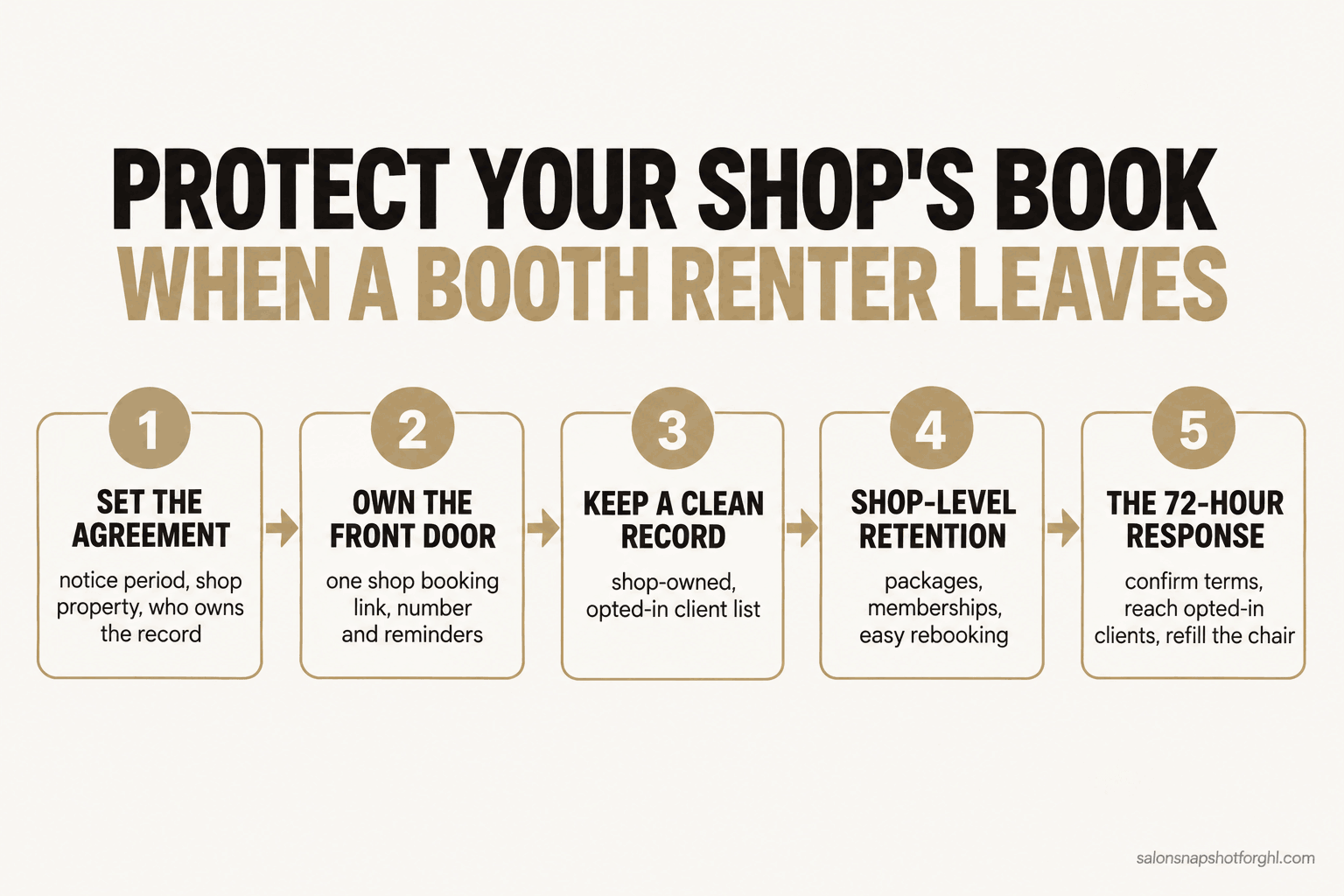
You do not own the renter. You own the shop, and that is where your real control lives: the rental agreement, the front door clients book through, the shop’s own booking record, retention that belongs to the shop, and a calm response when notice comes. Work them in order.
Part 1: Put the real levers in the agreement
You cannot stop a renter from taking clients, but you can set the terms of the tenancy, like any landlord. These clauses cover the shop’s property, not the renter’s trade, which is why they hold.
- A real notice period. Thirty days is standard. It buys you time to re-rent the chair and run your retention play on shared clients before the renter is gone.
- Shop property stays with the shop. The booking software, the shop phone number, the business social accounts, the review profile, the key or door code. State that these are the shop’s and that access ends at exit. A renter can take their clients, but not your Google Business Profile.
- Client records, named plainly. The renter’s own client list is generally their record. The shop’s booking record, meaning appointments made through your system and your own opt-in list, is the shop’s. Write down which is which so there is no fight later.
- A normal security deposit tied to notice, keys, and station condition.
Part 2: Own the front door, not just the chair
This is the single highest-impact move, and most shops skip it.
When a client books by texting a stylist’s personal cell, that relationship is 100% the stylist’s, and when the stylist leaves, the client’s thumb already knows the number. When they book through the shop, on a shop link, with a shop reminder and shop checkout, the relationship is shared, and the client ties the easy experience to your business.
So move booking off personal phones onto one shop channel: one booking link, one business texting number, one reminder that fires automatically the day before. The renter still cuts the hair. What changes is that the shop owns the convenience layer, and convenience is stickier than people admit. Salons text constantly and the rules tightened in 2025, so run reminders compliantly, as we cover in how to send salon reminder texts legally under TCPA and 10DLC.
Part 3: Keep a clean shop booking record
If every appointment runs through the shop’s system, you get a shop booking record as a byproduct, and that record plus your own opt-in marketing list is the shop’s property. That is what lets you reach shared clients when a renter gives notice.
Keep it lawful: do not scrape a renter’s private list or pretend their book is yours. You need the clients who booked through you to have opted in to hear from the shop, so a “we would love to keep you in the chair” message is one they agreed to receive. Collecting your own consented contacts at the front door over months builds an asset. Grabbing a departing renter’s phone contacts on the way out builds a lawsuit.
Part 4: Retention that is not chair-dependent
A client with one reason to visit leaves with that one stylist. So give them three reasons that belong to the shop:
- A prepaid package or membership. A client six visits into a ten-visit package does not follow a renter across town and forfeit four paid visits.
- More than one service relationship. A client who sees your renter for color and someone else for a quick fringe trim has two threads tying them in, not one.
- A booking experience that is genuinely easier at your shop. Instant online booking, one-tap reschedule, a waitlist text when a slot opens.
None of this stops a client who adores a stylist and will follow them anywhere. The point is to change the default. For the full cadence, see the six-week rebooking rhythm.
Part 5: Warning signs, and the 72-hour response
A renter rarely leaves out of the blue. Watch for the pattern weeks ahead: they stop booking through the shop system and start “handling it themselves,” go quiet about their numbers, ask pointed questions about the notice period, or start decoupling their brand from the shop’s online. You do not confront. You quietly make sure your systems and retention plays are ready.
When notice comes, the first three days decide how much of the column you keep. Move calmly, in this order:
- Hour 1: Be gracious, confirm the terms in writing the same day. A renter who leaves warm sends referrals; one you fought sends a review you do not want.
- Day 1: Lock the shop property. Plan the handover of the shop phone number, booking access, keys, and social logins for their last day.
- Day 1 to 2: Reach the shared clients you are allowed to reach, meaning those who booked through the shop and opted in. Warm, honest, no guilt trip. The copy is below.
- Day 2 to 3: Fill the chair. An empty chair is lost rent every day, and a fast fill tells your other renters the shop is healthy.
Steal this: clauses and texts
Adapt this language, then have a local attorney review it.
Rental agreement, notice and property clause (starting point):
Either party may end this rental with thirty (30) days’ written notice. On the final day, the Renter returns all shop property, including keys and door codes, and the Shop revokes the Renter’s access to the shop’s booking system, business phone number, business social accounts, and review profiles. The booking records created within the Shop’s system, and the Shop’s own marketing contacts, are the property of the Shop. The Renter’s own client list and professional records remain the Renter’s property. Nothing in this agreement restricts where or for whom the Renter may work after the rental ends.
That last sentence is deliberate: it tells a court you are not restraining the renter’s trade.
Shared-client message, day after notice (from the shop, to opted-in clients only):
Hi [First name], it’s [Shop name]. [Stylist] is moving on and we wish them the best. We’d love to keep taking care of you. [New stylist] has openings this week and knows your history, and booking is the same easy link as always: [link]. Reply here anytime, we’re glad you’re with us.
Front-desk script, when a client asks where their stylist went:
“She’s opened her own place, we’re so happy for her. If you’d rather stay with us, [New stylist] has great availability and I can get you in this week. Totally your call, we’re glad either way.”
The messages never badmouth the renter, never claim the client belongs to the shop, and never go to anyone who did not opt in. Send them from a registered business number.
Three shops, three versions
The framework is the same. What you prioritize changes with your setup.
The solo owner with one renter. Your whole risk sits in one person, so Part 2 matters most: get both of you booking through one shop channel now, while things are good. A thirty-day clause and a clean client-record line in a one-page agreement cover you.
The mixed shop with four to eight chairs. With commission staff, renters, and maybe a suite tenant, your risk is that one exit unsettles the room. The agreement terms and the clean shop record do the heavy lifting. Put every renter on the same agreement and channel.
The suite-heavy or rental-first shop. Most of your income is rent and your tenants are independent by design, so lean into being a landlord: a tight lease, a fast re-rent process, and a shop brand strong enough that clients book “at [Shop name].”
The legal fine print
A few things worth stating plainly, because getting them wrong is costly.
Classification is the foundation. A booth renter is a contractor only if they operate independently. In California, licensed barbers and cosmetologists are assessed under the Borello standard rather than the stricter ABC test, but only when the renter genuinely sets their own rates, collects payment directly, chooses their own hours and clients, and keeps their own book, per Labor Code section 2778 and the state’s guidance. Control them like staff and you lose the exemption.
Non-competes are the weak tool, and in California a void one. Section 16600 voids restraints on trade, and the FTC’s national ban is dead as of September 2025, leaving it a state question. Do not build protection on a clause a judge may not uphold.
Taxes follow the relationship. Booth renters are self-employed, and the IRS treats them that way. The cleaner your paperwork says “landlord and tenant,” the safer you are in an audit.
This is general information, not legal advice. Classification law is state-specific and changing, so confirm your setup with a local attorney and a tax professional.
Objections
“If I cannot stop them, why bother with an agreement?” Because it protects the shop’s property and sets the terms of the exit, which is the part you can enforce. A thirty-day notice and a clean client-record line are worth far more than an unenforceable non-compete.
“Won’t moving booking to the shop channel annoy my renters?” Framed as control, yes. Framed as a free front desk, no. You are handing them automatic reminders, online booking, and a professional texting number they do not pay for. Most take that deal gladly once they see it fills their own column.
“I already pay for booking software. Do I need another tool?” Maybe not another one, but you do need one place the whole shop books through and controls, that produces a shop-owned record. If each renter runs a separate flow on their own phone, your setup is not protecting you. If you are moving, do it without losing history: how to switch salon booking software without losing your client list. And no, none of this needs you to be technical. It is a done-for-you setup, not a coding project.
FAQ
Can I legally stop a booth renter from taking my clients?
Generally no. A booth renter is an independent contractor who owns their own clients, and employer tools like non-competes and non-solicitation clauses are hard to enforce against a true contractor. In California, non-competes are void under Business and Professions Code section 16600. What you can control is the agreement terms, the shop's booking channel and brand, and the shop's own client record.
Who owns the client list when a booth renter leaves?
A renter's own client list is generally their professional property. The shop's booking record, meaning appointments made through your system and your own opted-in contacts, is the shop's. Name which is which in the written agreement so there is no dispute at exit.
Is a non-compete in a booth rental agreement worth including?
In most cases it is weak, and in California it is void and can expose you to a lawsuit for even requiring it. The FTC's national non-compete ban was struck down and abandoned in 2025, so enforceability is a state question. A notice period and a clear client-records clause protect you far more reliably.
What is the fastest thing I can do today to protect the shop's book?
Move booking onto one shop-controlled channel, so clients book, get reminded, and pay through the shop rather than a stylist's cell. That turns a chair-only relationship into a shared one, and produces a shop-owned, consented client record you can lawfully use when a renter gives notice.
A renter already left and took clients. Is it too late?
You cannot claw back clients who chose to follow them, and should not try. You can send a warm, opt-in message to shared clients who booked through the shop, fill the chair fast, and tighten your systems so the next exit costs less. The scripts above are written for this moment.
Back to that Wednesday at the back sink. Your best renter is still leaving, and some regulars are going with her. That part you cannot change. But if the shop owns the booking link, the reminders, the number, and a clean record of who booked through you, then when she goes you lose a renter and a handful of clients, not a column and a quarter. That is the system doing its job while you keep cutting hair.
Sources
- U.S. Bureau of Labor Statistics, Occupational Outlook Handbook: Barbers, Hairstylists, and Cosmetologists
- California Business and Professions Code section 16600
- California Labor Code section 2778
- California DLSE, Independent contractor versus employee FAQ
- Fisher Phillips, What employers need to know about California’s new non-compete laws (AB 1076 and SB 699)
- Squire Patton Boggs, The FTC’s non-compete rule abandoned (2025)
- Paul Weiss, FTC shifts approach to non-compete enforcement
- IRS, Self-Employed Individuals Tax Center