
It is a slow Tuesday and you finally set up the reminder texts everyone told you to. You send the first batch Thursday. By the weekend, half your confirmations are not landing, two regulars reply asking who this is, and someone screenshots your text next to the word “spam.” You were trying to cut no-shows. Instead you are wondering if a text message can get you sued.
Here is the answer first. Yes, a careless reminder can expose you to real penalties, and yes, your messages can quietly stop arriving if you skip one registration step. Both are fully avoidable. A salon reminder program that stays legal in 2026 comes down to six things done in order, and this guide walks all six, with the exact messages to steal and the failure modes nobody mentions in a demo.
Key takeaways (the TL;DR)
- A2P 10DLC registration is not optional. Since February 2025, unregistered business texting on US carriers gets filtered, so your reminders stop arriving and nobody tells you why.
- Reminders are the safe category, if you keep them that way. A reminder sits under a lower consent bar than marketing. Bolt a promo onto it and it becomes marketing, with stricter rules.
- The opt-out rule changed in April 2025. Honor a STOP (or CANCEL, QUIT, UNSUBSCRIBE) within 10 business days, and you cannot force clients to use one exact word.
- Proof is the whole game. What protects you in a complaint is a time-stamped record that the client gave you their number and agreed to be texted.
Table of contents
- What a sloppy reminder setup actually costs you
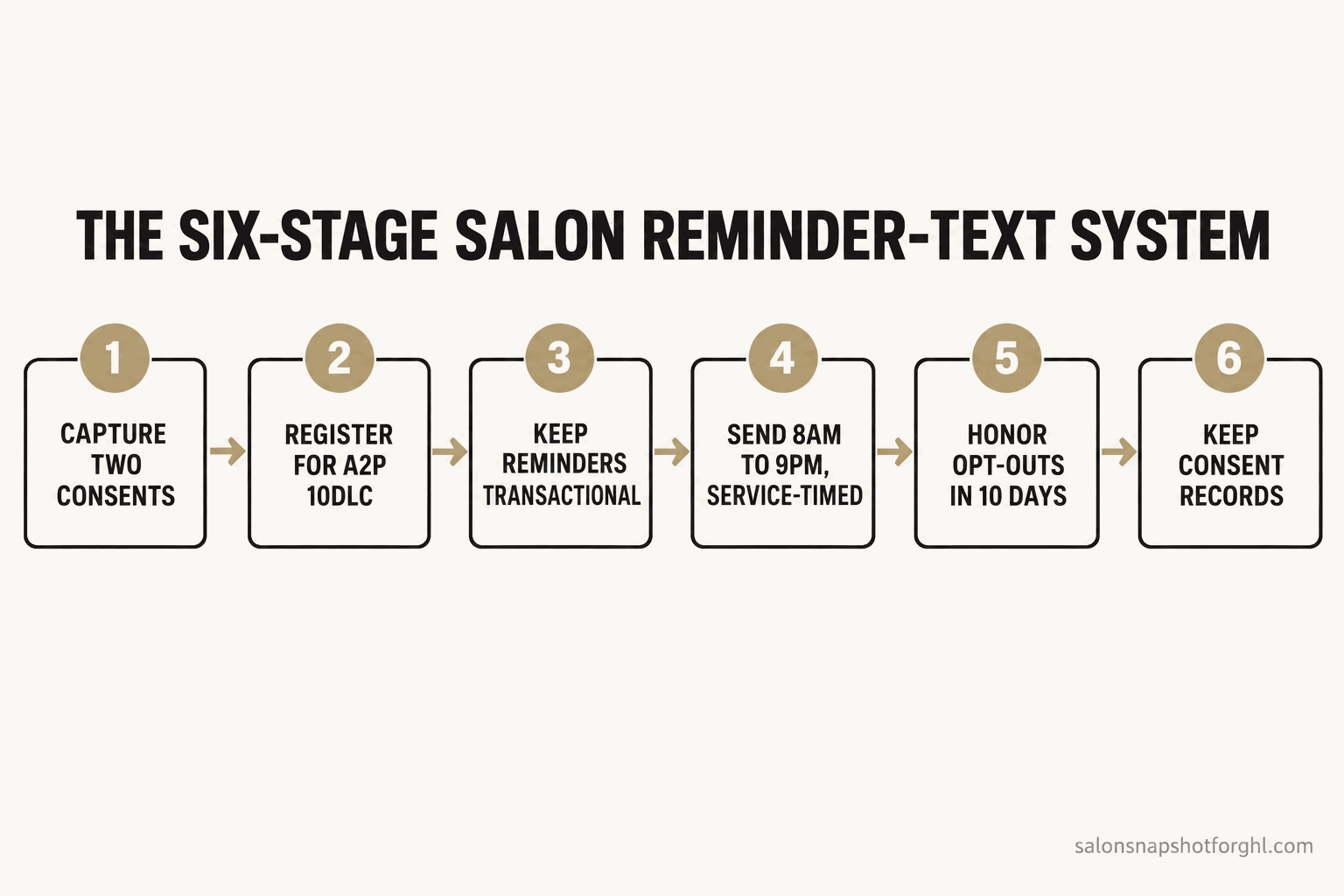
- The six-stage reminder system that stays legal
- Stage 1: Get the two consents, not one
- Stage 2: Register your number for A2P 10DLC
- Stage 3: Keep reminders on the transactional side
- Stage 4: Time it right, quiet hours and cadence
- Stage 5: Handle opt-outs the way the 2025 rule demands
- Stage 6: Keep the records that win the dispute
- Steal this: the exact messages
- Three shops, three setups
- The legal fine print
- Objections
- FAQ
What a sloppy reminder setup actually costs you
There are two bills for getting this wrong, and most owners know only one.
The first you feel: the chairs. When your texts get filtered or ignored, the no-shows come back, and for a shop that runs on self-employed stylists (about 48% of hairdressers and cosmetologists work for themselves, per the BLS Occupational Outlook Handbook) a dead slot is money out of a specific person’s pocket, not some abstract “the business.”
The second you do not see coming. A text to a client is governed by the Telephone Consumer Protection Act, which carries statutory damages of $500 per message sent without proper consent, rising to $1,500 for a willful or knowing violation, enforced through private lawsuits and class actions.
TCPA statutory damages per non-consented message, per 47 U.S.C. § 227(b)(3). Source: Cornell Legal Information Institute and the FCC.
You send reminders to protect appointments worth $40 to $250, and a careless setup can turn one angry client into a claim that dwarfs a month of bookings. That is not a reason to skip reminders. It is the reason to build them properly, once.
The six-stage reminder system that stays legal
A reminder program that holds up is a chain, not a setting: perfect copy still gets blocked if your number is not registered, and full registration still gets sued if your consent is sloppy. Build the six links in order.
Stage 1: Get the two consents, not one
Most salons think consent is one checkbox. It is two, and they do different jobs.
Consent to text at all is the baseline. For a plain reminder, which is informational, the bar is prior express consent, and a client who writes their mobile number on your booking form in order to book has generally given it.
Consent to marketing is stricter. The moment you want to text a promo (“20% off color this week”), you need prior express written consent, an affirmative, written agreement. Bundle a promo into a reminder without it and the whole message is treated as marketing.
The fix is two unchecked boxes at booking: one for appointment texts, one for marketing. Keep them separate and let the client pick.
How it breaks. Phone and walk-in bookings are the hole: a client gives you their number but never saw an opt-in. The fix is a confirmation step that routes even a phone booking through a written opt-in before the first automated text, the same discipline behind a real no-show reduction system.
Stage 2: Register your number for A2P 10DLC
A2P 10DLC is the system US carriers use to approve business (“application-to-person”) texting from a normal 10-digit number. Since February 1, 2025, registration has been mandatory, and unregistered traffic is filtered or blocked. You can send all day, see “delivered,” and your clients never get it. Skipping this step throws no error. It just makes your reminders disappear.
Registration has two parts, both through The Campaign Registry. You register your brand (your legal business name exactly as it appears on your IRS paperwork, plus your EIN) and a campaign describing what you will send, with real sample messages. Even sole proprietors now need an EIN for a new registration.
The cost is small and mostly one-time: brand registration around $4.50, campaign vetting around $15, and a monthly campaign fee of roughly $10 (lower for sole-proprietor and low-volume campaigns).
Representative A2P 10DLC first-year costs for a standard small-business campaign (USD); fees vary by provider. Source: The Campaign Registry and carrier schedules such as HighLevel’s 10DLC fee breakdown.
How it breaks. Register for what you send, and send what you registered: in 2026 carriers audit campaigns after approval, so a mismatch can get you suspended later. Our SMS compliance guide for salons covers the registration screens in detail.
Stage 3: Keep reminders on the transactional side
A reminder is the safest text a salon sends, right up until it is not, and the line is content. A transactional message is about an appointment the client already has (a confirmation, a reminder, a reschedule link). It carries the lower consent bar because the client gave you their number to receive it. A marketing message promotes something (a discount, a new service, a “we miss you” win-back) and needs the higher written-consent standard.
The trap is blending them. “Reminder: you are booked Thursday at 2. P.S. ask about our new keratin treatment!” just became a marketing text, and now it needs marketing consent and marketing hours. Keep the reminder clean and promote in a separate message, to clients who gave marketing consent.
How it breaks. The sneaky version is the “friendly” add-on: a stylist grows the reminder with a product special because it feels warm. Each one feels harmless, but together they turn your reminder stream into unconsented marketing. Write the templates once and lock them.
Stage 4: Time it right, quiet hours and cadence
Two timing questions live here: the law, and not annoying people.
The law is quiet hours. The TCPA bars telephone solicitations before 8am or after 9pm in the client’s local time, and that window is widely applied to texts. Whether an opted-in client’s permission overrides it is unsettled and actively litigated (see this Federalist Society overview). So never schedule a reminder before 8am or after 9pm local, in the client’s time zone, not your shop’s.
The cadence is the craft. Too few reminders and people forget; too many and they opt out. For most salons a sequence timed to the service works:
| When | Message | Why |
|---|---|---|
| At booking | Confirmation with date, time, service, reschedule link | Locks details while fresh |
| 48 hours before (long color, extensions, bridal) | Reminder with easy reschedule | Long slots are hardest to refill |
| 24 hours before (standard cuts and color) | Reminder with easy reschedule | The main no-show saver |
| 2 to 3 hours before | Short day-of nudge | Catches the “I forgot it was today” miss |
Scale it to the risk, and time each text off the appointment, not the booking. A reminder that fires in the middle of a client’s color service is worse than no reminder at all.
Stage 5: Handle opt-outs the way the 2025 rule demands
This stage got stricter in 2025, and many salons still run on old assumptions.
Under the FCC’s revocation-of-consent rule, effective April 11, 2025, a client can revoke consent by any reasonable means, and you cannot require one magic word. The FCC named keywords you must treat as an opt-out: STOP, QUIT, END, CANCEL, UNSUBSCRIBE, REVOKE, and OPT OUT (see this JD Supra summary). A plain-English “please stop texting me” counts too.
Once a client opts out, you must honor it within 10 business days, a real tightening from the old timeline, and in practice you should stop instantly through your software. You are allowed one confirmation text (“You are unsubscribed”) as long as it carries no marketing.
How it breaks. The worst failure is “we still had them in the old list.” A client opts out, and weeks later a reminder goes out anyway because two systems were not in sync. Every message after a clear opt-out is a fresh violation at $500 to $1,500. One source of truth for consent is the only safe setup.
Stage 6: Keep the records that win the dispute
The first five stages keep you compliant; this one keeps you safe when a client claims otherwise, because a dispute is decided by what you can prove.
For every client you text, keep a time-stamped record of three things: that they gave you this number, that they agreed to receive texts (and separately to marketing, if applicable), and the moment and content of any opt-out. A checkbox ticked at 2:14pm on a dated booking form is evidence. “We always ask” is not.
If you switch booking platforms, carry the consent records with you rather than starting fresh, one of the quiet traps in any booking-software migration. The reminder is also the channel for a no-show or cancellation fee notice, which leans on these same records.
How it breaks. The record lives only in a stylist’s memory, or in a booking tool you later cancelled and lost access to, and when a demand letter shows up you have nothing to produce. Store consent where you own it and can export it.
Steal this: the exact messages
Adjust the details, and have a local attorney review the final opt-in language. Edit these, do not paste them blind.
The two opt-in checkboxes at booking (both unchecked by default):
☐ Text me appointment confirmations and reminders at this number. Msg & data rates may apply. Msg frequency varies. Reply STOP to opt out, HELP for help.
☐ Also text me occasional offers and salon news. (Optional. Separate from reminders. Reply STOP to opt out anytime.)
The booking confirmation:
[Salon Name]: You’re booked for [service] on [date] at [time] with [stylist]. Need to change it? [reschedule link]. Reply STOP to opt out.
The 24-hour reminder:
[Salon Name]: Reminder, you’re booked tomorrow [date] at [time] for [service]. Can’t make it? Reschedule here: [link]. See you soon! Reply STOP to opt out.
The day-of nudge:
[Salon Name]: See you today at [time] for your [service]. Running late or need to move it? [link].
The opt-out confirmation (no marketing in it):
[Salon Name]: You’re unsubscribed and won’t get more texts from us. For anything about an existing appointment, call us at [phone]. Thanks!
The salon name and a reschedule link sit in every appointment message, because a reminder’s whole job is to turn a quiet “I can’t make it” into a freed-up slot instead of a no-show. And not one sneaks in a promotion, so every reminder stays on the transactional side of Stage 3.
Three shops, three setups
The six stages are the same everywhere. What changes is who runs them and how much happens without a person.
The solo booth renter. You are the brand, so you register A2P 10DLC under your own EIN, not the salon’s, because you run your own book. (If that line is fuzzy, read our guide on booth rent versus commission versus W-2 classification; who owns the texting relationship is part of what keeps you a contractor.) Keep it lean: a confirmation and one 24-hour reminder covers most of your risk. What you cannot skip is the opt-in box and honoring STOP.
The five-chair commission shop. One registered number, one consistent template set, because you own the client relationship across every chair. The risk is drift: one stylist adds a “book your next color” line, another texts at 10pm from a personal phone, and your compliant program grows holes nobody authorized. Lock the templates at the shop level and route all client texting through the one system.
The twelve-chair salon. Here the failure mode is volume and staff turnover, so consent capture, quiet-hour scheduling, opt-out propagation, and record-keeping all have to be automatic, because a manual step across a big team gets skipped on a busy Saturday. Everything the solo renter does by hand, you do by machine, with one source of truth so an opt-out on Chair 3 is honored at Chair 11 the same second.
The legal fine print
None of this is legal advice, and the rules have moving parts. Confirm your final setup with an attorney who knows telecom and your state.
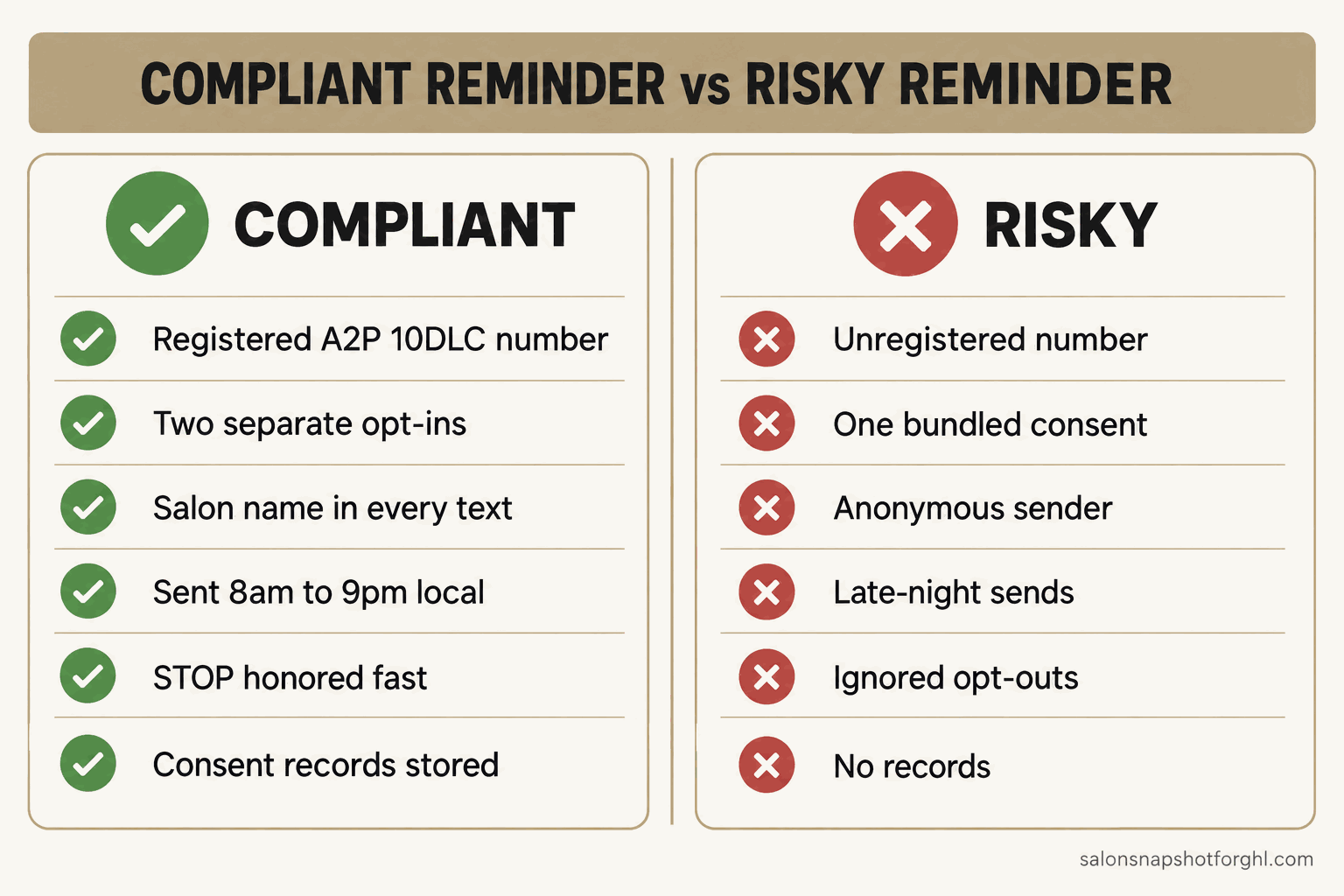
The federal baseline is the TCPA. Marketing texts need prior express written consent; informational texts like a reminder need prior express consent at a lower bar, plus an honored opt-out and respect for quiet hours. Statutory damages run $500 to $1,500 per message, per 47 U.S.C. § 227.
Consent rules shifted in 2025. The revocation rule that took effect in April 2025 tightened opt-out handling, as above, while the Eleventh Circuit vacated the FCC’s “one-to-one consent” rule that January (see Polsinelli’s analysis). That is why “the TCPA rules” are genuinely different in 2026 than two years ago, so older advice may be stale.
States add their own layers. Several states have mini-TCPA statutes with their own consent and quiet-hour nuances, some stricter than the federal floor, and A2P 10DLC registration through The Campaign Registry is a carrier requirement on top of all of it. Check your own state, and when in doubt, treat the stricter rule as the one that applies. The FTC’s business guidance is a starting point for the consumer-protection side.
Objections
“Won’t clients find the automated texts annoying?” The ones who opt in and get a clean, well-timed reminder do not, because it is the same thing their dentist does. What annoys people is a text from an unknown number, at a weird hour, with a sales pitch stapled on.
“I already pay for Vagaro, GlossGenius, or Square. Doesn’t it handle this?” Booking tools usually capture an opt-in box and support STOP, a real head start. What they often do not do is join your consent, A2P registration, cadence, and opt-out records into one system you control and can export. If yours registers your number and stores consent you can get back out, keep it.
“What if a client opts out and then books again?” An opt-out stops you from texting them, not from taking their booking. When they rebook, they can opt back in with a fresh, time-stamped checkbox, and you are clear to text again. Never assume the old consent came back on its own.
FAQ
Common questions about salon appointment reminder texts
Are appointment reminder texts legal for a salon to send?
Yes. A reminder is a transactional message, lawful when the client gave you their number and agreed to be texted. The lower consent bar applies, but you still need consent, a registered number, quiet hours, and an honored opt-out. Marketing texts are a separate, stricter category.
Do I really need A2P 10DLC registration for a small salon?
Yes, if you send business texts from a standard 10-digit US number. Since February 2025, carriers filter or block unregistered traffic, so an unregistered salon's reminders quietly stop being delivered. Registration is a one-time brand and campaign setup through The Campaign Registry for a few dollars plus a small monthly fee.
What hours can a salon send reminder texts?
The safe window is 8am to 9pm in the client's local time, the TCPA quiet-hours rule. Courts are still testing whether an opted-in client's consent overrides it, so the cautious practice is to never schedule outside that window, using the client's time zone, not your shop's.
What do I legally have to do when a client replies STOP?
Honor it. Under the FCC rule effective April 2025, a client can opt out by any reasonable means, including STOP, CANCEL, QUIT, UNSUBSCRIBE, or a plain-English request, and you cannot require one exact keyword. You must stop within 10 business days, and in practice should stop immediately. One confirmation text with no marketing is allowed.
Can I add a promotion to my appointment reminder?
Not without turning it into a marketing message. The moment a reminder promotes a service or discount, it needs prior express written consent and the stricter marketing rules apply. Keep reminders purely about the appointment, and send promotions as separate messages to clients who opted in to marketing.
So back to that Tuesday. The version of you with this system in place sent nothing until the number was registered and two clean opt-in boxes were live. Reminders go out at 10am and the day before, never at midnight, never with a sales pitch, always with your name and a reschedule link. Reply STOP and the texts stop that second, with the record to prove it. You are not lying awake wondering if a reminder can get you sued, because you built the boring parts once and they run themselves. The no-shows went down, which was the point.