
It is 9:15 on a Saturday and your 9:00 balayage has not walked in. You texted at 8:50. Nothing. By 9:40 you have blocked three hours of a paying chair for someone still asleep. You have a policy taped to the mirror about a fee, but you have never once charged it, because you are not sure you legally can and you dread the one-star review that follows. So you eat the loss again.
Here is the answer first. You can charge a no-show or late-cancellation fee, and it is lawful in every US state, as long as the client saw the policy before booking, clearly agreed to it, and you can prove both. The fee is not the hard part. The hard part is the two things around it: capturing consent you can show later, and sending the fee notice without breaking texting law. This is the whole policy, written out, with the copy to steal and the failure modes nobody warns you about.
Key takeaways (the TL;DR)
- A no-show fee is legal when disclosed and agreed to in advance. A fee the client never saw is not enforceable, and charging it anyway is where the trouble starts.
- Proof beats policy. A sign on the mirror is not consent. What protects you is a time-stamped record that this client accepted these terms before the appointment.
- Card on file and deposits do different jobs. A deposit collects up front; a card on file collects nothing until someone breaks the rule. Most shops want both.
- The fee notice is a text, and texts are regulated. The TCPA and A2P 10DLC rules apply to it, and a careless notice can cost more than the appointment did.
Table of contents
- What a missing policy actually costs you
- Part 1: The written policy
- Part 2: Advance disclosure
- Part 3: Consent you can prove
- Part 4: Card on file or deposit
- Part 5: The charge itself
- Part 6: The notice, inside texting law
- Steal this: the copy, word for word
- Three shops, three policies
- The legal fine print
- Objections
- FAQ
What a missing policy actually costs you
The obvious cost is the chair. A three-hour colour slot that walks is one you cannot resell that morning, and it is the biggest hole in most weeks.
The cost you do not see sits on the wrong side of the ledger. The fee is safe when handled right; the way most shops collect it is not. Salons text constantly, and the fee notice is a text like any other, which puts it under the Telephone Consumer Protection Act. Statutory damages there start at $500 per message sent without proper consent and rise to $1,500 for a willful violation, enforced through class actions.
TCPA statutory damages per non-consented message, per 47 U.S.C. § 227(b)(3). Source: Cornell Legal Information Institute and the FCC.
Read that against a single no-show fee, usually $25 to $75, and the math is stark. You are chasing fifty dollars with a message that can expose you to five hundred if the consent behind it is not clean. So this guide weighs how you tell the client as heavily as how much you charge.
A policy that survives a dispute has six parts, and they only work together: the written policy, advance disclosure, consent you can prove, a card or deposit to charge, the charge itself, and a compliant notice. Most shops have one or two and wonder why the fee never sticks.
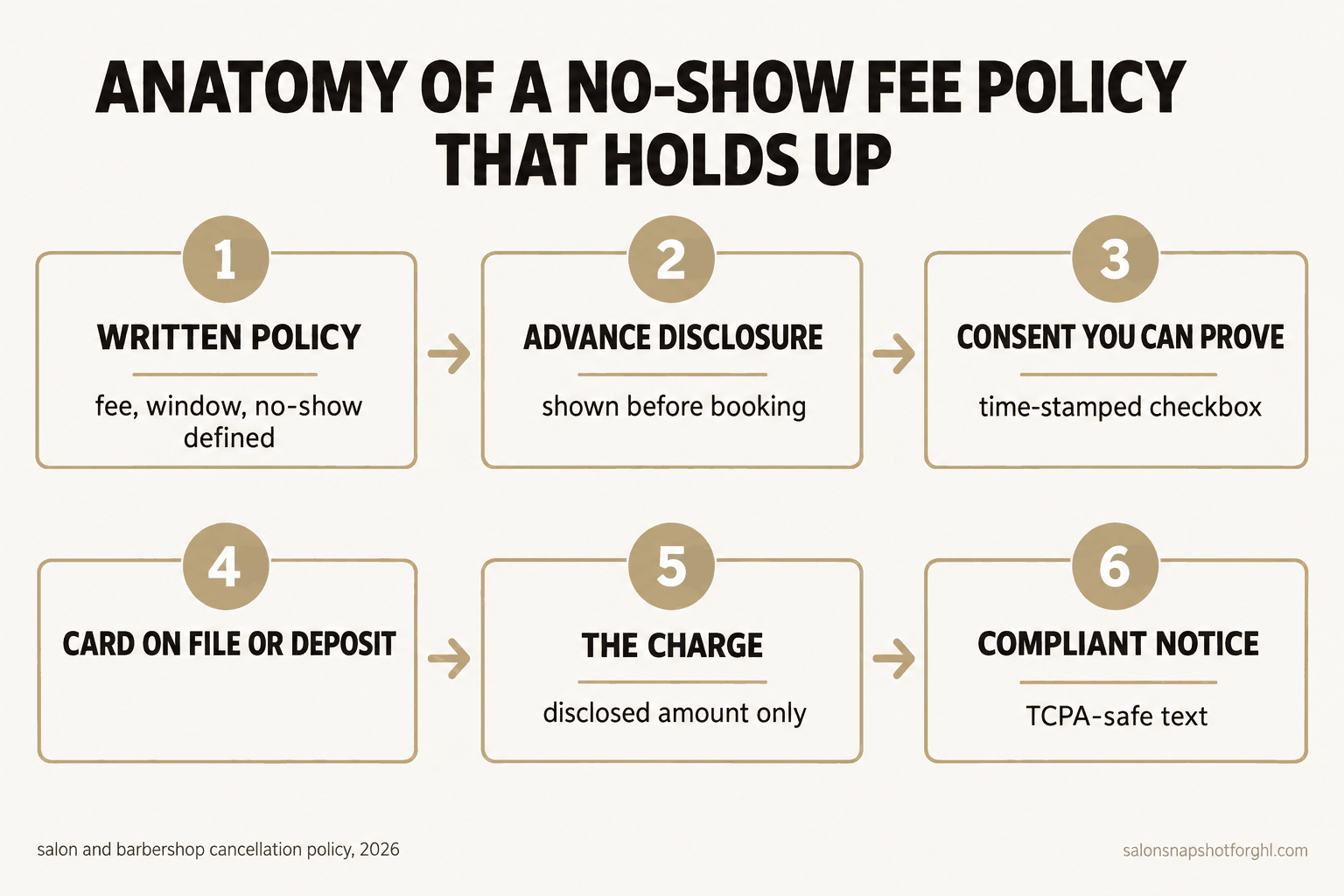
Part 1: The written policy
Good terms answer three questions in plain language.
How much? Tie it to the loss, not a punishment: a flat fee (say $50), a percentage of the service (25 to 50 percent), or the full price for a repeat no-show. A percentage scales fairly across a $30 cut and a $250 colour.
What is the window? Twenty-four hours is standard, forty-eight for long colour or extensions, because those slots are harder to refill. State it in hours, not “the day before,” which is ambiguous.
No-show versus late cancel? A late cancel is inside the window; a no-show is a client who never arrives and never calls. Charge partial for the first, full for the second.
How it breaks. A vague window is the common failure. “Please give notice” is not enforceable, because there is no line to have crossed, and a card issuer will side with the client in a chargeback. Write the hours down and never soften them.
Part 2: Advance disclosure
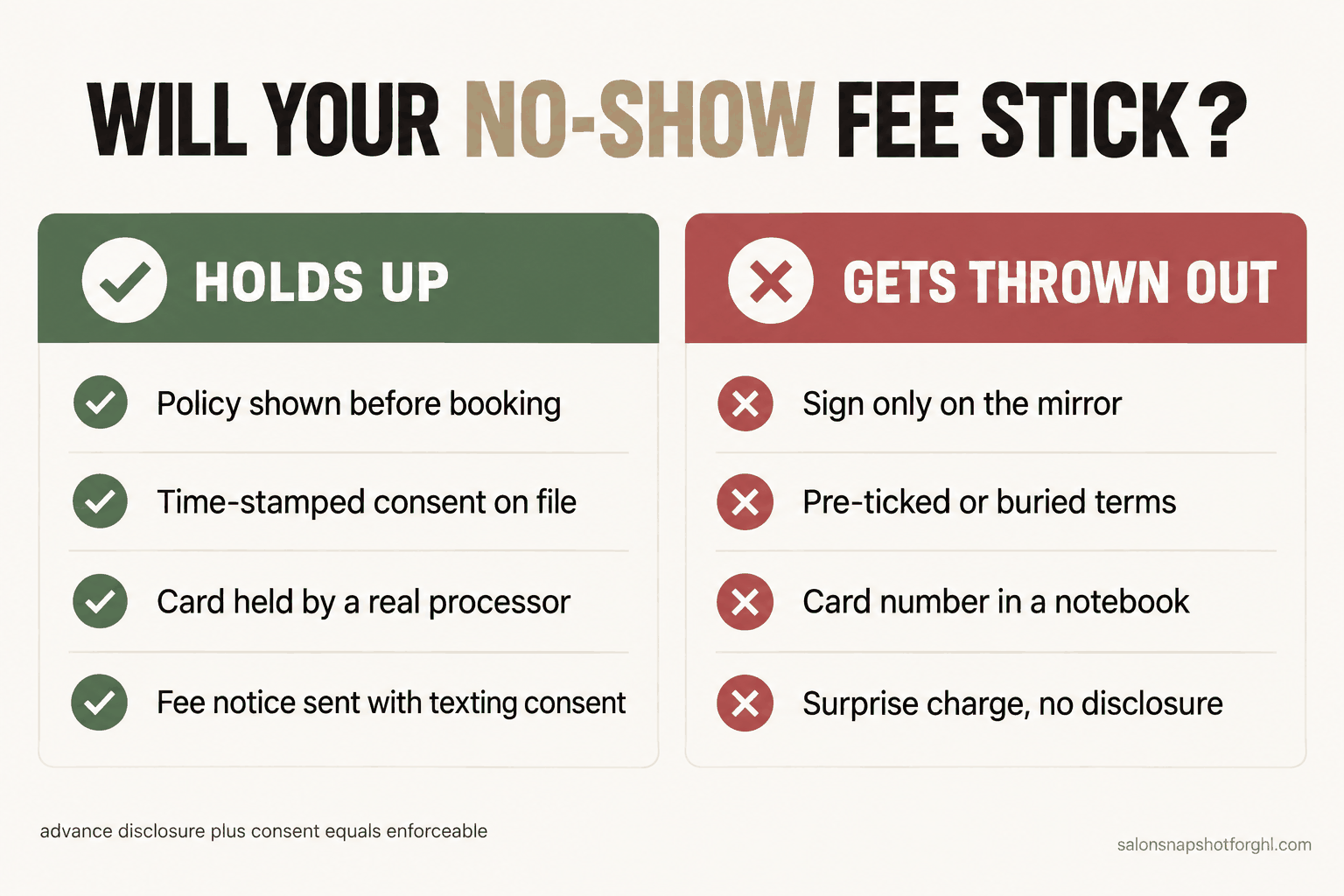
A policy the client meets for the first time in the fee notice is not a policy. It is a surprise charge, and a surprise charge turns a lost hour into a lost client. Disclosure means the terms are in front of them before money is at stake, in four places: on the booking page as a checkbox they tick before confirming, in the confirmation message, in the day-before reminder, and on the intake form a new guest signs.
How it breaks. Phone and DM bookings are the hole. A client messages “can you fit me in Thursday,” you say yes, and nobody ever showed them a policy. The fix is a short confirmation step (Part 3) that pushes even a phone booking through a written acceptance before the slot is locked, the same discipline that underpins a real no-show reduction system.
Part 3: Consent you can prove
This is the part shops skip, and the part that decides every dispute. Disclosure is showing the rule; consent is the client agreeing, in a form you can produce months later when a card issuer asks for it.
Good consent is affirmative (the client took an action, like ticking a box or replying YES), specific (tied to these terms), and time-stamped and stored. Capture it per channel: online, an unchecked box they must tick; by phone, a confirmation text or email with the policy and a one-word reply, with no held slot until they answer; in person, a signed, dated intake form.
How it breaks. Pre-ticked boxes and buried terms fail. If the box is already checked, or the policy is a link nobody opens, a client can credibly say they never agreed, and the chargeback goes against you. Make the box empty and the sentence plain.
Part 4: Card on file or deposit
You cannot charge a fee if there is nothing to charge. A deposit takes money at booking, applied to the service or forfeited on a no-show, which is right for high-risk bookings: new guests, long colour, and bridal or group blocks. A card on file charges only if the policy is broken, which regulars prefer since it collects nothing up front. Most shops run both: a card on file for everyone, a deposit on top for the bookings that hurt most.
| No policy | Card on file | Upfront deposit | |
|---|---|---|---|
| Collected at booking | None | None | Partial or full |
| Friction for a regular | None | Very low | Moderate |
| Protection on a new guest | None | Medium | High |
| Best for | Nothing | Established book | New guests, long services |
| Dispute risk if consent is clean | N/A | Low | Very low |
How it breaks. Storing card numbers yourself, in a notebook or spreadsheet, turns a good policy into a data breach. Cards on file must be held by a payment processor built for it. Never write a card number down.
Part 5: The charge itself
You have consent and a card, and a client just no-showed. Now the part that feels worst and matters most.
Give a short grace, then act. Decide your grace window in advance (say fifteen minutes) and apply it the same way every time. Consistency is what makes the fee a rule, not a mood.
Charge the disclosed amount, no more. If your policy says fifty percent, charge fifty percent, even when the lost slot cost more. Charging above the agreed number is the fastest way to lose a chargeback.
Send the notice before you charge. A client who sees the fee coming disputes far less than one who finds a mystery line on their statement (Part 6 has the wording).
How it breaks. The chargeback is the real test. If a client disputes with their bank, you will be asked to prove they agreed in advance. With a time-stamped acceptance you win. Without it you lose the fee and eat the dispute charge. Keep every consent record at least a year.
Part 6: The notice, inside texting law
The fee notice is a message to a customer, and in a salon it is almost always a text. That puts it under the TCPA and, on a normal business number, under A2P 10DLC carrier registration through The Campaign Registry. Three rules matter.
You need consent to text at all. Separate from the fee agreement, the client must have opted in to messages from you. If they did, a notice about their own appointment is a transactional message, the safer category. If not, call or email instead.
Register your number. Business texting from a standard US number runs through A2P 10DLC registration. Unregistered traffic gets filtered by carriers, so your reminders and fee notices quietly stop arriving and you never find out until the no-shows tell you.
Respect quiet hours and the opt-out. Do not send outside 8am to 9pm local time, and honour a STOP reply instantly and forever. A notice sent at 11pm, or to someone who opted out, is the willful end of the damages scale. Our SMS policy covers the consent and opt-out side in full.
Steal this: the copy, word for word
Adjust the numbers to your shop and have a local attorney read the final version. This is a starting point you edit, not a form you paste blind.
The policy, at booking:
Cancellation and no-show policy. We ask for at least 24 hours’ notice to change or cancel (48 hours for colour and extension services). Cancellations inside that window are charged 50% of the booked service. A no-show, meaning no arrival and no contact, is charged 100%. By booking, you agree to these terms and to keeping a card on file, which we charge only if this policy applies.
The consent checkbox (unchecked by default):
☐ I have read and agree to the cancellation and no-show policy above, and I authorise a card on file to be charged the disclosed fee if I cancel late or do not show.
The separate SMS opt-in (a second, unchecked box):
☐ Text me appointment reminders and confirmations at this number. Message and data rates may apply. Reply STOP to opt out.
The booking confirmation:
You’re booked with [Shop] on [date] at [time] for [service]. Cancellations inside 24 hours are 50% and no-shows are 100%, per the policy you agreed to. Need to change it? Tap here: [link].
The fee notice (sent before you charge):
Hi [name], we missed you today for your [time] appointment. Per the cancellation policy you agreed to at booking, a [amount] fee applies and we’ll charge the card on file. If something came up, reply here and we’ll talk it through.
The chargeback response (send to the card issuer with your records):
The cardholder booked on [date] and accepted our cancellation policy at that time via an affirmative checkbox (record attached, timestamp [time]). The disclosed fee of [amount] was applied per those terms after a no-show on [date]. Confirmation and fee notice attached.
That last one is why Part 3 exists. When a dispute lands, you are not arguing about whether the fee was fair. You are producing the moment the client agreed to it.
Three shops, three policies
The solo booth renter. You are the whole business. You set your own fee, take your own deposits, and the card on file is yours, not the salon’s. Keep it simple: a card on file for repeat clients, a deposit for new guests and long services, a 24-hour window. Because you rent your chair, the shop does not set or collect your fee, and it should not, because that separation is part of what keeps you a contractor. If that line is fuzzy, read our guide on booth rent versus commission versus W-2 classification.
The five-chair commission shop. Here it has to be one policy applied the same way at every chair, because you own the client relationship and the book. The risk is not the rule, it is inconsistent enforcement: one stylist waives every fee, another charges hard, and clients compare notes. Set the policy at the shop level and take the judgment call out of each stylist’s hands.
The twelve-chair salon. At this size the failure mode is volume. The checkbox, the record, the reminder, and the fee notice all have to fire without a person, and card storage has to be processor-held, because a data slip across a big team is a real liability. Same policy as the solo renter, different machine behind it.
The legal fine print
None of this is legal advice, and the rules vary by state. Have a local attorney confirm your final policy.
No-show fees are lawful when disclosed and agreed to. A salon can charge a cancellation or no-show fee as a term of service, provided the client saw the policy before booking and consented. Enforceability rests on that advance disclosure and consent.
Card on file is fine with clear consent. Storing a card to charge a disclosed fee is accepted practice when the client affirmatively agreed and a compliant processor holds the card. Some states add consumer-protection nuance around stored payment, so check the FTC’s business guidance and your own state rules.
Texting is regulated separately. The TCPA governs the messages you send. Marketing texts need prior express written consent; transactional messages like a reminder or fee notice need consent too, at a lower bar, plus an honoured opt-out and quiet hours. Many states also have their own mini-TCPA statutes.
In California, booth rent and classification collide here. A licensed barber, cosmetologist, esthetician, or electrologist can be a booth renter under the Borello test rather than the stricter ABC test from AB5, but only if they genuinely run their own business: set their own rates, process their own payments, keep their own book, hold a business license, and issue a 1099 to the shop (Labor Code section 2775 and its exemptions). Charging their own cancellation fee is part of that independence, so a shop that charges a renter’s fees quietly undercuts it. California also extended its separate manicurist exemption through the end of 2028. Verify your own state first.
Objections
“Won’t a fee scare clients away?” The clients a clear policy scares off are the ones who cost you slots. Good clients read “24 hours’ notice, card on file” and think nothing of it, the same as at any doctor or dentist. What loses clients is a surprise charge with no disclosure behind it.
“A client is disputing the charge.” Send the chargeback response above with the time-stamped consent record attached. With that record you almost always win. Without it, you learn why Part 3 is not optional.
“I already pay for Vagaro or GlossGenius.” Booking tools capture the checkbox and store the card. What they do not do is join your consent, reminders, fee notices, and texting compliance into one flow that runs without you. If your tool captures consent cleanly, keep it and tighten the policy around it. Weighing a switch? Our salon software cost breakdown covers what each really does.
FAQ
Common questions about salon cancellation fees
Is it legal to charge a no-show fee at a salon?
Yes. A cancellation or no-show fee is lawful in every US state when the client saw the policy before booking and agreed to it. The enforceable part is the advance disclosure and consent, not the fee itself, so the record of their agreement matters more than the amount.
How much should a salon no-show fee be?
Most shops charge 50% of the service for a late cancellation and 100% for a true no-show, or a flat fee of $25 to $75. A percentage scales fairly between a short cut and a long colour service. Never charge more than the amount the client agreed to at booking.
Can I keep a client's card on file to charge later?
Yes, with clear advance consent and a compliant payment processor. The client must affirmatively agree to keep a card on file and to be charged the disclosed fee if the policy applies. The card should be tokenised by the processor, never written down or kept in a spreadsheet.
Does texting a client about the fee break any law?
It can if the messaging setup is not clean. The fee notice is a text, so it falls under the TCPA and, on a standard business number, A2P 10DLC registration. You need consent to text, a registered number, respect for 8am to 9pm quiet hours, and an honoured STOP opt-out. If any of those is shaky, send the notice by email or phone.
I'm a booth renter. Do I set my own cancellation policy?
Yes. As a booth renter you run your own business, so you write, disclose, and charge your own fee using your own card-on-file setup. The salon should not charge fees on your behalf, because that undercuts the independence that keeps you a contractor rather than an employee.
So back to that Saturday. The version of you with this policy in place is not eating the loss and not sweating a review. The client agreed to the terms when she booked, her card is on file, and at 9:40 a calm, pre-written notice goes out applying the fee she agreed to, with an offer to talk if something genuinely came up. You are not the bad guy. You are the business that told her the rule, proved she agreed, and applied it the same way for everyone. The chair still walked, but this time it did not walk for free, and nothing about how you handled it can come back on you. That is the whole point of writing it down.