It is a slow Tuesday and you are between heads, phone in hand, trying to decide. Every barber in your group chat is on Booksy. The shop two doors down switched to Square because it was free. Your cousin who does color swears by GlossGenius. And you are standing there with four open tabs, unsure which one is actually built for a barbershop with walk-ins, a booth renter or two, and nobody at a front desk to run it.
Here is the short version. Booksy wins the barbershop marketplace and feeds you new clients, but it charges a 30% cut on each one’s first visit, so it is a lead source with a toll. Square is the free floor, a real calendar and payments for a solo chair at zero monthly cost. Vagaro is the budget middle that does a lot adequately. GlossGenius is the most polished owner-run tool, flat price, no per-client cut. Pick on how your shop runs, how many new clients you need the app to find, and your card volume. This guide puts the real 2026 numbers and the honest fit side by side.
Key takeaways (the TL;DR)
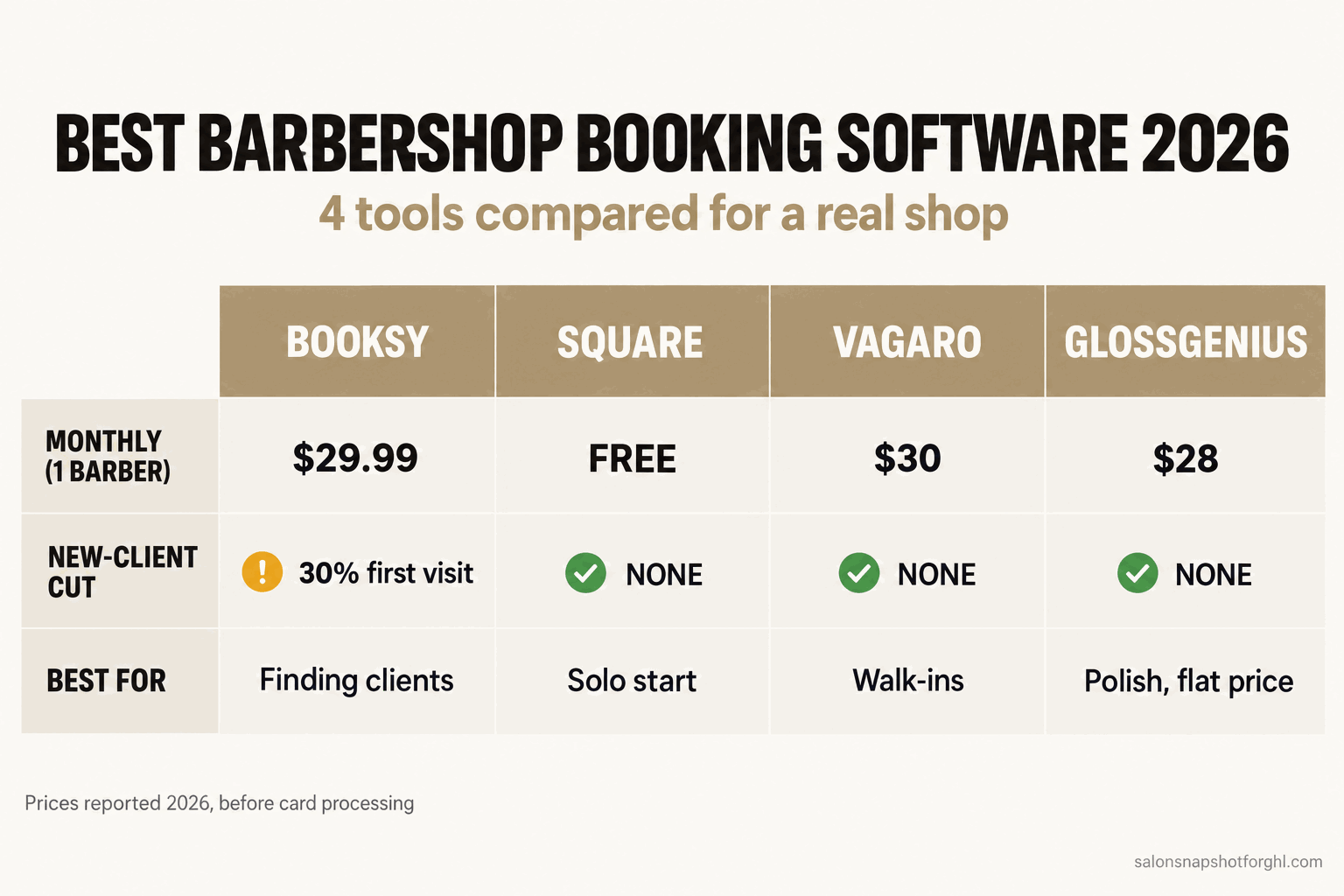
- Booksy is a marketplace with a toll. About $29.99 a month for one barber plus $20 per extra staff member, but Boost takes a one-time 30% commission on each new client’s first visit (reported $10 minimum, $100 maximum). Great for discovery, expensive if you forget to turn it off.
- Square is the free floor. A genuinely free plan for a solo chair; you pay only card processing. No marketplace, but the cheapest start there is.
- Vagaro is the budget middle. About $30 a month for one calendar, $10 per extra, a free Marketplace listing without Booksy’s standing 30% cut.
- GlossGenius is the polished owner-run pick. Flat $28, $56 or $168 a month, 2.6% flat processing, no commission.
- Processing is the bill that hurts, not the subscription: a shop doing $15,000 a month in cards at roughly 2.6% pays about $390, which dwarfs any $28 or $30 plan.
- Added up three years of renting per chair and winced? There is a fourth path: owning your booking and automation once instead of renting it forever.
Table of contents
- What getting this choice wrong costs you
- The 8 things that actually decide it for a barbershop
- Which one fits your shop: three real scenarios
- Steal this: the texts and policy lines
- The legal part nobody reads until it bites
- Objections
- FAQ
- Sources
What getting this choice wrong costs you
The monthly sticker is the cheapest part of this decision. The expensive part is picking a tool that does not match how your shop runs, then half-using it for a year or paying a toll you never meant to pay.
Two facts frame why fit beats fee. First, 80% of barbers are self-employed, at a median wage of $18.37 an hour as of May 2025, per the US Bureau of Labor Statistics. Most people reading this run the chair and the business, with no receptionist to drive a complicated system, so the software has to run itself. Second, card processing almost always costs more than the subscription. The plan is the small number on the bill; the rate on every fade and lineup is the big one.
Pick wrong and you pay a commission on clients who would have found you anyway, buy seats you never use, or lock three years of history in a tool you cannot export. Pick once, eyes open about where the money goes.
The 8 things that actually decide it for a barbershop
Forget the feature-list arms race. These eight things decide whether a tool fits a real barbershop, all four side by side, with the failure mode on each.
| What matters | Booksy | Square | Vagaro | GlossGenius |
|---|---|---|---|---|
| Monthly price, one barber | ~$29.99 | $0 free plan | ~$30 | $28 |
| Price, 4 barbers | ~$89.99 | paid tier | ~$60 | $56 Gold |
| New-client commission | 30% first visit | None | None standing | None |
| Card processing | ~2.49% + 10c | ~2.6% + 15c | ~2.6% + 10c | 2.6% flat |
| Marketplace / discovery | Strong | None | Listing | None |
| Walk-in / queue fit | Good | Basic | Good | Basic |
1. Real monthly price. Booksy is reported near $29.99 a month plus tax for one barber, about $20 per extra staff member, so four barbers land around $89.99 before processing. Square has a free plan for one chair; its paid tiers add staff but the page renders price dynamically, so reported figures put Plus between $29 and $49 per location. Vagaro is $30 a month for one calendar ($23.99 for six months), then $10 per added calendar. GlossGenius is $28, $56 and $168 flat, up to nine staff on the $56 Gold plan. The failure mode is comparing stickers and ignoring the two rows below, where the real money lives.
2. Card processing. This decides your real bill. GlossGenius publishes a flat 2.6% on all transactions, no per-swipe fee. Booksy runs roughly 2.49% plus 10 cents with the reader, Square near 2.6% plus 15 cents in person, Vagaro in a 2.2% to 3.5% band by volume. On $15,000 a month in cards, the gap between 2.49% and 2.9% is about $60 a month, far bigger than any plan difference. The failure mode is choosing on the plan line and never doing the processing math.
3. The new-client commission, the real barbershop tax. The biggest difference, and it only exists on Booksy. Booksy Boost takes a one-time 30% commission on each new client’s first visit, reported with a $10 floor and $100 ceiling, charged only when the visit happens. On a $40 cut that is $12 gone the first time. If the client rebooks for years it was cheap marketing; if they ghost, you paid to find someone who never came back. Square, Vagaro and GlossGenius take no cut. The failure mode is leaving Boost on once the chair is full, paying 30% on clients who already knew you.
4. Walk-ins and the queue. Barbershops are not salons. A real chunk of the day is walk-ins, and the tool has to hold a live queue without wrecking the booked column. Booksy and Vagaro handle walk-ins and a waitlist natively. Square manages it through its point-of-sale lineup but leans booking-first, and GlossGenius treats walk-ins as same-day bookings. The failure mode is forcing a pure appointment tool onto a walk-in shop.
5. Deposits, card-on-file, and no-show protection. All four can hold a card and charge a no-show. What matters is turning it on and disclosing it right. Booksy, Square and Vagaro support deposits or a cancellation fee; GlossGenius ships card-on-file policies on every plan. The policy and the consent behind it are what holds up when a client disputes the charge, as we cover in the cancellation and no-show fee policy guide and the deposits and same-day recovery playbook. The failure mode is charging a fee you never disclosed, then eating a chargeback.
6. Reminder texts and two-way SMS. No-shows die when the reminder lands and the client can reschedule in one tap. All four send reminders through their own numbers. Either way the texts are regulated under TCPA and the A2P 10DLC rules carriers enforce; send them wrong and your number gets filtered, so reminders quietly stop arriving. We walk through doing it legally in the appointment reminder texts guide. The failure mode is assuming the app handles compliance, then watching delivery fall off a cliff.
7. Who owns the client and the number. This quiet one costs the most later. When a client books through the Booksy marketplace, the relationship runs through its app and, in a real sense, its number; the same client on your own GlossGenius booking site is yours, with their real number in your list. Ask every vendor, in writing, whether you can export your full client list, history and card tokens, and in what format, as covered in switching booking software without losing your client list. The failure mode is building your book inside a marketplace, then finding you cannot take the numbers.
8. Reviews and rebooking. The money is in the rebook. All four can request a Google review and nudge a rebook, but differ in how automatic it is. Booksy prompts reviews inside its app, building its marketplace ranking more than your Google profile. Square, Vagaro and GlossGenius can push the review to Google, which pulls new local search traffic. The failure mode is harvesting reviews that help the app, not your shop’s name in local search.
Entry and small-team monthly subscription prices, 2026, in US dollars, before card processing and any new-client commission (Booksy figures rounded and reported). Sources: Square, GlossGenius, Booksy, Vagaro.
Which one fits your shop: three real scenarios
The same four tools give different answers depending on your shop. Run yours against the closest of these three.
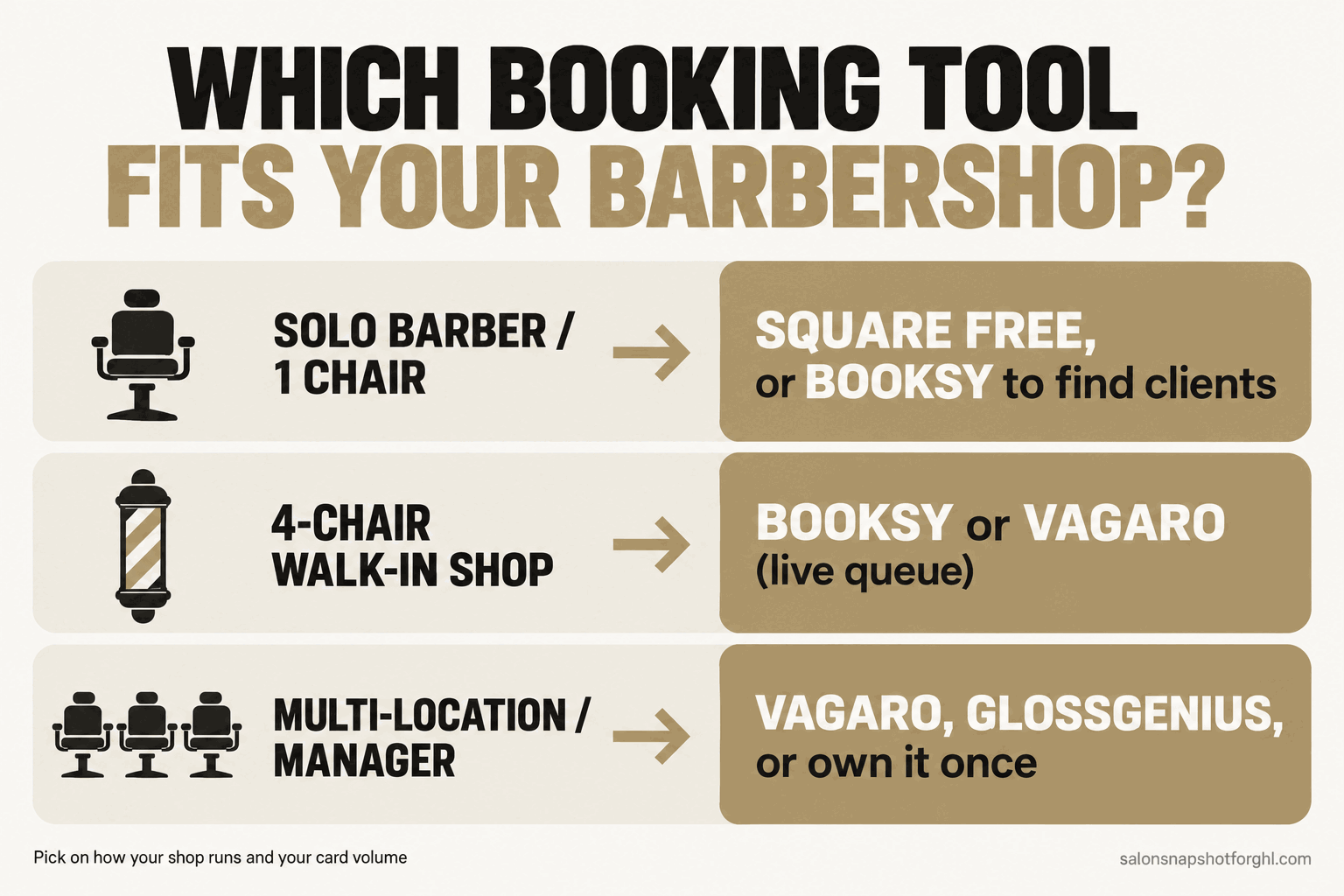
Scenario 1: the solo barber or single-chair booth renter. You need new clients more than features. With zero budget and an established local name, start on Square’s free plan: calendar, payments and reminders for nothing but processing. New in town and need the app to find clients? Booksy earns its 30% toll here, because the discovery is real and you pay only for first visits you would not have gotten anyway. The smart move is to use Booksy to fill the chair, then shift regulars onto a cheaper, commission-free tool once the marketplace has done its job. The failure mode is paying 30% forever on clients who are now loyal.
Scenario 2: the four-chair shop that lives on walk-ins. A couple of employees or booth renters, a busy Saturday, a steady walk-in flow. Booksy or Vagaro fit best, because both hold a live queue and waitlist without breaking the booked column. Booksy if discovery still matters and you can manage the Boost toll per barber; Vagaro if you want the walk-in handling without a standing commission. GlossGenius Gold at $56 fits a shop that is more appointment-driven than walk-in. The failure mode is forcing an appointment-first tool onto a walk-in shop.
Scenario 3: the multi-location barbershop or group with a manager. Now per-chair math compounds. Four barbers on Booksy is near $90 a month before the 30% cut, per location, climbing with every site and seat. Vagaro stays predictable and GlossGenius folds staff into one plan, but neither was built as a true multi-site operations platform. This is where owning your booking, reminders, no-show recovery and reviews as one system starts to beat renting four seats per location forever. Model two or three sites at the full rate first, and if the number makes you wince, price the owned route instead.
Steal this: the texts and policy lines
Two things save a barbershop money: a reminder cadence that kills no-shows and a card-on-file line that holds up. Paste these into any of these tools, and keep the opt-out on the first message.
Booking confirmation (sent right after they book):
“You’re booked with [Barber] at [Shop] on [Day] at [Time]. Reply C to cancel or R to reschedule. Reply STOP to opt out of texts.”
24-hour reminder (the one that saves the slot):
“Reminder: [Client], you’re in tomorrow at [Time] with [Barber]. Tap to reschedule if you need to: [link]. See you then.”
Card-on-file policy line (show it at booking, before the card field, not after):
“To hold your chair we keep a card on file. No-shows and cancellations inside [24 hours] are charged [50%] of the service. By booking, you agree to this policy.”
Walk-in waitlist text (when the queue is long):
“Thanks for stopping in. You’re on the list, about [25] minutes out. We’ll text when your chair is ready, so grab a coffee.”
Google review request (send a few hours after the cut, not in the chair):
“Appreciate you coming in today, [Client]. If you’re happy with the cut, a quick Google review helps the shop a ton: [link]. Thanks.”
Win-back for a lapsed regular (fires at eight weeks with no rebook):
“[Client], it’s been a minute since your last cut at [Shop]. Want your usual slot this week? Reply and I’ll get you in.”
The legal part nobody reads until it bites
Booking software does not make you compliant. The shop owner, not the app, carries the risk. Three rules matter.
Reminder texts are regulated. Automated appointment texts fall under the federal Telephone Consumer Protection Act, and US carriers enforce A2P 10DLC registration for business texting. In plain terms: get clear consent, include an opt-out like “Reply STOP,” and register your texting so carriers do not filter you. The Federal Communications Commission explains the rules; we break down the barbershop version in the appointment reminder texts guide.
No-show fees are generally lawful with disclosure and consent. Charging a card on file for a no-show is allowed in most places, as long as you disclosed the policy clearly in advance and the client agreed before you held the card. The nuance is state consumer-protection law, so keep the disclosure plain and keep proof.
Worker classification is not the app’s problem. If your barbers are booth renters or 1099 contractors, the tool does not settle whether they are really independent. In California, licensed barbers are tested under the older Borello standard rather than the stricter ABC test, which matters directly for booth-rent shops, as covered in booth rent versus commission versus W-2.
Objections
“Everyone in my area is on Booksy. Don’t I have to be?” For discovery, maybe, for a while. If clients in your town genuinely search Booksy to find a barber, being listed is worth the toll. But use it as a lead source: move regulars onto something commission-free once they know you, and keep your own list of their numbers.
“I already pay for Vagaro. Is switching worth it?” Usually not for the subscription gap alone. The difference between a $30 Vagaro plan and a $28 GlossGenius plan is a rounding error next to your processing bill. Switch only for a real reason: no-shows you cannot control, a queue that fights you, or reviews that only help the app. Read the switching guide first.
“Where does a GoHighLevel system fit against these four?” It is a different category, not a drop-in booking app. The four here are booking-first products you rent monthly, forever, and some take a cut of new clients on top. A GoHighLevel system like ours is a one-time setup you keep, covering booking, reminders, no-show recovery and reviews, with your clients’ real numbers in your list. It is the math for an owner who added up three years of per-chair subscriptions and did not love the total, not for a barber who wants a free calendar this afternoon.
FAQ
What is the best booking software for a barbershop in 2026?
There is no single best. Square is the free floor for a solo chair, Booksy is the marketplace that finds new clients for a 30% cut on their first visit, Vagaro is the budget middle with strong walk-in handling, and GlossGenius is the most polished flat-price tool with no commission. Pick on how your shop runs, how much you need the app to find clients, and your card volume.
How much does Booksy really cost for barbers?
Booksy is reported near $29.99 a month plus tax for one barber, with about $20 per additional staff member, so four barbers land near $89.99 before processing. On top of that, Booksy Boost takes a one-time 30% commission on each new client's first visit, reported with a $10 minimum and $100 maximum. Card processing is separate, around 2.49% plus 10 cents with the reader.
Is Square Appointments free for a barbershop?
Square has a genuinely free plan for a single location with one staff member, where you pay only card processing of about 2.6% plus 15 cents in person. Paid tiers add staff, but Square renders those prices dynamically, so reported figures put Plus between $29 and $49 per location. Confirm the current number on Square's own page.
Which barbershop tool handles walk-ins best?
Booksy and Vagaro both handle a live walk-in queue and waitlist natively, which is why many barbershops prefer them. Square manages walk-ins through its point-of-sale lineup but leans booking-first, and GlossGenius treats them as same-day bookings. If your shop lives on walk-ins, weight this heavily.
Should I use a GoHighLevel system instead of a barbershop booking app?
It depends on your horizon. Booking apps are rented monthly forever, and some take a commission on new clients. A GoHighLevel system is a one-time setup you own, covering booking, reminders, no-show recovery and reviews, with your clients' real numbers in your list. Over three years, especially for a multi-chair or multi-location shop, owning it once often costs less than renting per seat and paying per client.
The four tabs, closed
Back to that slow Tuesday and the four open tabs. You can close them now. A solo barber who needs clients more than features starts free on Square, or lets Booksy find faces for its 30% toll on first visits. A walk-in shop leans on Booksy or Vagaro for the queue. Want polish and a flat price with no cut? That’s GlossGenius.
Pick on how your shop runs and your real card volume, not on which app looked best between heads. And if the three-year math on renting a seat per chair made you wince, price out owning the whole thing once instead.
Sources
- Barber and stylist workforce and self-employment data: US Bureau of Labor Statistics, Occupational Outlook Handbook
- Booksy pricing and Boost commission: booksy.com for business; reported US figures corroborated by SchedulingKit and Koalendar
- Square Appointments: squareup.com/us/en/appointments; reported tier prices and rates from Capterra and Koalendar
- Vagaro pricing: vagaro.com/pro/pricing
- GlossGenius pricing and flat processing rate: glossgenius.com/pricing
- Text-message rules (TCPA): US Federal Communications Commission