It is 10:40 on a Saturday and your hands are full of foils. The front desk phone rings, rings again, and rolls to voicemail. You will call back at lunch, you tell yourself. By lunch the caller has booked a colour correction with the salon two blocks over, because they called at 10:43 and a human picked up. You never knew they existed: no name, no missed-call light, just a chair that stayed empty on your busiest day.
Here is the answer first. You are not losing new clients because your work is not good enough. You lose them in the ninety seconds between when they reach out and when you reply, and that is a systems problem, not a hustle problem. The fix is a speed-to-lead system that catches every missed call, web form and DM automatically, texts the person back in seconds, and walks them to a booked appointment while they are still thinking about their hair. This guide builds it stage by stage, with the messages to steal.
Key takeaways (the TL;DR)
- Speed beats everything. The business that replies first usually wins the booking, and “first” now means minutes, not hours.
- Inquiries arrive on five channels and all go cold the same way. The phone, your website form, Instagram, Facebook Messenger, and Google. One system has to catch all of them.
- Automation does the catching, not the convincing. An instant text-back and a short follow-up buy you time to do the human part later, so you stop losing people before you can close them.
Table of contents
- What a missed inquiry actually costs you
- The speed-to-lead system: six stages
- Stage 1: Text back every missed call in seconds
- Stage 2: Catch the website form and Book Now button
- Stage 3: Pull Instagram and Facebook DMs into one inbox
- Stage 4: Cover after-hours and mid-service
- Stage 5: The no-reply follow-up cadence
- Stage 6: Route to a booked chair and log the source
- Steal this: the scripts
- Three shops, three versions
- Keep it legal: TCPA and 10DLC
- Objections
- FAQ
What a missed inquiry actually costs you
A missed call feels like nothing because you never see the person, which is exactly why it is the most expensive thing in the shop. You can count an empty chair, but not the client who called once, got voicemail, and quietly booked elsewhere.
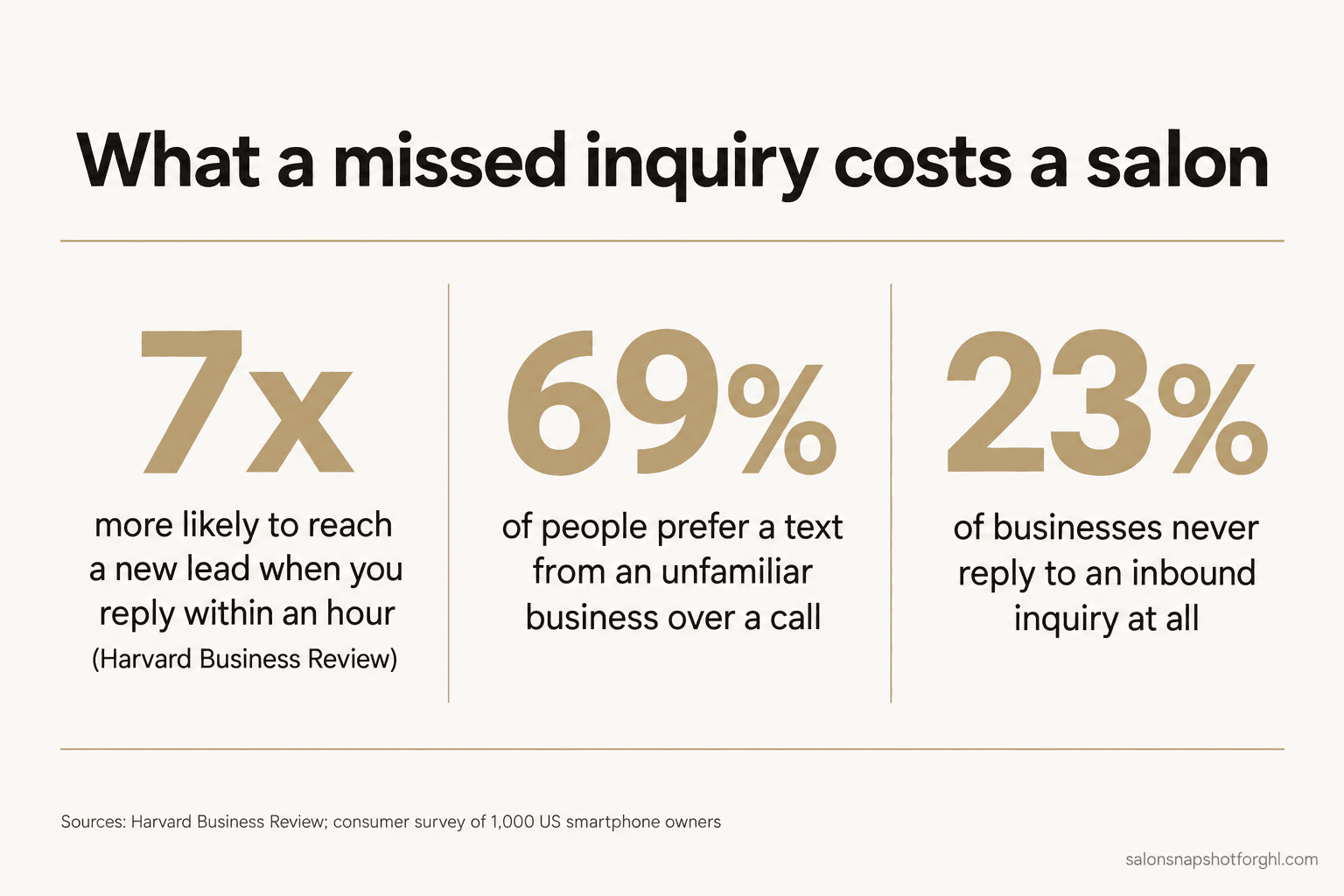
The research is settled. In the Harvard Business Review study The Short Life of Online Sales Leads, firms that reached a new inquiry within an hour were nearly seven times more likely to have a real conversation with the decision-maker than firms that waited even an hour longer, and more than sixty times more likely than those that waited a full day. The same audit of 2,241 companies found 23% never responded at all. Not late. Never.
How fast companies reply to a new inbound inquiry, share of 2,241 firms audited. Source: Harvard Business Review, The Short Life of Online Sales Leads.
Then there is how people behave today: they do not try twice. A survey of 1,000 smartphone owners found 69% would rather an unfamiliar business text them than call, so when your line goes to voicemail, most callers will not leave one. They tap the next salon and the booking is gone. This lands hardest on small shops, because most have no front desk at all. The Bureau of Labor Statistics reports about 76% of barbers and 48% of hairdressers, hairstylists, and cosmetologists are self-employed, out of roughly 651,200 jobs in 2024. If you are solo, you are the stylist and the receptionist at once, and the one with scissors in hand wins. A system has no scissors.
The speed-to-lead system: six stages
Speed-to-lead is simply this: the shorter the gap between a person reaching out and your shop replying, the more of them book. The goal is to make that gap seconds, automatically, whatever you are doing at the time.
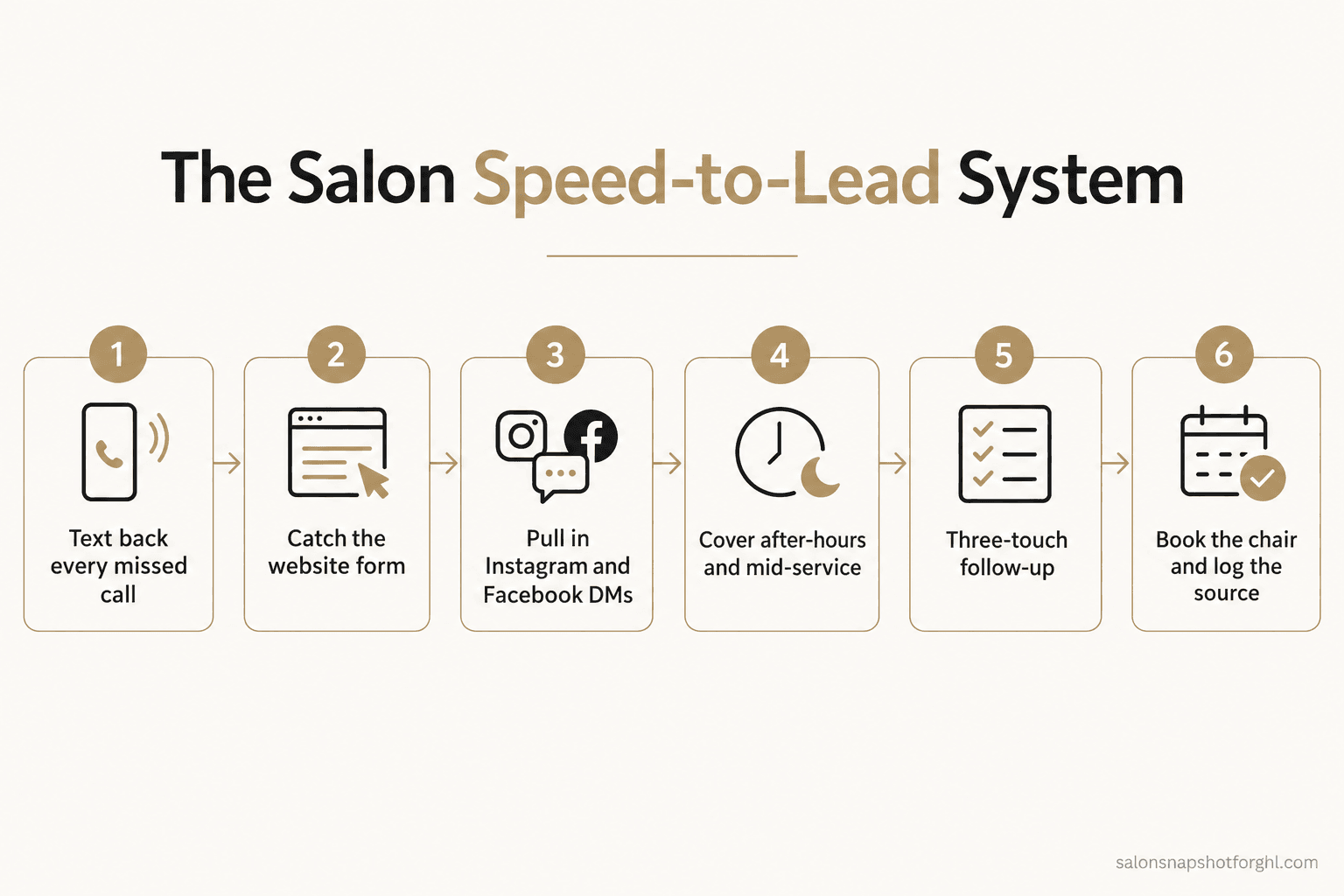
The six stages cover the five ways a new client reaches you, plus the follow-up that catches the ones who go quiet. None of it asks you to answer more calls. It asks your shop to reply instantly whether or not you are free, which software does and a busy human cannot.
Stage 1: Text back every missed call in seconds
This is the highest-return thing in the system, and almost no independent shop has it. When a call rings out, an automatic text goes to that number before the caller hangs up: it names your shop, apologises, and offers a booking link. The person who was about to dial the next salon now has a reply from you, on the channel two thirds of them preferred.
To set it up, connect a business texting number (not your personal cell) to a tool that fires the reply after a fifteen-to-twenty-second delay, so it does not go out when you answer on the fourth ring. In a GoHighLevel setup like the Salon Snapshot it is a prebuilt workflow. It breaks three fixable ways: fire it instantly and it texts people you did answer; send it from a different number and it looks like spam; say “sorry we missed you” with no next step and they do nothing.
Stage 2: Catch the website form and Book Now button
Your contact form and Book Now button are missed calls that happen to be silent. Someone filled one out, which means they were ready, and if nothing happens next, the numbers above are working against you. Every submission should trigger an instant text and email back, inside a minute, that hands them a booking link or asks the one question that gets them to a slot: what service, and roughly when. “Thanks, we will be in touch” is a dead end.
Connect the form to the same system that runs your text-back, so a submission confirms immediately and drops the person into the stage-five follow-up if they go quiet. The usual failure is a form that only emails you, so you see it four hours later and they have moved on. The second is asking for too much: a ten-field form gets abandoned, so ask for a name, a number, and the service.
Stage 3: Pull Instagram and Facebook DMs into one inbox
For salons and barbershops, the DM is a booking request wearing a costume. “Do you do balayage?” at 11pm is a client with a card in their hand, but DMs live in an app you are not in while you work. Route Instagram and Facebook Messenger into the same inbox as your texts and form replies, so a DM gets the same instant first reply: a warm answer and a nudge to the booking link. A saved post turns into a consultation instead of dying unread. If this is your main channel, our guide to turning Instagram DMs into salon bookings goes deeper.
Keep that first auto-reply human and short while you take the real conversation between clients. It breaks when the auto-reply answers a specific question wrong, quoting a price you do not charge, so keep it general and let a person handle specifics. It also breaks when you connect the accounts and never check the inbox, so DMs sit answered by a bot and abandoned by a human.
Stage 4: Cover after-hours and mid-service
A large share of inquiries arrive when you physically cannot answer: evenings, your day off, or mid-colour. Those are the easiest wins in the system: the competition is also closed, so whoever replies first, automatically, takes the booking.
Share of workers who are self-employed, by occupation, which is why so many shops have no one free to answer. Source: BLS Occupational Outlook Handbook, 2024 data.
After-hours coverage is the same text-back and auto-reply, with wording that fits the moment: an inquiry at 9pm gets a warm “we are closed right now, here is the link to grab a time, and we will confirm first thing.” Give your automations business hours so the wording changes outside them, and put a self-serve booking link in every after-hours reply. It breaks when the message promises “we will call you first thing” but has no link, because now you have a pile of morning callbacks. Let them book themselves, and test the link on your own phone whenever you change hours.
Stage 5: The no-reply follow-up cadence
Most people do not book on the first message, and that is normal, not a rejection. They got pulled away, they are comparing two shops, they meant to reply and forgot. The cadence is three touches over about three days, then stop. The first goes a few hours after contact, the second the next day with a specific next step, the third a day or two later as a soft last call.
The sequence stops the moment they reply or book, so nobody who is already talking to you keeps getting chased. That stop condition is the most important setting in the cadence: the classic disaster is a follow-up that keeps sending after the person has booked, so a paying client gets “still thinking about it?” texts and you look careless. Test it by booking yourself through the flow and confirming the chase stops.
Stage 6: Route to a booked chair and log the source
Catching the inquiry is not the finish line. A booked appointment is, held with whatever deposit or card-on-file rule you use. When someone replies “yes, Thursday works,” hand them a link that shows live availability and books the slot, with the deposit taken in the same step. Pair this with our playbook on stopping salon no-shows with deposits and reminders.
Then log where the booking came from, tagging every new contact with its source channel as it arrives. Knowing the text-back books more new clients than your website form tells you where to point your attention and ad spend. It breaks when a link shows times you are not actually available and double-books you, so keep the calendar synced; and when nothing tags the source, you are back to guessing which channel is worth your time.
Steal this: the scripts
Adapt the wording to your voice, keep every message short, and send them all from one registered business number. Never send one without the booking link.
Missed-call text-back (fires about 15 seconds after a missed call):
Hi, this is [Shop name], sorry we missed your call! We were probably with a client. What can we help you book? Grab a time here anytime: [link]
Website form auto-reply (within a minute of submission):
Hi [First name], thanks for reaching out to [Shop name]! Got your note about [service]. The fastest way to lock in a time is right here: [link]. Prefer to text? Just reply and I’ll help you find a slot.
Instagram or Facebook DM first reply:
Hey [First name]! Thanks for the message. Yes, we’d love to get you in. Here’s our live booking so you can pick a time: [link]. Any questions, reply right here and a human will jump in.
After-hours reply:
Hi, this is [Shop name]. We’re closed right now but we don’t want you to wait, book a time yourself here: [link] and we’ll confirm first thing in the morning. Thanks for thinking of us!
Follow-up 1 (a few hours later, no reply):
Hi [First name], just making sure you saw this, we’d love to get you booked at [Shop name]. Here’s the link whenever you’re ready: [link]
Follow-up 2 (next day):
Hi [First name], we have a couple of openings this week for [service]. Want me to hold one for you? Book here: [link]. Reply STOP to opt out.
Follow-up 3 (a day or two later, soft last call):
Hi [First name], no pressure at all, just leaving the door open! If you’d still like to come in, we’re here: [link]. Hope to see you in the chair soon.
Every one shares a friendly tone, one clear action, and a way out, which is the only way automated messages work in a relationship business.
Three shops, three versions
The stages are the same everywhere. What you lean on changes with your setup.
The solo operator or booth renter. You have no front desk and never will, so the missed-call text-back and after-hours coverage are your whole game: you miss the most calls because you are always in the chair, and win the most back while competitors’ voicemails pile up. Start with stages one and four, and if you rent, run them on a shop-approved business number.
The three-to-five-chair shop. Your thin front-desk coverage vanishes at lunch and on busy afternoons, which is exactly when inquiries spike. Make the system catch what the desk drops: calls that ring out during a checkout, forms that arrive overnight, DMs nobody is watching. The stage-five cadence matters most here.
The multi-stylist or multi-location shop. Your risk is inconsistency: one location answers fast, another lets everything roll to voicemail, and you cannot see the difference. Run one system across all of it with stage six’s location tagging, so you can spot the weak site and fix it.
Keep it legal: TCPA and 10DLC
Automated texts sit under real rules, and salons text enough that they apply to you. The good part is that this system runs on messages people basically asked for: a first reply to someone who just called, filled out your form, or messaged you responds to a contact they started, the safe case. The ongoing follow-ups and any marketing later need consent, a clear opt-out (the “reply STOP” line above), and respect for quiet hours. US business texting also runs through A2P 10DLC registration now, so an unregistered number gets filtered or blocked no matter how good the message is.
This is a lead-capture guide, not a compliance guide. The full version is separate: how to send salon appointment reminder texts legally under the TCPA and 10DLC covers consent, registration, quiet hours, and opt-out wording, and the FCC’s guidance on unwanted calls and texts is the primary source.
Objections
“Won’t an instant automated text annoy customers?” Only if it reads like a robot or shows up when they did not reach out. A warm reply to a call they just made, that helps them book, is the opposite of annoying. Most people would rather get it than sit in voicemail.
“I already pay for Vagaro, GlossGenius or Fresha. Doesn’t it do this?” Most booking platforms handle the booking well and the catching poorly. They remind people who are already booked, but the brand-new caller who never made it into the system is the gap they leave open. Check yours: does it text back a missed call, reply to a form in under a minute, and pull your DMs into one inbox? If not, this fills the gap in front of the booking.
“Do I need to be technical to run this?” No. Every stage is a configuration, not code: a trigger, a message, a link. In a done-for-you setup it is installed and tested for you, and your job is to keep the messages in your own voice.
“What if I would rather just answer the phone?” Answer every call you can. This is not a wall between you and your clients. It is the safety net for the calls you cannot get to, which, with no front desk, is most of them.
FAQ
What is speed-to-lead for a salon?
It is the time between a new client reaching out and your shop replying, and how you shrink it. In practice it means answering every missed call, website form and social DM within seconds, automatically, so the person books with you instead of the shop down the street.
How do I text back a missed call automatically?
You need a business texting number connected to a tool that watches for missed calls and fires a reply after a short delay, naming your shop and offering a booking link. In a GoHighLevel setup like the Salon Snapshot it is a prebuilt workflow you turn on.
Isn't an automated text against the TCPA?
A first reply to someone who just called or messaged you responds to a contact they started, which is the safe side of the rules. Ongoing follow-ups and marketing need consent and a clear opt-out, and your number must be registered under A2P 10DLC to send reliably.
My booking software already sends reminders. Do I need this too?
Reminders go to people who are already booked. This catches the new client who called, got voicemail, and never made it into your booking software at all. The two work together: this captures the inquiry, your booking tool holds the appointment.
I'm a solo stylist with no front desk. Will this work for me?
It works best for you, because you miss the most calls and have the most to gain. Your text-back and after-hours auto-reply answer while you are in the chair and competitors' voicemails pile up. Start with those two stages and add the rest over time.
How many follow-up messages should I send if someone doesn't reply?
Three over about three days, then stop: a few hours after contact, the next day, and a soft last call. Every message needs an easy way to book and to opt out, and the sequence must stop the moment the person replies or books.
Back to that Saturday with your hands full of foils. The phone still rings while you are mid-colour, and you still cannot answer it. The difference is that fifteen seconds after it rolls to voicemail, that caller gets a text from your shop with a booking link, grabs the one slot you have left on Thursday, and confirms before you have rinsed the bowl. The chair that used to sit empty is full, and you never became a receptionist.