It is a Tuesday, the shop is half full, and a rep is walking you through a booking-platform demo that looks incredible. Then you ask the only question that matters, “so what does this actually cost me every month,” and the answer turns into a maze. “It depends on your locations.” “That’s before processing.” “Texts are extra above the bundle.” You hang up knowing less than when you started.
Here is the short answer, before the sales gravity pulls you around. In 2026, salon booking software splits into three price shapes: a flat monthly subscription (roughly $28 to $410 a month), a free-to-start marketplace tool that takes a cut of new clients, or a demo-gated platform that will not print a number at all. The sticker is almost never the real price. Card processing, per-location charges, text bundles and add-ons decide what you actually pay. This teardown puts real, sourced 2026 numbers side by side so you can stop guessing.
Key takeaways (the TL;DR)
- Flat-subscription tools (GlossGenius, Square, Vagaro) publish prices and start cheap, $28 to $49 a month. The real cost hides in processing (2.5% to 2.6% per swipe) and per-location charges.
- Boulevard is transparent but premium: $176 to $410 per location, before processing. Built for front-desk-run salons, not a solo booth.
- Fresha looks free because the software is free. It earns a 20% one-time fee on the first booking of a marketplace new client, plus processing.
- Phorest and Zenoti hide their pricing behind a demo. Reported numbers start near $99 and $300 a month and climb.
- Processing usually costs more than the subscription. $20,000 a month in card sales at 2.6% is $520, dwarfing a $28 plan.
- The alternative most owners never price out: owning your automation once instead of renting forever, where a one-time GoHighLevel setup like ours changes the math.
Table of contents
- The three ways software charges you
- The transparent tools, priced
- The demo-gated tools
- The fees the demo skips
- Three cost scenarios
- The legal fine print
- Steal this: questions and scripts
- Objections
- FAQ
The three ways salon software charges you
Before you compare a single price, know which of three models a tool uses. Mixing them up is how owners end up shocked by a bill.
Model one, the flat subscription. A set monthly fee for a tier, plus card processing. GlossGenius, Square Appointments and Vagaro work this way. Predictable, but the published fee is only part of the bill.
Model two, free software that monetizes clients. Fresha gives the software away and earns two ways: a fee on new clients its marketplace sends you, and card processing. With a full book and no marketplace use, it is genuinely cheap. Lean on the marketplace and the “free” tool can cost more than a paid one.
Model three, the demo-gated enterprise platform. Phorest and Zenoti will not publish a price. You book a demo, get a quote shaped to your salon, and the number starts high and grows with locations, users and add-ons. Built for multi-location groups, not a two-chair studio.
Why this matters: a $0 tool, a $28 tool and a “call us” tool can all land at the same real monthly cost once fees hit. Price the fees, not the sticker.
The transparent tools, priced
These vendors publish their numbers. Every figure below is the current 2026 price reported on the linked source. Read across the table, then the notes, because the notes are where the money moves.
| Tool | Entry price (monthly) | Top published tier | Processing (in person) | The catch |
|---|---|---|---|---|
| GlossGenius | $28 (Standard) | $168 (Platinum) | 2.6% flat | Payroll add-on extra |
| Square Appointments | $0 (Free) | $149, per location | 2.6% free, 2.5% + 15¢ paid | Paid is per location |
| Vagaro | ~$30 per calendar | Custom | ~2.2% to 2.75% | Per bookable calendar |
| Boulevard | $176 per location | $410 (Prestige) | from 2.65% + 15¢ | Per location; text caps |
| Meevo | ~$139 (reported) | ~$329 (reported) | quote-based | Tiers not public |
| Fresha | $0 core software | $19.95 per calendar | 2.29% + $0.20 | 20% new-client fee |
GlossGenius ($28/$56/$168, Capterra, Pabau) is the transparent budget anchor: one flat 2.6% card rate, no per-booking commission. Watch the add-ons, like payroll at about $40 a month plus $6 per employee.
Square Appointments (Koalendar) is genuinely free for a single stylist and charges only processing, and the free plan’s 2.6% + 15¢ rate is slightly higher than the paid plans’ 2.5% + 15¢. The catch: paid tiers are billed per location. Best for a solo operator who wants zero subscription.
Vagaro (Pro pricing) starts around $30 a month per bookable calendar ($24 on promo) and scales as you add calendars. One myth worth killing: its marketplace takes no per-booking commission. The “20%” people repeat is the opt-in Daily Deals promo tool (5% returning, 20% new), charged only when you run a deal.
Boulevard (Capterra, The Salon Business) is the transparent premium option, published per location and worth it for a busy, front-desk-run salon. The catch is that word “per location,” plus text caps (100, 250, 2,500) before overages. Overkill for a booth renter.
Fresha (Pabau, BeeViral) gives the software away free, then earns a 20% one-time fee (minimum around $6) on the first appointment of a marketplace-sourced new client, plus 2.29% + $0.20 processing. Optional paid plans arrived in 2025 (Independent about $19.95 per calendar). If clients already know you, the fee rarely fires and it is cheap. Lean on the marketplace and you must model that 20%.
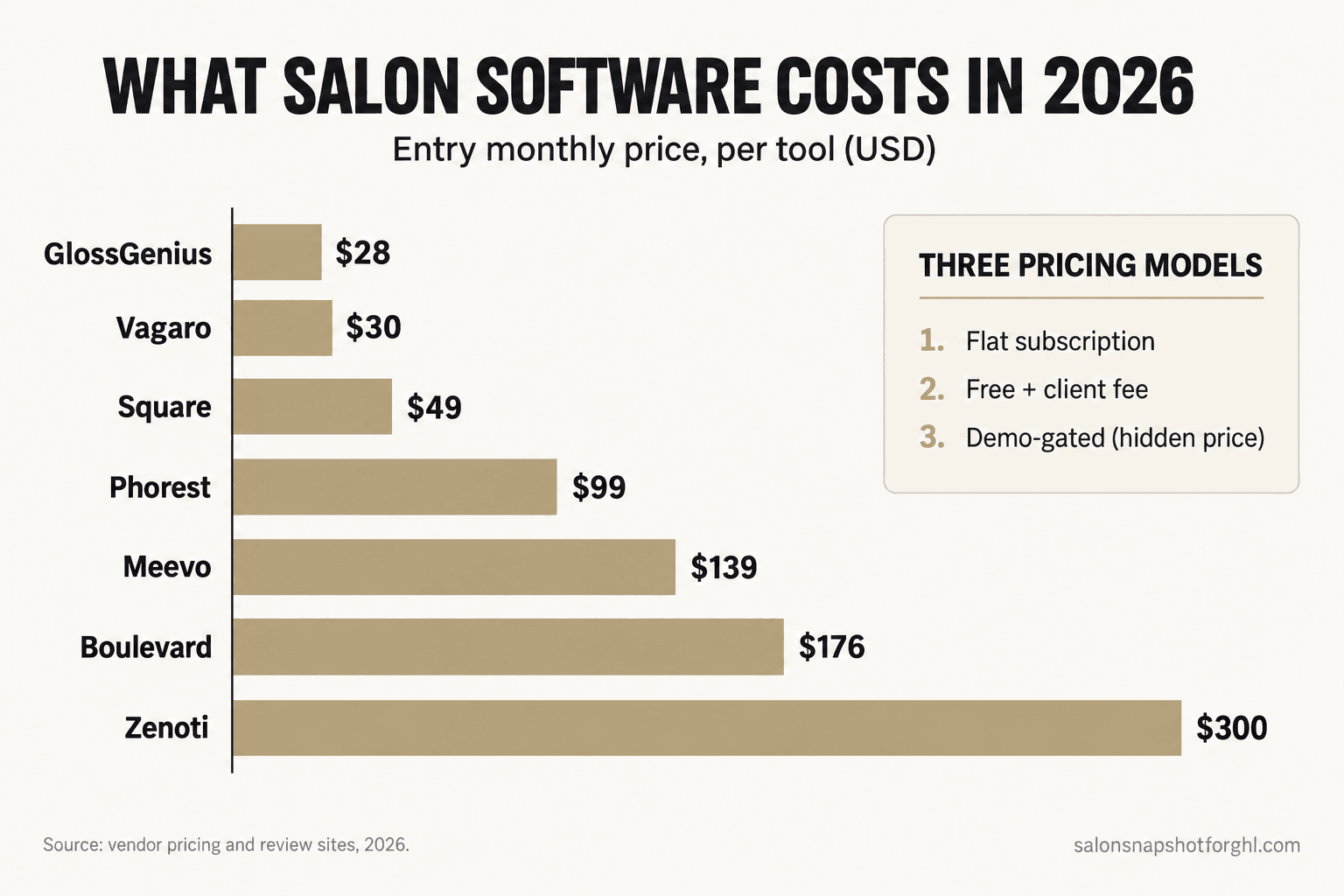
Here is the entry monthly subscription, side by side, so the spread is obvious.
Entry monthly subscription in USD, 2026. Asterisked bars (Phorest, Meevo, Zenoti) are reported starting figures from review sites, since those vendors do not publish prices.
The demo-gated tools, and what people actually pay
Two of the biggest names refuse to publish a price, which usually means the number is high enough that a public list would scare off small shops. Here is what real users and review sites report.
Phorest is quote-based, with no public tier. SelectHub lists a start around $99 a month, and reviewers on GetApp mention figures closer to $85 for a single operator, with add-ons on top. A capable mid-market tool, but you cannot know your price without the demo, which is the whole point of this article.
Zenoti aims higher. Capterra lists a start around $300 a month, and review sites report real-world spend of $300 to $600 per location once features, SMS and integrations are counted. It is enterprise software for multi-location groups. Run one five-chair shop and the quote will tell you that you are not the customer.
The fees the demo skips
Every one of these tools breaks the same way: the subscription is the small number, and the real cost lives in fees that never make the headline.
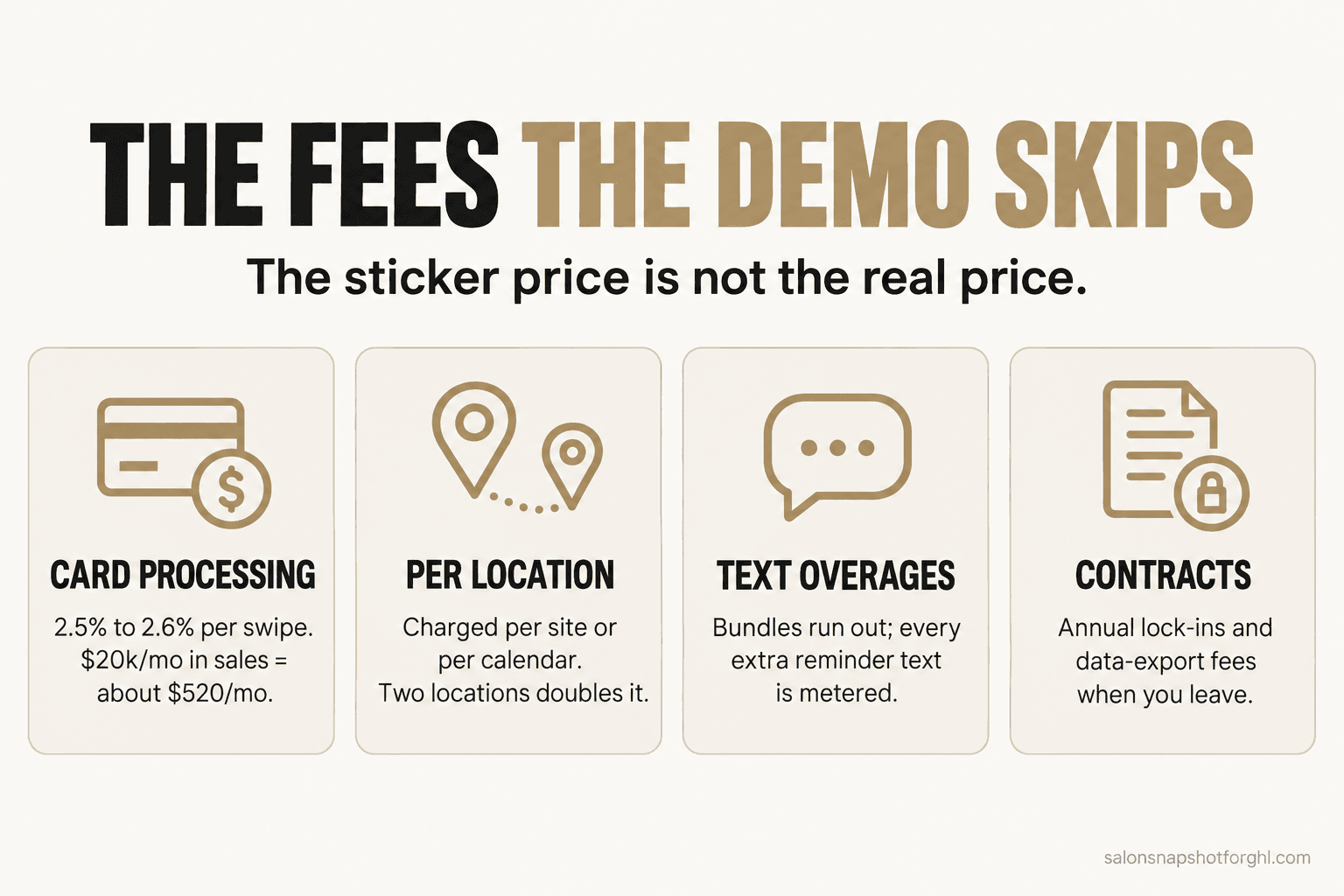
Card processing is usually your biggest software-adjacent cost. At a blended 2.5% to 2.6%, a salon running $20,000 a month in card sales pays $500 to $520 in processing, more than the priciest Boulevard tier. Compare processing rates as hard as the monthly fee, because on volume the rate wins. Here is the in-person spread.
In-person card processing rate (percent), 2026, before fixed per-transaction cents.
Per-location and per-calendar charges are how a “$30 tool” becomes a $300 bill. Vagaro charges per bookable calendar; Square’s paid tiers and every Boulevard tier are per location. Two locations on Boulevard Premier is $586, not $293. Read the word “per” before the number.
Text and email overages. Most tools bundle a text allowance and then meter you. A salon that texts every reminder and rebooking prompt blows through a bundle fast, and the overage is a real invoice.
Onboarding, migration and data. Enterprise tools sometimes charge onboarding or migration fees, and getting your client list back out is not always free. Ask, in writing, what it costs to import your data and what happens if you leave.
Contract length. The transparent tools are month-to-month; the demo-gated ones are likelier to want an annual commitment. A twelve-month contract on a tool you outgrow in three is a real cost.
Three real cost scenarios: solo, five chairs, twelve chairs
The “best value” answer genuinely changes with your size. Run your own numbers, but here is the shape of it.
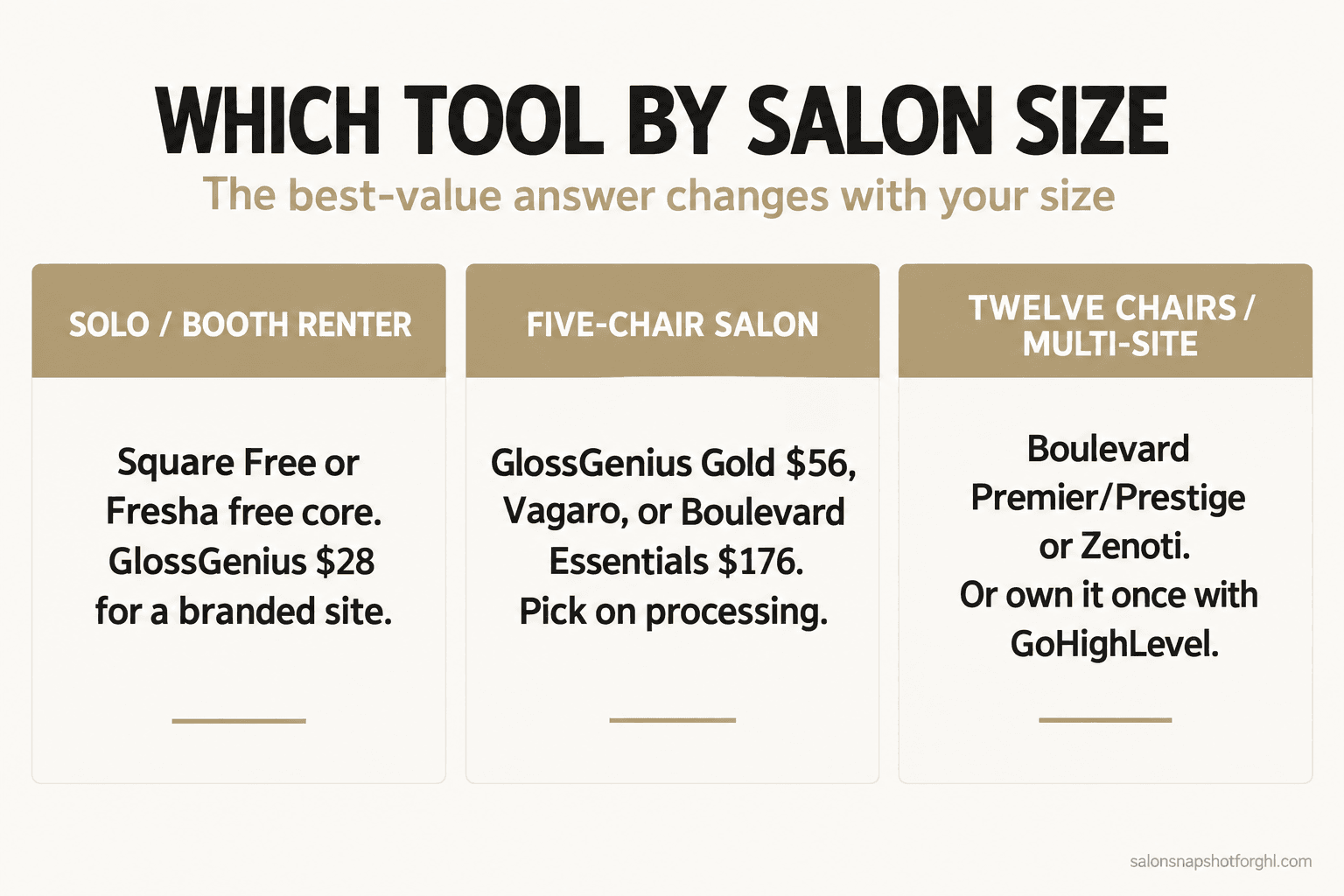
The solo booth renter or suite operator. One chair, you own your clients, no front desk. Your cheapest honest path is Square Appointments Free (pay only processing) or Fresha’s free core if you skip the marketplace, with GlossGenius Standard at $28 worth it the moment you want a branded booking site. Do not pay for Boulevard or Zenoti; you would buy a front desk you do not have. About 48% of US hairdressers, hairstylists and cosmetologists are self-employed per the BLS Occupational Outlook Handbook, so this is the most common salon “business” in the country and should almost never pay enterprise prices.
The five-chair commission or booth-rent salon. You need staff calendars, reminders and rebooking: GlossGenius Gold ($56), Vagaro at a few calendars, or Boulevard Essentials ($176). The deciding factor is card volume and texts, not the subscription. At $30,000 a month in card sales, your processing (about $750 to $780) matters ten times more than the gap between a $56 and a $176 plan.
The twelve-chair or multi-location group. Now per-location pricing bites and the demo-gated tools enter honestly, because you are buying real front-desk operations and multi-site control. Two locations on Boulevard Premier is about $586 a month before processing; add texts and add-ons and you budget $700-plus. This is the size where owning your automation, rather than renting per seat forever, looks very different on a three-year view.
The legal fine print on fees and texts
Two areas quietly decide whether your money-saving setup is also a legal one. None of this is legal advice, and you should confirm your own situation with a professional, but here is what an owner needs to keep on the radar.
Card-on-file and no-show fees are generally lawful, with consent and clear disclosure. You can hold a card and charge a documented cancellation or no-show fee, but the client must agree to the policy in advance and see it plainly at booking. Buried terms are where chargebacks come from. Write the policy, show it before the card is entered, and keep the record.
Reminder and marketing texts fall under the TCPA and A2P 10DLC. Business texting in the US now runs through carrier registration (10DLC) with consent rules under the FCC’s TCPA framework. Get explicit opt-in, honor STOP instantly, and register your texting properly in whatever tool you use. Email blasts follow CAN-SPAM.
If you rent chairs in California, classification is its own minefield. Licensed barbers and cosmetologists are generally tested under the older Borello standard, not the stricter ABC test (Labor Code section 2775 and following), and the state extended the manicurist exemption through the end of 2028. Check the California Department of Industrial Relations, because getting booth-rent classification wrong costs far more than any software bill.
Steal this: the demo questions and client scripts
Two things save you real money: knowing what to ask on a demo so the price stops being a mystery, and having the client-facing copy ready so your fee policy holds up. Take these word for word.
The seven questions that force a real number out of a demo:
- “Total monthly price for my locations and staff, in writing?”
- “Card processing rate, in person and online, plus any fixed per-transaction fee?”
- “How many texts and emails are included, and what does each cost above that?”
- “Any onboarding, setup or data-migration fee, one time or recurring?”
- “Is there a contract, what term, and what is early-termination?”
- “If I leave, can I export my full client list and history, in what format, at what cost?”
- “Which features in this demo are add-ons not in the price you just quoted?”
The card-on-file and cancellation policy line (show this at booking, before the card field):
“To hold your appointment we keep a card on file. Cancellations within 24 hours or no-shows are charged [50%] of the service. By booking, you agree to this policy. Questions? Reply or call us.”
The 24-hour reminder text (opt-in only, include your STOP language):
“Hi [Name], this is [Salon] reminding you of your [service] with [Stylist] tomorrow at [time]. Reply C to confirm or R to reschedule. Reply STOP to opt out.”
The same-day no-show recovery text (fires when a slot opens):
“Hi [Name], a [time] spot with [Stylist] just opened today. Want it? Reply YES and it’s yours. First to reply gets it.”
For the mechanics behind those messages, our guides on stopping salon no-shows and the six-week rebooking rhythm cover the timing and failure modes.
Objections
“Isn’t the free tool (Fresha) just cheapest, full stop?” Only if you never use the marketplace. Fresha’s free software plus a 20% one-time fee on marketplace-sourced new clients can beat or lose to a $28 flat plan depending on how many new faces come through the marketplace. For an established book, free core plus processing is hard to beat. For a shop leaning on discovery, do the 20% math first.
“I already pay for Vagaro (or Square). Is switching worth it?” Usually not for the subscription difference alone; the gap between a $30 and a $56 plan is a rounding error next to your processing bill. Switch only for a real reason: no-shows you cannot control, rebooking you cannot automate, texts that do not land, or per-location seats you do not use. Weigh it with our build-versus-buy breakdown first, because migration is the risky part, not the price.
“Do I need to be technical to run any of this?” No. The transparent tools are built for owner-operators and set up in an afternoon; the demo-gated ones lean on an onboarding team you are partly paying for. Technical help only earns its keep on the owned-automation route in GoHighLevel, where a done-for-you setup replaces the DIY build. (That link is our GoHighLevel partner link, and we may earn a commission if you sign up.)
“Where does a GoHighLevel system fit against these?” It is a different category. GlossGenius and Square are booking-first tools you rent monthly, forever. A GoHighLevel automation system like ours is a one-time setup that owns your booking, reminders, no-show recovery and reviews as workflows you keep. It is not a drop-in for a stylist who just wants a calendar today. It is the better math for an owner who has priced three years of per-chair subscriptions and did not love the number.
FAQ
How much does salon booking software cost per month in 2026?
Flat-subscription tools run about $28 to $410 a month depending on the tool and your size, plus 2.3% to 2.65% card processing. Fresha's software is free but takes a 20% one-time fee on marketplace new clients. Phorest and Zenoti are demo-gated, reportedly starting near $99 and $300.
What is the cheapest salon software?
For a solo stylist, Square Appointments Free and Fresha's free core are cheapest, since you pay only processing. GlossGenius Standard at $28 is the cheapest paid plan with a branded booking site. On volume, the processing rate matters more than the subscription.
Why won't Phorest and Zenoti show their prices?
Both are quote-based, so you only get a number after a sales call. Reported figures start around $99 for Phorest and $300 per location for Zenoti, climbing with locations and add-ons. Hidden pricing usually signals enterprise software for multi-location groups, not solo operators.
Do card processing fees cost more than the subscription?
Often, yes. At a blended 2.5% to 2.6%, a salon doing $20,000 a month in card sales pays $500 to $520 in processing, more than the priciest Boulevard tier. Weigh the rate as heavily as the monthly fee.
Are no-show fees and card-on-file charges legal for salons?
Generally yes, when the client agrees to the policy in advance and sees it clearly at booking. Keep the disclosure visible before the card is entered and keep a record of consent. Reminder texts are separately governed by TCPA and A2P 10DLC. This is not legal advice; confirm your own situation.
Is a GoHighLevel system cheaper than salon booking software?
It is a different model. Booking tools are rented monthly forever; a GoHighLevel system is a one-time setup you own, covering booking, reminders, no-show recovery and reviews. Over three years, especially for multi-chair salons paying per seat, owning it once often costs less.
The Tuesday demo, revisited
Back to that half-full shop and the rep who would not give you a number. Now you can end that call in ninety seconds. You know the three price shapes, the published tools ($28 to $410), the free-but-not-free one (20% on new clients), and the two that hide behind a demo ($99 and $300 to start). You know the processing rate decides your bill, not the subscription. And you know the seven questions that turn “it depends” into a real quote.
Pick on your size and your card volume, not the sticker. And if you have run the three-year math on renting per chair forever and did not like it, price out owning your automation once instead.
Sources
- GlossGenius: Capterra, Pabau
- Boulevard: Capterra, The Salon Business
- Vagaro: Pro pricing, Daily Deals note
- Square Appointments: Koalendar
- Fresha: Pabau, BeeViral
- Phorest: SelectHub, GetApp; Zenoti: Capterra
- BLS Occupational Outlook Handbook: Barbers, Hairstylists, and Cosmetologists
- FCC TCPA, FTC CAN-SPAM, California DIR contractor FAQ