It is a normal Thursday when your best stylist asks for a word in the back. You know before she says it. She has found a suite two miles away, and she is leaving in two weeks. Then you get home, open the calendar, and count: her Fridays are booked six weeks out, half her clients have been with her longer than with you, and every one of them has her personal cell. It feels like watching money walk out the door with a person you actually like.
Here is the answer first. You cannot stop a stylist from leaving, and in most of the country you cannot stop them from telling clients where they went. What you can do is make the client’s relationship belong to your shop, not just to one chair, so the clients stay bookable when a chair empties. That is built before anyone gives notice: shop-owned booking, a client list only you control, retention that runs on the brand, and clean paperwork underneath it. Do that, and a resignation becomes a staffing problem you solve in a week, not a slow bleed you feel for a year.
Key takeaways (the TL;DR)
- Nobody owns the client. But you can own the relationship infrastructure, the booking page, the number, the reminders, so the client keeps coming to your address.
- Do the work before the resignation. Every fix here is cheap in a calm week and impossible in the two weeks after notice.
- Keep one copy of the client list that is yours, in a system where you, the owner, control the export. Not on a stylist’s personal phone.
- Paperwork sets the floor. A non-solicitation clause deters and gives a remedy; the federal non-compete rule is gone, so state law is what counts now.
- When it happens, move in 72 hours: secure the data, lock the accounts, re-match the clients, send the win-back before the new suite’s opening text does.
Table of contents
- What losing a stylist actually costs you
- The system, in six parts
- Part 1: Make the relationship the shop’s
- Part 2: Get the paperwork right
- Part 3: Own the client data in one place
- Part 4: Build retention that survives one exit
- Part 5: Read the warning signs early
- Part 6: The 72-hour response
- Steal this copy
- Three shops, three versions
- The legal fine print
- Objections
- FAQ
What losing a stylist actually costs you
This hurts more in hair than in almost any other business, because it is a trade of individual relationships at scale. Hairdressers, hairstylists and cosmetologists held about 595,000 jobs in 2025 and barbers another 75,800, and the Bureau of Labor Statistics notes many work in salons where some lease booth space. Booth rent, commission, suite: the arrangement differs, but the client bonds with the person holding the scissors, not the sign on the door. That bond is the product, and it walks out.
Median pay is about $18.37 an hour for barbers and $17.21 for hairdressers and cosmetologists as of May 2025, per the BLS, with the top ten percent over $34.23. A senior stylist earns the high end because they carry a full, loyal column. Lose them and you lose the highest-value book in the shop plus the cost of hiring a replacement.
US jobs by role, 2025. Source: BLS Occupational Outlook Handbook. A trade this large runs on individual relationships, which is why one departure moves real money.
The churn is structural: employment is projected to grow about 7 percent from 2025 to 2035, per the BLS, which means plenty of new suites competing for your stylists. Your job is not to end it; it is to stop letting every exit take your clients along.
The system, in six parts
Most owners treat this as an emergency to handle when it lands, by which point they are negotiating from zero. The shops that keep their clients treat it as infrastructure built in advance: shop-owned relationships, paperwork, one data system, and automated retention. The first four parts below are all pre-work; the last two are what you do when notice actually lands.
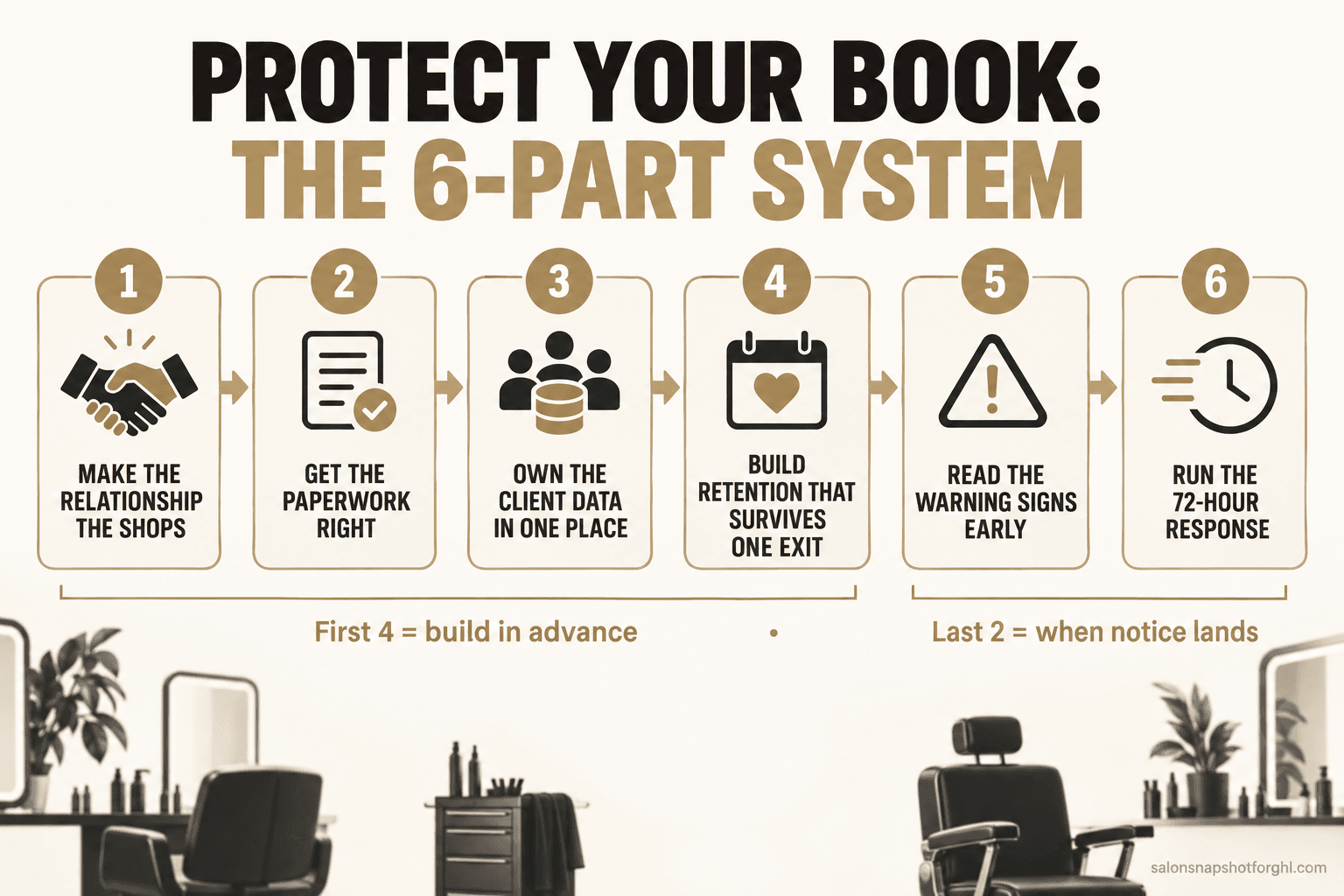
Part 1: Make the relationship the shop’s
The change with the most impact is where the client thinks they are booking. If every touchpoint routes through one stylist’s personal phone and Instagram, the client is theirs; if it routes through the shop, the client is bonded to both, and the shop keeps a claim when the stylist leaves.
Set it up. One shop booking page where clients pick their stylist, instead of DMing a personal account. One shop business number for reminders and rebooking prompts, so a reschedule text lands in a shop inbox, not a personal thread that leaves with the person. Confirmations that say the salon’s name first (“Your appointment at [Salon] with Maria”). And reviews that go to the salon’s Google Business Profile, an asset you keep.
How it breaks. The classic failure is the “personal client” carve-out, where a stylist books long-timers off-platform “to save the fee” and the shop never sees those bookings. Those are exactly the clients you lose, because you have no record they exist. Make on-platform booking the rule for everyone, owner included.
Part 2: Get the paperwork right
Paperwork will not physically stop a departing stylist. It deters casual poaching and gives you a remedy if someone crosses a line. Put it in place at hire; you cannot bolt it on the day someone quits.
The big change: the federal non-compete rule was formally removed from the books in 2026 after courts blocked it, so there is no national ban and enforceability comes down to your state. As Foley & Lardner’s 2026 overview lays out, some states (California among them) void most non-competes outright, while others enforce narrow ones. Do not copy a template off the internet and assume it holds.
Focus on the tool that travels better: a non-solicitation clause. As Salon Today explains, a non-solicit does not stop someone from working down the street; it restricts them from actively soliciting your clients and staff for a reasonable period, and courts treat that far more kindly than a blanket ban on earning a living.
How it breaks. Either you use a scary non-compete your state will not enforce, or you have solid paperwork but undercut it by letting the list live on personal devices, so a judge sees you never treated it as confidential. Have a local attorney draft the version that fits your state and your worker classifications, a tangle covered in booth rent vs commission vs W-2.
Part 3: Own the client data in one place
If your client data is scattered, a resignation is a data-loss event. If it lives in one system you control, a resignation is just a name change on some appointments.
Set it up. Consolidate into a single CRM with workflow automation the owner administers: contacts, visit history, color formulas, notes, and tags for who is due and who has lapsed. The non-negotiable is that you hold the admin account and the export; stylists get only the access they need. Run one drill: can you log in right now and export a complete client file? If the answer is “I’d have to ask Maria,” you do not own your data, Maria does. The mechanics of a clean, portable file are the same as in switching booking software without losing your client list.
How it breaks. Three holes: formulas living only in a stylist’s head, a shared login you cannot lock one person out of cleanly, and no backup, so a disgruntled stylist deleting clients leaves no copy. A weekly automatic export to a place only you control closes all three.
Part 4: Build retention that survives one exit
Here is the uncomfortable truth: if your rebooking depends on one charismatic stylist remembering to say “see you in six weeks,” then that stylist is your retention, and it leaves when they do.
Set it up. Automate the rhythm so it belongs to the salon: rebooking prompts on each client’s cycle, sent from the shop, so a client who has not booked gets a nudge whether or not their stylist thought to ask (the full cadence is in the six-week rebooking rhythm); lapsed-client win-backs that fire when a regular goes quiet; and a review engine that builds the salon’s reputation after every visit.
When the shop keeps clients on cadence, a departing stylist takes their skills but not the machine that fills the chair.
Part 5: Read the warning signs early
Almost nobody quits without a run-up, and a few weeks of warning is the difference between reacting and being ready. Watch the quiet tells: a stylist blocking out large chunks of “personal” calendar time, asking newly specific questions about their client counts and whether they can export “their” contacts, or drifting off-platform so clients say “oh, she just texts me directly now.” And watch the obvious one: a competitor suite complex opening nearby with a “stylists wanted” banner.
Set it up. No surveillance needed, just a monthly glance at data you already own. Pull per-stylist booking volume and note anyone trending down for no seasonal reason, or anyone who stopped using the shop booking flow. Keep the relationship warm enough that a stylist thinking about leaving talks to you first. If you notice the tells, have the honest conversation early; even if you do not change their mind, you buy the weeks that make Part 6 work.
Part 6: The 72-hour response
Notice has been given. The clock starts now, and the first three days largely decide how many clients you keep. Move in order and skip nothing.
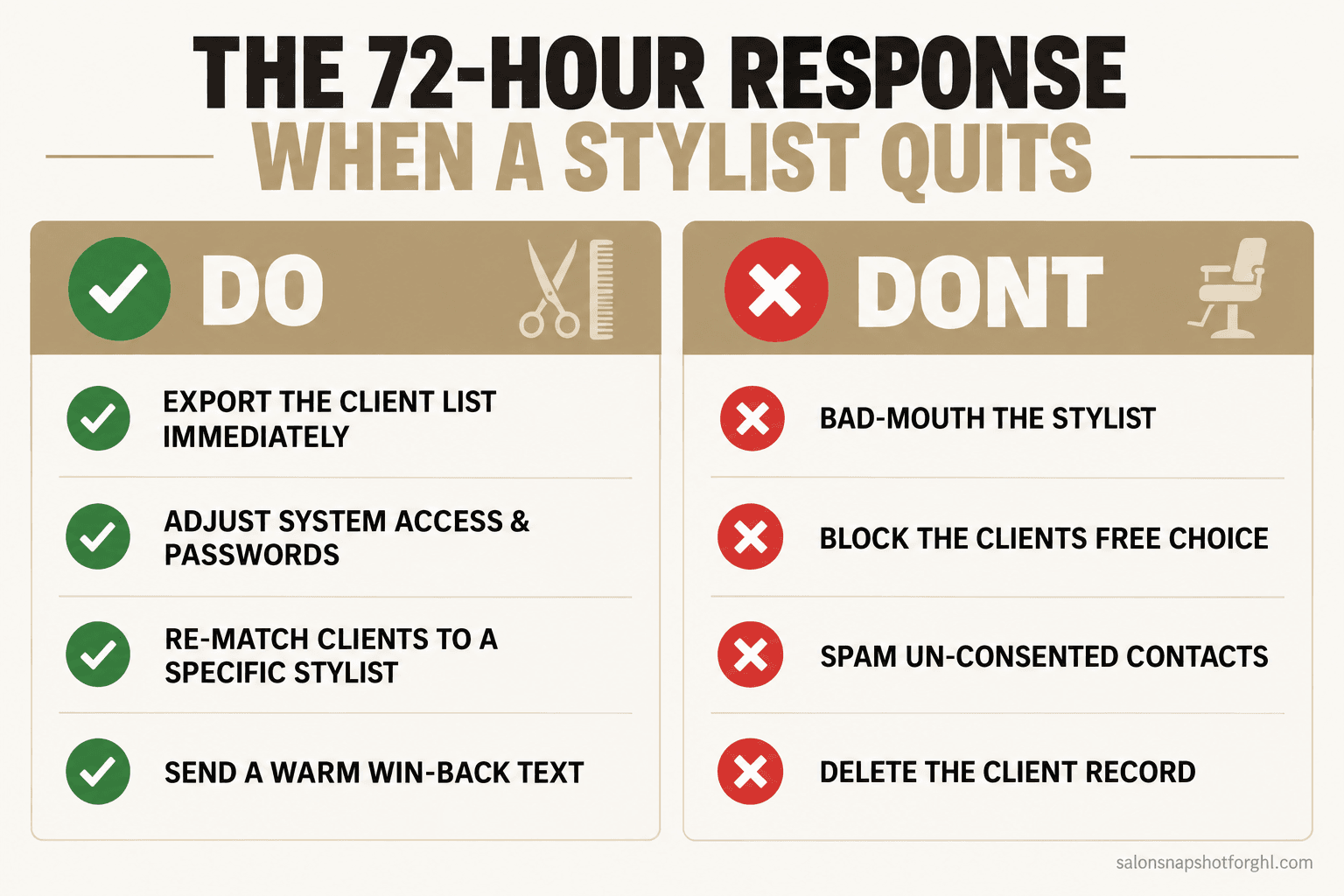
Hour 0 to 24: secure the data and accounts. Export a full, current client file the moment you can. Move the departing stylist to the access they need to finish their notice and no more, removing admin rights, shared-login access and bulk-export, calmly, as operational hygiene. Change passwords on shop social and the Google Business Profile if that stylist had them.
Hour 24 to 48: plan coverage and the message. Re-match clients to remaining stylists on service and vibe, not just open slots: a client handed to “our other balayage specialist who I think you’ll love” feels cared for, not processed. Brief your team before any client hears anything.
Hour 48 to 72: reach the clients first. Send the win-back (copy below) from the shop, warmly and once, before the new suite’s opening blast lands. You are reminding a client their salon still knows them and has a chair ready.
How it breaks. The two mistakes are cold (clients discover the change at an empty chair and follow the stylist who did text them) and petty (bad-mouthing the departing stylist makes you look small and the client defensive of someone they like).
Steal this copy
Word these carefully. You may not lie, and never tell a client they cannot see the stylist they choose. Never text anyone who has not opted in, per SMS compliance for salons.
The client win-back text, from the shop, to that stylist’s clients:
“Hi [Name], it’s [Salon]. We wanted you to hear from us: Maria has moved on, and we’ve saved your color notes and history. We’d love to keep you in the chair. [Stylist] does beautiful balayage and has a spot for you here: [booking link]. Reply STOP to opt out.”
The warmer re-match version, when you have a specific stylist in mind:
“Hi [Name], [Salon] here. With Maria’s move, I personally picked [Stylist] to take care of you, she trained on the same techniques and knows your history. First visit’s on us for the change. Book here: [link].”
The front-desk phone script for the confused caller:
“Hi! Yes, Maria’s no longer with us, but everything about your visits is saved here, your color formula, your notes, all of it. I can book you with [Stylist] this week, she’s wonderful and already has your history. Want me to text you the confirmation?”
Three shops, three versions
The six parts are the same everywhere. What changes is who is leaving.
The solo owner losing a booth renter. A booth renter is closer to an independent business, so your paperwork claim is thinner and the clients they brought may genuinely be theirs. Your protection is Part 1 and Part 3: any client who booked through your shop page and number is one you can win back, so make shop-owned booking a condition of the rental from day one (the classification underneath is in booth rent vs commission vs W-2).
The five-chair commission salon losing a mid-level stylist. The sweet spot for the full system. These are usually W-2 employees, so a reasonable non-solicit is more likely to hold, and you own the booking, data and retention machine. Run the 72-hour response cleanly and re-match every client to a specific teammate, and you keep most of the book.
The twelve-chair or multi-location shop losing a senior stylist. Higher stakes. A senior stylist may carry a hundred-plus regulars and influence over junior staff, so watch Part 2 (are they recruiting your team too?) and Part 5 hardest. Assign one manager to own the response, re-match clients in batches by service type, and lean on automation to hold the wider book steady while you backfill.
The legal fine print
None of this is legal advice; confirm anything specific with a qualified attorney in your state. There is no federal non-compete ban anymore, so enforceability is state by state, and several states bar most restrictions entirely. A former employee is generally free to compete, and even to say where they went; a well-drafted non-solicitation restricts active solicitation of your clients and staff, for a reasonable time and scope. Your client list is protectable mainly when you have actually treated it as confidential. And every win-back text lives under the TCPA and carrier rules: send to opted-in contacts, identify your salon, honor STOP.
Objections
“Can’t I just make everyone sign a non-compete and be done?” No, and it can backfire. With the federal rule gone, an overbroad non-compete in the wrong state is void. A narrow, reasonable non-solicitation drafted for your state and worker types is the stronger tool.
“Isn’t it slimy to text a client after their stylist leaves?” Not if you do it right. You are contacting your own opted-in clients to tell them their history is safe and they still have a chair. That is service, not poaching. It only crosses a line if you lie or text people who never consented.
“My stylist already has all their clients’ numbers. Haven’t I lost?” Not necessarily. They may have the numbers, but if the clients book through your page, get reminders from your number, and see your brand every visit, the relationship is shared, not stolen. Plenty stay with the shop they know. If you would rather have the whole system installed for you, a done-for-you GoHighLevel setup handles booking, data ownership and automations in one place. (That is our GoHighLevel partner link, and we may earn a commission.)
FAQ
Can a stylist legally take clients when they leave my salon?
In most states, yes: a departing stylist can generally compete and tell clients where they moved. A well-drafted non-solicitation agreement can restrict their active solicitation of your clients and staff for a reasonable period. The federal non-compete rule was removed in 2026, so enforceability is decided by your state's law. This is general information, not legal advice.
Who owns the salon client list, the shop or the stylist?
Nobody owns the people. You can own the relationship infrastructure: the booking page, the business number, the CRM and the review profile. Whether the list itself is a protectable trade secret depends on your state and on whether you actually treated it as confidential, with controlled access and no copies on personal phones.
What should I do in the first 24 hours after a stylist gives notice?
Export a full, current client file immediately so you have your own copy. Then reduce the stylist's access to what they need to finish their notice, remove admin and bulk-export rights, and change passwords on shop social and Google Business Profile if they had them. Do it calmly, as routine operational hygiene.
How do I win back clients after a stylist leaves without looking petty?
Contact your opted-in clients once, from the shop: their history is saved, and you have matched them to a specific stylist you think they'll love. Never bad-mouth the departing stylist and never claim a client can't see who they choose. Warm and fast keeps clients; slow and bitter loses them.
Are appointment reminder and win-back texts from my salon legal?
They are when you follow the rules: text only clients who opted in, identify your salon, register for A2P 10DLC, and honor STOP promptly. Keep marketing consent separate from appointment-reminder consent. See our SMS compliance guide for the setup. Not legal advice.
Back to that Thursday
Play it forward with the system in place. Your best stylist still gives notice; you still wish her well. But this time you export the book that afternoon because it is your account, and her clients booked through your page, so you have every one of them. By Friday your team knows the plan, each client is matched to a specific chair, and the warm win-back has gone out from your number. Some clients follow her, and that is life. Most stay, because the salon they trusted still knows them and still has a seat ready.
Nothing about that took luck. It took building the relationship into the shop, not the chair. A stylist can take a job; they cannot take a client who was never only theirs to begin with.
Sources
- BLS Occupational Outlook Handbook: Barbers, Hairstylists, and Cosmetologists (2025 jobs, May 2025 pay, 2025-2035 outlook)
- Foley & Lardner: Noncompete Agreements in 2026, a Federal and State Overview
- Federal Register: Removal of the Non-Compete Rule
- FTC: Noncompete Rule (legal library)
- Salon Today: Non-Solicitation vs. Non-Compete Agreements in the Salon Industry
- FCC: Telemarketing, robocalls and the TCPA