
It is 1:40 on a Tuesday. Two of your four chairs are empty. One stylist is sweeping hair that is already swept, the other is scrolling her phone, and the calendar looks like a ghost town until Thursday. Then you glance at Saturday: fully booked, a waitlist, a client you turned away for a cut she wanted this week. All that demand, three days out of reach of the empty chairs in front of you.
Here is the answer first. A dead midweek is almost never a demand problem. It is a scheduling problem. The clients exist, they are just crowding your three or four popular slots while nobody nudges the flexible ones into the quiet hours. The fix is a six-part system: measure your dead hours, build a waitlist that works, price the slow slots differently, send a same-week flash-fill text, convert regulars into standing appointments, and point new-client offers at the empty chairs. This guide walks through each: how to set it up, the copy, and how it breaks.
Key takeaways (the TL;DR)
- A slow midweek is a scheduling gap, not a demand gap. Demand piles onto the weekend; move the flexible part into Tuesday and Wednesday.
- Measure first. Pull eight weeks of bookings and find your real dead hours before you fix them.
- A waitlist only works if you use it. It must fire automatically the moment a slot frees.
- Price the slow slots, not the whole week. A fenced midweek-only offer moves flexible clients without training your Saturday regulars to wait.
- The durable fix is standing appointments. A recurring six-week slot fills that chair eight times a year with no reminder from you.
- Automated texts are governed by law. The TCPA and A2P 10DLC decide whether your reminders get delivered at all.
Table of contents
- Why your midweek is dead
- What an empty chair costs
- Part 1: Find your dead hours
- Part 2: A waitlist that fires itself
- Part 3: Price the slow slots
- Part 4: The flash-fill text
- Part 5: Standing appointments
- Part 6: Aim new-client offers at dead chairs
- Three scenarios
- The legal fine print
- Objections
- FAQ
Why your midweek is dead
Left alone, clients book what is easiest for them: end of the week, and weekends. Industry write-ups on filling quiet weeks say it repeatedly, that Tuesdays and Wednesdays are the slowest stretch for most beauty businesses while Friday and Saturday overflow (HostMerchant Services, Bookedin). That is not a sign your shop is failing. It is the default gravity of how people plan a week.
The good news buried in that: a slow midweek means the demand is real and close. You already have a book full of people who need a cut every four to six weeks, and a Saturday that turns some away. The whole game is redistribution, steering that flexible demand toward the chairs that sit empty. That is far easier than “nobody wants to come in,” and most of the fix costs nothing but a few automations and a change in how you ask.
What an empty chair costs
An empty midweek slot feels like nothing. But the cost is real, just quiet: that hour cannot be sold tomorrow, it is gone.
Who runs the chair makes it worse. It is a huge occupation, about 651,200 jobs across barbers, hairstylists and cosmetologists in 2024, at a median wage of $35,420 a year per the Bureau of Labor Statistics, and a large share are not salaried staff but booth renters and self-employed operators paying rent whether the chair earns or not. A dead Tuesday is the renter in the back covering rent out of pocket, and you paying for a lit, staffed room that took in nothing.
Say a midweek service averages $65. Here is what walks out the door each week at different levels of empty:
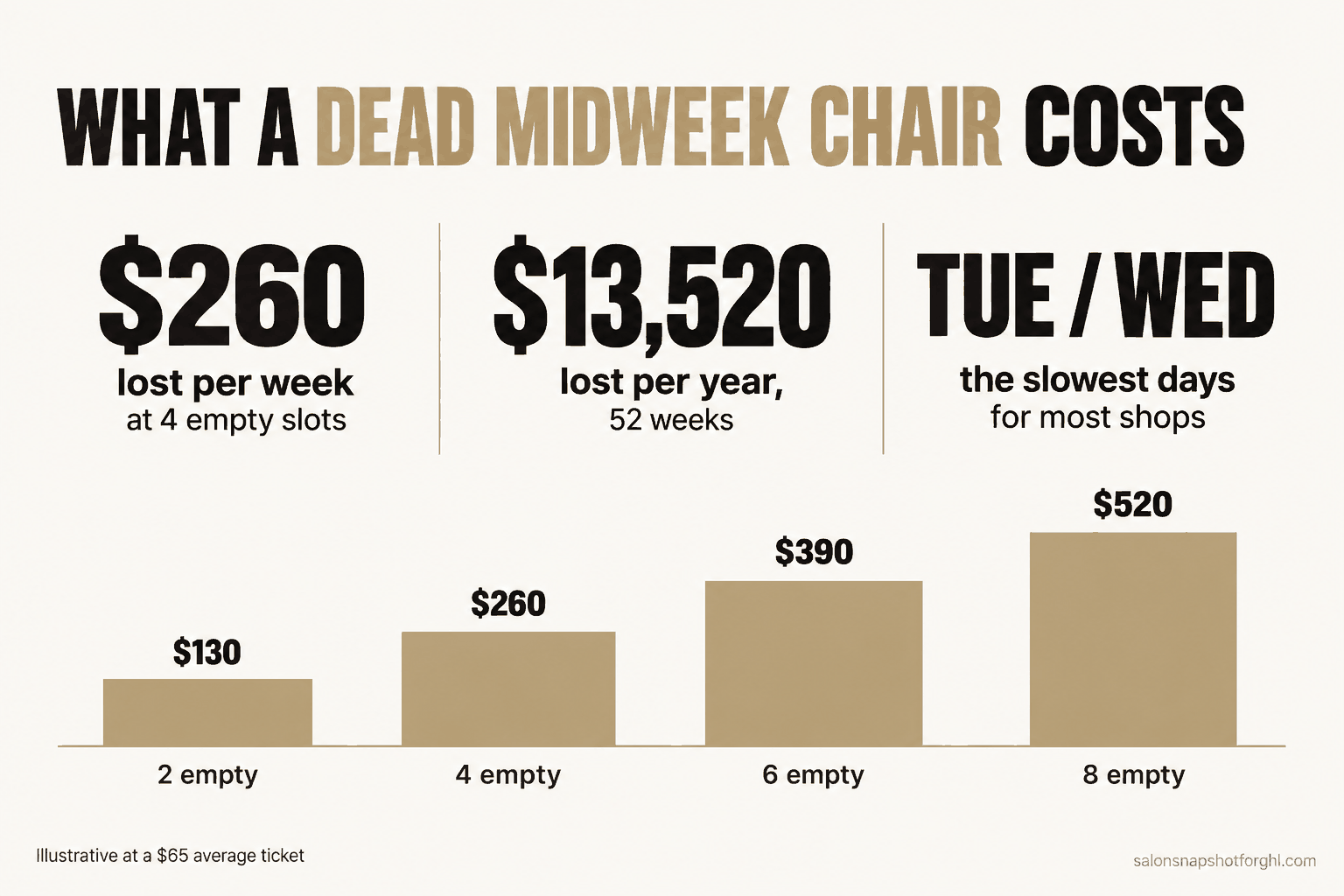
Four empty slots a week at $65 is $260, or $13,520 across a year. The exact figure is not the point, the scale is: small weekly gaps compound, so a system that fills even a few is worth building once.
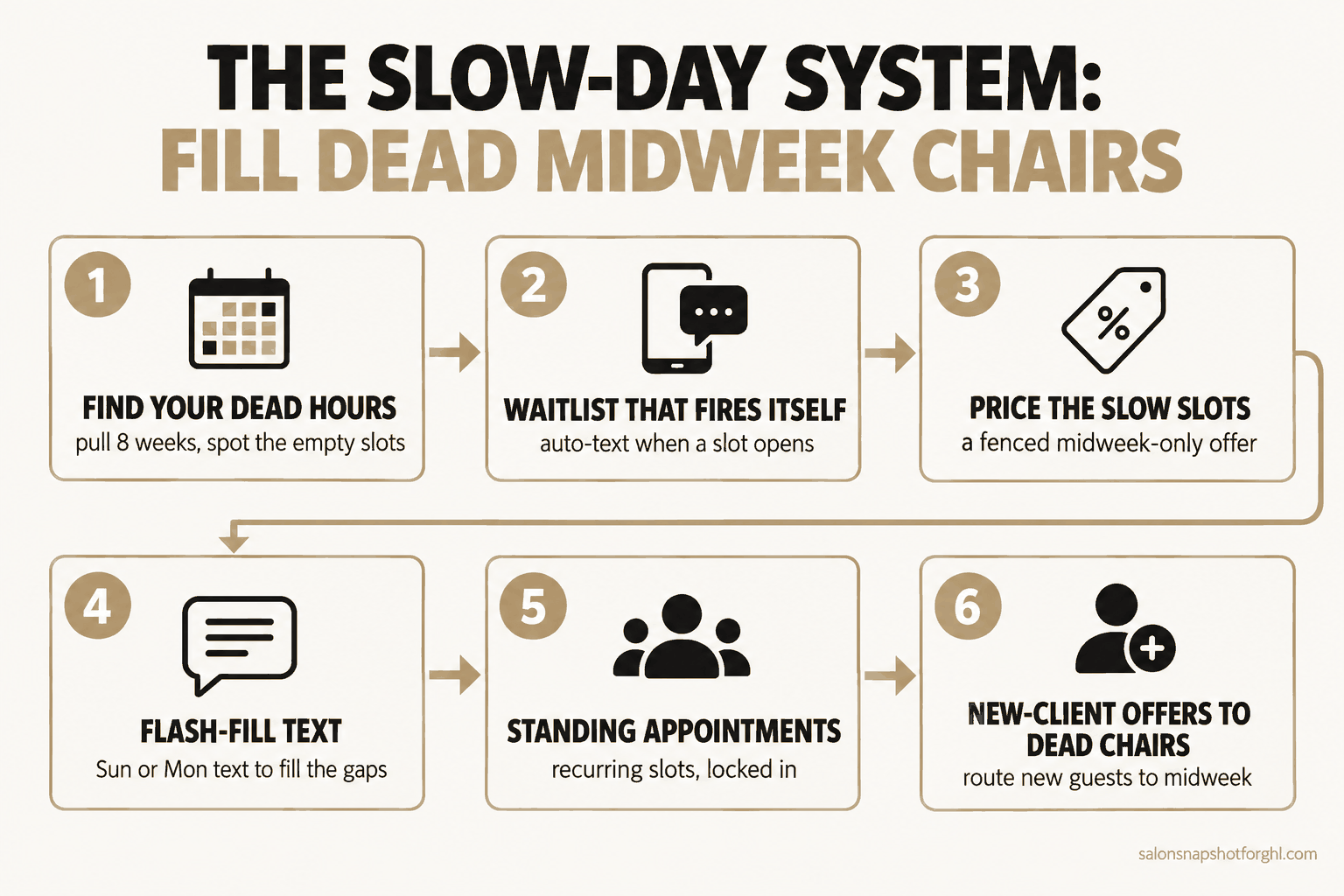
The first two parts are setup, the middle two are your active levers when a week looks thin, and the last two are durable fixes that shrink the problem for good.
Part 1: Find your dead hours
You cannot fix a slow patch you have only felt. Pull the last eight weeks of your calendar and count booked slots by day and hour. For most shops the pattern is Tuesday and Wednesday, late morning to mid-afternoon.
Measure, do not guess, because your dead hours might not be where you assume: a barbershop near offices might be slammed at lunch and dead at 3. Aim offers at the wrong window and you discount slots that would have filled anyway.
Set it up. Export eight weeks, build a grid of days and hours, mark each slot booked or empty, and circle the blocks empty more than half the time. Those are what the system targets.
How it breaks. Staleness and seasonality. A pattern from last quarter drifts, so re-pull every couple of months, and one odd week (a holiday, a flu) can look like a trend. Read the eight-week pattern, not one bad Tuesday.
Part 2: A waitlist that fires itself
Every shop runs a fake waitlist. A client asks for Saturday at 11, it is taken, someone says “I’ll text you if anything opens,” nobody writes it down, and the client books elsewhere. That is a polite goodbye, not a waitlist.
A real waitlist captures the client who missed their first choice, then notifies them automatically the instant a matching slot frees up. When a Wednesday at 1 opens, the system texts the people who wanted a similar time, first to reply gets it, and the chair fills itself.
Set it up. If your booking tool has a native waitlist, turn it on and use it. If not, an appointment automation workflow handles it: a client who hits a full slot is offered the waitlist, tagged with the times they want, and pulled automatically when a gap appears. The message that fires:
“Hi [Name], a spot with [Stylist] just opened for [day] at [time]. You’re first on the list. Reply YES to grab it and it’s yours. Reply STOP to opt out.”
How it breaks. A slow notification lands cold, so it has to fire automatically, not when the desk remembers. And blasting the whole list at once creates a scramble, so offer it in order, give the first person a short window, then move down.
Part 3: Price the slow slots
Owners get this wrong most often, and the fear is legitimate: discount carelessly and you cheapen your brand and train your best clients to wait. The fix is precision: not a sale, but a small incentive attached to the exact slots from Part 1, and nothing else.
A few honest ways: a modest midweek-only rate; a Tuesday-and-Wednesday-only bundle, a cut paired with a treatment at a slight saving, which also nudges clients to try a new service (Bookedin); or a free add-on rather than money off, so the price never drops. The add-on works best, because it fills the chair without teaching anyone your prices are negotiable.
How it breaks. Too deep a discount fills the chair but loses money, so keep it small, the goal is to tip a flexible client, not buy the booking. And do not run it forever, or it becomes your regular price; rotate or cap it.
Part 4: The flash-fill text
The waitlist handles clients who already tried to book. The flash-fill handles everyone else: your existing, opted-in list, texted early in the week. Sunday or Monday, count the holes in Tuesday and Wednesday, and text a slice of your list.
The key word is slice. Do not text your whole database; you will burn out the list. Text only the people who fit the open slots: clients due to rebook, nearby, or who have taken a midweek slot before.
“Hey [Name], we’ve got a couple of openings with [Stylist] this Wed afternoon if you’re due for a trim. Want me to hold one? Reply here or book at [link]. Reply STOP to opt out.”
A lighter version for a barbershop: “[Name], chairs are open Tue and Wed this week if you’re getting shaggy. Grab a slot: [link]. Reply STOP to opt out.”
How it breaks. Overuse is the killer. A flash-fill that goes out every week to the same people becomes spam, so send it only when you genuinely have gaps and honor STOP instantly. Timing matters too: text Tuesday morning for a Tuesday afternoon and people already have plans. Sunday or Monday gives them room to say yes.
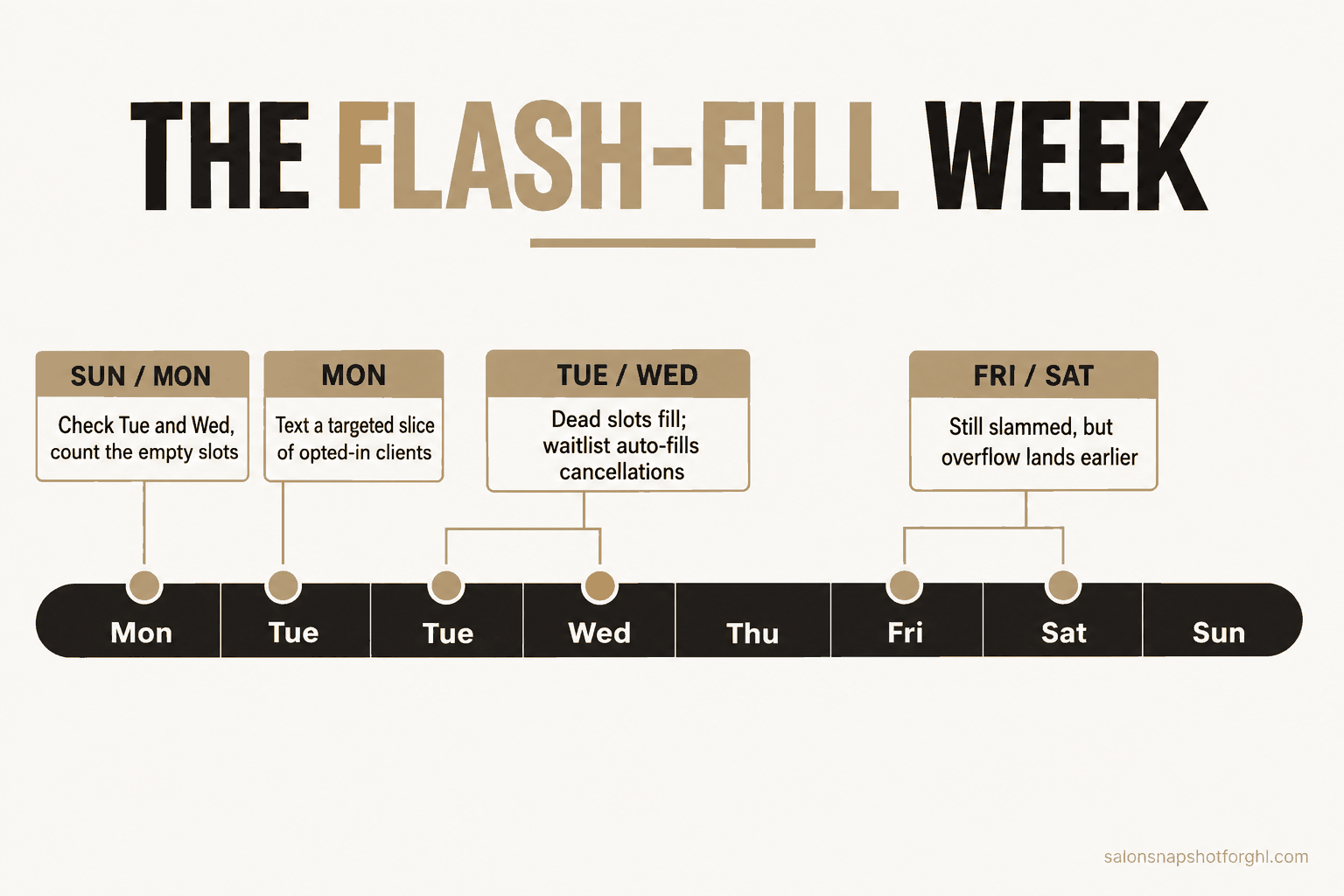
The result compounds week over week: fewer empty midweek slots, and a weekend overflow that finally has somewhere earlier to land.
Part 5: Standing appointments
Everything above is active work. Standing appointments are the durable fix that shrinks the problem itself: a regular booked into the same recurring slot every visit, your 1pm-every-third-Tuesday client, locked in for the year. Rebooking a client while they are still in the chair is the most dependable way to fill your next visit (Koalendar), and a standing slot is that on repeat.
The math is why it works: one client on a recurring six-week slot fills that chair eight or nine times a year, automatically. Convert ten flexible regulars and you have a backbone of guaranteed midweek bookings.
Illustrative annual value of standing clients on a six-week cadence (8-9 visits a year) at a $65 ticket. Your numbers will vary.
Set it up. The ask happens at the chair, at checkout, while the client is happy: “You’re on a six-week rhythm, want me to lock in your 1 o’clock Tuesdays so you never fight for a Saturday?” Frame the standing slot as the perk, and a light membership can formalize it. For the cadence behind this, our six-week rebooking rhythm goes deep.
How it breaks. Standing clients cancel, so you still need the waitlist and flash-fill to backfill. And an unconfirmed slot drifts into a no-show, so keep your reminder sequence running on them; our guide on stopping salon no-shows covers the timing.
Part 6: Aim new-client offers at dead chairs
Most shops run a new-client offer. The mistake is letting new clients book it into any slot, so your best acquisition tool fills your Saturday. Flip it. Make the offer redeemable only in your midweek dead block: that routes fresh demand into the empty chairs and protects your peak for full-price regulars. A lot of that flow comes through social, so bake the offer and its midweek terms into how you reply to a booking DM; our post on turning Instagram DMs into bookings covers the handoff.
Set it up. State the terms plainly wherever the offer lives: “New guests, [perk] on your first visit, Tuesday and Wednesday appointments.” Wire the booking so the offer link only exposes midweek availability. If someone asks for a Saturday, they are welcome, at the regular rate.
How it breaks. Fuzzy terms create friction when a new client shows up Saturday expecting the deal, so put the midweek condition in writing everywhere. And pair every offer with the standing-appointment ask in Part 5, or first visits become one-time bargains, not regulars.
Three scenarios: solo, five, twelve chairs
The system is the same, but which parts carry the weight changes with your size.
The solo booth renter or suite operator. You are the calendar, so the heavy machinery is overkill, but the empty hour hits you hardest because you pay rent on it directly. Your highest-impact parts are 1, 4 and 5: know your dead hours cold, personally flash-fill the handful of clients who fit, and push hard on standing appointments, because ten standing regulars can nearly fill your quiet block alone.
The five-chair commission or booth-rent salon. The manual approach falls apart, because you cannot track waitlists and flash-fills across five columns while running the floor. This is where automation earns its keep: a waitlist that fires itself, a Monday flash-fill targeted per stylist, and standing appointments tracked per chair. Fence the pricing offer tightly, because a discount on the wrong slot times five stylists is real money.
The twelve-chair or multi-stylist shop. Here a dead midweek is a staffing and data problem too. You have the volume to see patterns per stylist, so segment: if senior colorists are booked solid midweek and newer stylists have the gaps, route your flash-fill and new-client offers to the stylists with room. This is also the size where owning your booking and automation as one system, rather than renting per-seat tools that meter every text, changes the economics; our salon software cost breakdown runs those numbers.
The legal fine print
Two of the six parts, the flash-fill and the waitlist notification, send automated messages, which puts you inside rules you cannot ignore. None of this is legal advice; confirm your situation with a professional.
Business texting runs through the TCPA and A2P 10DLC. Since carriers began full enforcement, essentially all business text traffic from a standard number must be registered through A2P 10DLC or it does not get delivered (MessageDesk). The FCC’s TCPA framework also requires clear consent, so capture opt-in at booking, keep marketing consent separate from reminder consent, and honor STOP instantly. Our SMS compliance guide for salons walks the registration path, and the SMS automation module is built to keep you inside it. Email blasts follow the FTC’s CAN-SPAM rules: a working unsubscribe and your physical address in the footer.
Offer terms and card-on-file. If an offer or membership involves a card on file or a no-show charge, the client must agree to the terms in advance and see them clearly at booking; buried terms cause chargebacks. If you rent chairs in California, worker classification under the state’s Borello test is its own separate minefield, one we cover in classifying every chair in your salon.
Objections
“Won’t discounting my slow slots cheapen my brand and train people to wait?” Only if you do it lazily. You are attaching a small, fenced incentive to specific dead slots, or a free add-on that never touches your price. Your Saturday regulars never see it, so they never learn to wait.
“Do I need to be technical to run this?” No. Parts 1, 3, 5 and 6 are decisions and scripts, not software. The automation only earns its keep on Parts 2 and 4 once you have more than a couple of chairs. If you would rather own that automation once instead of renting per seat, a done-for-you GoHighLevel setup handles the waitlist and flash-fill workflows. (That is our GoHighLevel partner link, and we may earn a commission.)
“What if my midweek is dead for lack of demand, not scheduling?” Then the Part 1 data will show it: if your Saturday is not full and your waitlist is empty, you have a demand problem and need acquisition first, not this. But most shops that feel dead midweek are turning people away on the weekend. If that is you, the demand is there, just standing in the wrong line.
FAQ
Why is my salon so slow on Tuesdays and Wednesdays?
Clients default to end-of-week and weekend slots, so demand piles onto Friday and Saturday while midweek sits empty. For most shops it is a scheduling pattern, not a lack of clients. Move the flexible part of your demand into the quiet slots with waitlists, targeted offers and standing appointments.
How do I fill last-minute cancellation slots?
Run a waitlist that fires automatically. Add the client who missed their preferred time to a list tagged with the times they want, then text the best matches the moment a slot opens, first to reply gets it. Automatic beats waiting for the desk to remember, which is what fills the gap before it goes cold.
Should I discount midweek appointments to fill them?
You can, but fence it tightly. Attach a small incentive, or a free add-on, to your dead slots only, and make it impossible to redeem on a busy Saturday. A free add-on fills the chair without lowering your price. Never discount a whole day or your peak hours.
What is a standing appointment and why does it matter?
A regular booked into the same recurring slot every visit, say every third Tuesday at 1pm. One on a six-week rhythm fills that chair eight or nine times a year automatically. Converting a few flexible regulars is the most durable way to fill quiet days, because it removes the gap instead of chasing it.
Is it legal to text clients about open appointment slots?
Yes, with consent and registration. US business texting must be registered through A2P 10DLC to be delivered, and the TCPA requires clear opt-in, with STOP honored instantly. Text a targeted slice, not your whole list, and only in weeks you have real gaps. This is not legal advice; confirm your setup with your provider and a professional.
Back to that Tuesday
Picture the same afternoon, one system later. The two chairs are not empty: one holds a standing client who has had that 1 o’clock for a year, the other a new guest who booked the midweek-only offer off an Instagram reply. A waitlist text this morning already filled a 2:30 that opened.
None of that took a bigger marketing budget. It took measuring the real gaps, using a real waitlist, fencing an offer to the slow slots, and turning your best regulars into a standing backbone. Build it once, let it run, and the ghost-town midweek becomes just another part of the week that earns.
Sources
- BLS Occupational Outlook Handbook: Barbers, Hairstylists, and Cosmetologists
- Slow-day patterns and tactics: Bookedin, HostMerchant Services, Koalendar
- Texting compliance: FCC TCPA framework, A2P 10DLC overview (MessageDesk), FTC CAN-SPAM guide