
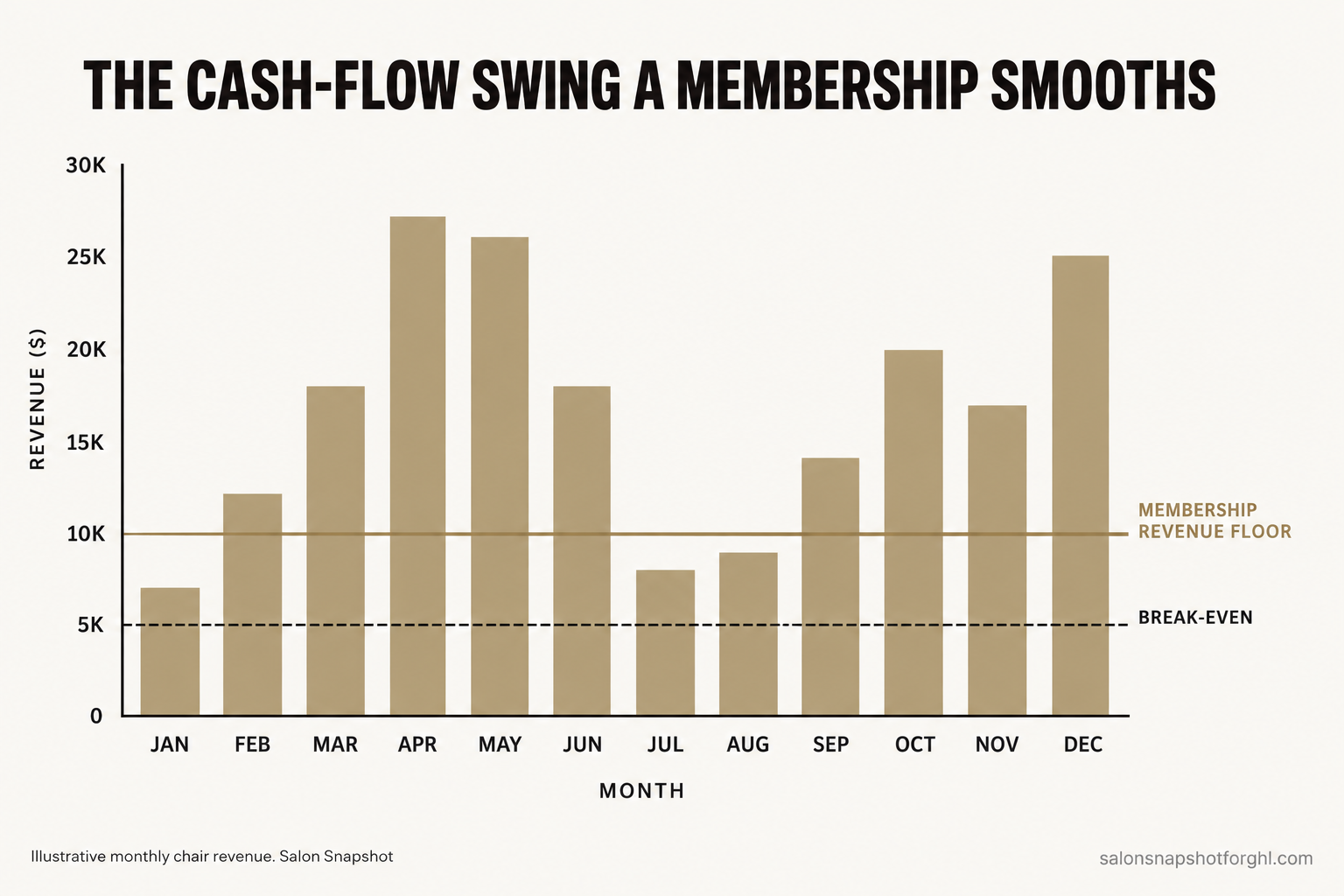
It is the second week of January. The holiday rush is a memory, the color clients you saw in December do not need you until February, and rent is due Friday. You were not lazy and you did not lose clients. The work bunched up in the good months and left a hole in the slow ones, and that hole is where owners lie awake.
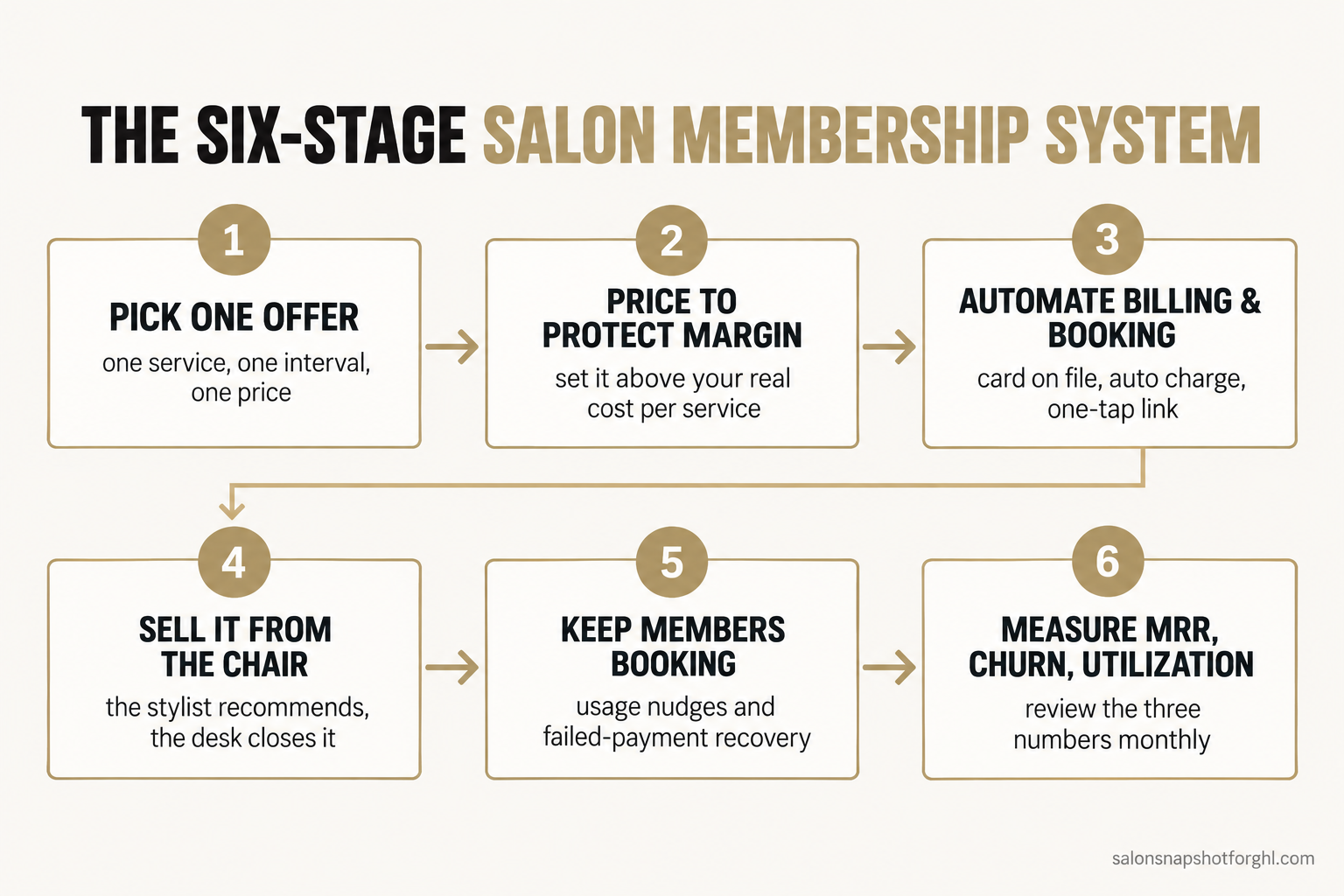
Here is the answer first. The fix for a lumpy calendar is not more bookings, it is money that lands whether the chair fills or not. A membership or a prepaid package does exactly that: the client pays on a schedule you can plan around, and your slow weeks stop being a crisis. What follows is a six-stage system, each stage with the words to say and the way it breaks.
Key takeaways (the TL;DR)
- A slow month is a cash-flow problem, not a bookings problem. Memberships and packages put money on the book before the chair fills.
- A membership is recurring money; a package is money banked up front. Pick one to start.
- Price it to protect margin, not to give away cuts. Build it around the routine services clients skip when money is tight.
- Sell it from the chair, as the stylist’s recommendation, when the client is happy and the next visit is on their mind. The billing and booking then have to run themselves, or you have bought a second job.
- Auto-renewal has real rules now. California tightened its law in July 2025, and the older federal subscription law still binds you. Get written consent and make cancelling easy.
Table of contents
- Why slow weeks wreck your cash flow
- Membership, package, or maintenance plan
- Stage 1: Pick the one offer your shop can run
- Stage 2: Price it to help cash flow, not loyalty
- Stage 3: Make billing and booking run themselves
- Stage 4: Sell it from the chair
- Stage 5: Keep members booking and catch the failures
- Stage 6: Measure MRR, churn, and utilization
- Three scenarios: solo, five, twelve chairs
- The legal fine print
- Objections
- FAQ
Why slow weeks wreck your cash flow
Your revenue is tied to hours in the chair, and those hours do not spread evenly: spring and December are packed, January and late summer are dead. Your rent and your own pay stay flat all year, and that gap between lumpy income and flat costs is what hurts.
In the Federal Reserve’s 2024 Small Business Credit Survey, 51% of small employer firms named uneven cash flow as a challenge, and 56% reported trouble covering operating expenses (Federal Reserve Banks). Now layer on who runs these chairs: of about 670,800 barber, hairstylist, and cosmetologist jobs in 2025, 80% of barbers and 48% of hairdressers are self-employed, per the Bureau of Labor Statistics. When you work for yourself, a slow week is your own paycheck that did not happen.
Share of US small employer firms citing each as a financial challenge, Federal Reserve 2024 Small Business Credit Survey. Uneven cash flow is not a salon-only problem, but a seasonal book makes it sharper.
Say twenty clients each commit to a $60 monthly membership. That is $1,200 landing on the first of every month, before a single walk-in. It raises the floor under your chair income, so the dead weeks clear your fixed costs instead of digging a credit-card hole. A set fee on a schedule makes budgeting possible in a business that is otherwise feast or famine (Boulevard). It does not make January busier. It makes January solvent.
Membership, package, or maintenance plan
These three get used interchangeably and are not the same. Pick deliberately.
| Membership | Prepaid package | Maintenance plan | |
|---|---|---|---|
| How they pay | Recurring charge, monthly | One lump sum up front | Recurring charge on a service cadence |
| What they get | A monthly credit or perk | A set number of services at a discount | A set service on a schedule |
| Cash-flow effect | Predictable monthly floor | Big one-time bank, then nothing | Predictable floor tied to real visits |
| Best for | A steady baseline | Shops that need cash now | Color, fades, brows at a fixed interval |
| Main risk | Members who never come in | Money spent before it is earned | Over-promising availability |
A membership smooths the whole year. A maintenance plan is the sweet spot for this trade, because salon work runs on a clock: roots grow and fades blur whether the client books or not, and the recurring services (the gloss, the root touch-up, the beard trim) are exactly the ones clients cut when money is tight. Wrap one in a membership and you lock in the routine visits that keep the chair warm.
Stage 1: Pick the one offer your shop can run
The biggest mistake is menu sprawl: owners launch bronze, silver, gold, and platinum, and nobody at the desk can explain them. One offer, explained in a sentence, beats four nobody understands.
Pick the single service with the most predictable repeat interval: the cut for a barbershop, the root touch-up or gloss for a color salon, the weekly blowout for a blow-dry bar. Name it plainly (“The Monthly Fade,” “The Color Club”) and write the one-sentence pitch your whole team can say.
Set it up. One service, one interval, one price, plus one perk that makes it a deal (priority booking, a standing slot, a retail discount).
How it breaks. Four tiers and vague perks. If the desk hesitates when a client asks “what do I get,” the program is already dead.
Stage 2: Price it to help cash flow, not loyalty
A membership priced wrong is worse than none, because you hand loyal clients a discount on visits they would have made anyway. Three rules keep it honest. Price off your real cost per service: if a cut is $40 and a member pays $70 for two, you have discounted to $35 a cut, fine if it fills a dead Tuesday, a loss if that chair is already booked solid. Build in breakage, the credits members pay for and never use; some is normal, but a plan that only works if half your members forget breeds cancellations. And add a perk that costs little and feels like a lot.
Set it up. Write down your real cost per service, set the member price above it, add one low-cost perk, then check: would twenty members at this price clear your rent in a slow month? If not, the price is too low or the perk too rich.
How it breaks. You anchor on a competitor’s number, or load in perks until the plan loses money.
Stage 3: Make billing and booking run themselves
Home-grown programs collapse here. The owner sells ten memberships by hand, then spends the first of every month chasing cards and arguing about who paid, and within three months it dies. Recurring revenue only helps if the billing is automatic.
You need four things wired together: a card on file with a compliant processor, an automatic charge on a set date, a booking link into the member’s stylist’s real availability, and a tag so the desk sees “member” instantly. Many booking platforms do pieces of this. GlossGenius builds memberships into its flat plans from around $28 a month (GlossGenius pricing), and Boulevard includes membership tools on plans from around $140 a month per location (Boulevard pricing). If yours does the job, use it. The trap is stitching a payment app, a booking app, and a spreadsheet together by hand.
For shops running the front office on GoHighLevel, the billing, the CRM and workflow automation that tags members, and the appointment automation that gives each member a one-tap link live in one place instead of three tools. Our salon software cost breakdown has the numbers across platforms.
Set it up. One system that holds the card, charges automatically, and books the visit. Test the full loop on your own card first.
How it breaks. Manual billing. If it is not automatic, it is not a system, it is a chore you will stop doing.
Stage 4: Sell it from the chair
A membership sells from the stylist, in the chair, when the client is happiest, the same way a good rebooking close works, which we break down in why clients leave without rebooking.
The pitch is not “do you want to join our membership.” It is a specific observation tied to what the client already does:
“You come in every four weeks like clockwork for your fade, right? We just started a Monthly Fade plan: two cuts a month, priority booking so you always get your Saturday, and it works out cheaper than paying each time. Want me to set it up? Your card stays on file and it just runs.”
Then enrollment is one tap and one confirmation text, which doubles as your proof of consent:
“You are in, Marcus. The Monthly Fade is $70/mo, two cuts plus priority booking, charged on the 1st to the card on file. Book anytime: [booking link]. Cancel anytime by replying CANCEL or at [link]. Reply STOP to opt out of texts.”
Set it up. Train stylists to name the membership during the service, tied to the client’s pattern, and give the desk one-tap enrollment plus the confirmation text.
How it breaks. It becomes a poster nobody reads, or a hard pitch at the door. It only lands as a recommendation from someone the client trusts.
Stage 5: Keep members booking and catch the failures
Two things kill a membership after the sale: members who forget to use it, and cards that quietly fail. Both are solved by automated nudges tied to each member’s cadence.
A member who pays and never comes in feels like easy money for two months, then feels scammed and cancels. Remind them to use what they paid for:
“Hi Dana, your Color Club credit for this month is ready, and you are due for your gloss around the 14th. Tap to grab your usual Thursday with Sasha: [booking link]. Reply STOP to opt out.”
Failed payments are the silent leak. Cards expire or get replaced, and if nobody catches it you give away services for free. Here is the recovery text:
“Hi Dana, heads up, your Color Club payment did not go through this month, probably an expired card. Update it in a tap so your membership keeps running: [update link]. Any trouble, just reply.”
Set it up. Tag each member with their service and interval, and let the system send the usage nudge when they are due and the recovery message when a charge fails, through your SMS automation. For members who book and ghost, lean on your no-show process.
How it breaks. No usage reminders, so members feel they pay for nothing and churn; or no failed-payment catch, so you bleed free services. Vendor data puts typical salon membership churn around 5% to 10% a month (Join It), so a steady trickle is normal; silent leaks sink it.
Stage 6: Measure MRR, churn, and utilization
A program drifts the moment you stop watching it. Three numbers, ten minutes a month.
MRR, monthly recurring revenue, is the total you bill members every month. This is your cash-flow floor, the number that makes a slow January survivable.
Churn is the share who cancel each month. A little is healthy; a spike means something broke, usually a price that stopped feeling fair or reminders that stopped going out.
Utilization is the share actually using their credits. Too low and they cancel soon; too high and you lose margin, so your price or breakage math was wrong.
Most booking systems report MRR and churn; utilization you tally from bookings against active members, or let a CRM workflow surface all three. Track only revenue and the program rots from the inside while the top line still looks fine.
Three scenarios: solo, five, twelve chairs
The six stages do not change, but which ones carry the weight does.
The solo booth renter or suite operator. No handoff to lose, but only you to chase cards, so Stage 3 is everything. A maintenance plan on your busiest recurring service is the fastest win: twenty members at $60 clears your booth rent before you pick up the shears in January. If you rent your chair, mind the line between the shop and your own clients, which our guide on classifying every chair in your salon covers.
The five-chair commission or booth-rent salon. The handoff between stylist and desk is where memberships die. Stage 4 and Stage 5 matter most, because no one tracks a few hundred members’ credits across five columns by hand. This is also where owning booking, billing, and reminders as one system beats renting per-seat tools that meter every text.
The twelve-chair shop. Membership is now a management number. Stage 6 is where you live: MRR is a line on your P&L, and you watch churn and utilization per stylist.
The legal fine print
A membership is an automatic recurring charge, which puts you inside consumer-protection rules that have moved a lot lately. None of this is legal advice, so confirm your own situation with a professional.
Auto-renewal law is tightening, and the rules depend on where your clients live. The Federal Trade Commission’s “click-to-cancel” rule, which would have set one national standard, was struck down by the Eighth Circuit in July 2025 and never took effect (Morgan Lewis). That does not mean anything goes: the older federal law, ROSCA, still binds you, and states are writing tougher rules. California amended its Automatic Renewal Law effective July 1, 2025, now requiring express affirmative consent, an annual reminder of the price and how to cancel, and online cancellation for anyone who signed up online (Winston & Strawn). The takeaway: get written consent at sign-up (that confirmation text does double duty), state the price plainly, and make cancelling easy. Here is the annual reminder:
“Hi Marcus, a quick yearly note: your Monthly Fade is $70/mo, two cuts plus priority booking, renewing automatically on the 1st. Nothing to do to continue. To change or cancel anytime, reply CANCEL or go to [link].”
Texting members runs through the TCPA and A2P 10DLC. US business texts from a standard number must be registered through A2P 10DLC or carriers throttle them, and the FCC’s TCPA framework requires clear consent with STOP honored instantly. Our SMS compliance guide for salons walks the registration. Email members under the FTC’s CAN-SPAM rules.
Objections
“My clients will not want to be locked into a subscription.” They already pay you every month, just unpredictably. A membership gives them a better price and a guaranteed slot in your busy season for a card on file they can cancel anytime. Frame it as a deal, not a lock-in.
“I already pay for a booking app. Does it not do this?” Maybe. GlossGenius and Boulevard build memberships in, and if your tool charges the card, books the visit, and sends reminders, use it. Running billing and bookings in separate apps and tracking it in your head is a chore that lapses.
“What if members pay and never come in? I feel like I am scamming them.” That is why Stage 5 exists: send the usage reminders and make booking one tap, and passive payers become regulars.
FAQ
How does a salon membership actually help cash flow?
It replaces unpredictable seasonal income with a fixed amount that lands on the same date every month, before the chair fills, so your slow weeks still clear your rent instead of forcing you onto a credit card. It does not make a quiet January busier, it makes it solvent.
What should I charge for a salon membership?
Price off your real cost per service, not a round number. Set the member price above what the service costs you in product, time, and the stylist's cut, then add a low-cost perk like priority booking. Check it against a slow month: would twenty members at this price clear your rent?
Is a membership or a prepaid package better?
A membership is recurring money that smooths the whole year. A prepaid package is a lump sum up front, good if you need cash this quarter but it gives you nothing next. For fixed-interval services like color and fades, a maintenance plan on that cadence lines the money up with the visits.
Do I need special software to run a salon membership?
You need a system that holds the card with a compliant processor, charges it automatically, books the visit, and flags failed payments. Many salon platforms build this in, and GoHighLevel can run billing, member tagging, and reminders in one place. Stitching separate tools together by hand is what fails.
Are salon memberships legal, and what are the rules?
Yes, but auto-renewal is regulated. The federal click-to-cancel rule was struck down in July 2025, but the older ROSCA law still applies and states like California require express consent, an annual reminder, and easy online cancellation. Get written consent at sign-up and make cancelling simple. This is not legal advice; confirm your situation with a professional.
Back to that second week of January
Picture the same slow Tuesday, one system later. The book is still half empty, because it is January. But on the first, thirty memberships charged automatically, and the money is already in the account. Rent on Friday is covered, and the usage reminders filled a few of the quiet midweek slots you would otherwise have stared at.
None of that took a busier season. It took selling the routine visit as a membership and letting the billing run without you. Your calendar will always be lumpy. Your cash flow does not have to be.
Sources
- BLS Occupational Outlook Handbook: Barbers, Hairstylists, and Cosmetologists
- Federal Reserve Banks: Small Business Credit Survey
- Boulevard: Salon membership software guide
- GlossGenius: Pricing
- Boulevard: Pricing
- Join It: Best salon membership software (churn benchmark)
- Morgan Lewis: FTC’s click-to-cancel rule vacated
- Winston & Strawn: California’s amended Automatic Renewal Law
- FCC: Telemarketing and robocalls (TCPA)
- FTC: CAN-SPAM Act compliance guide